The Cyborg Athlete: How Neural Tech and AI Are Changing Sports Forever
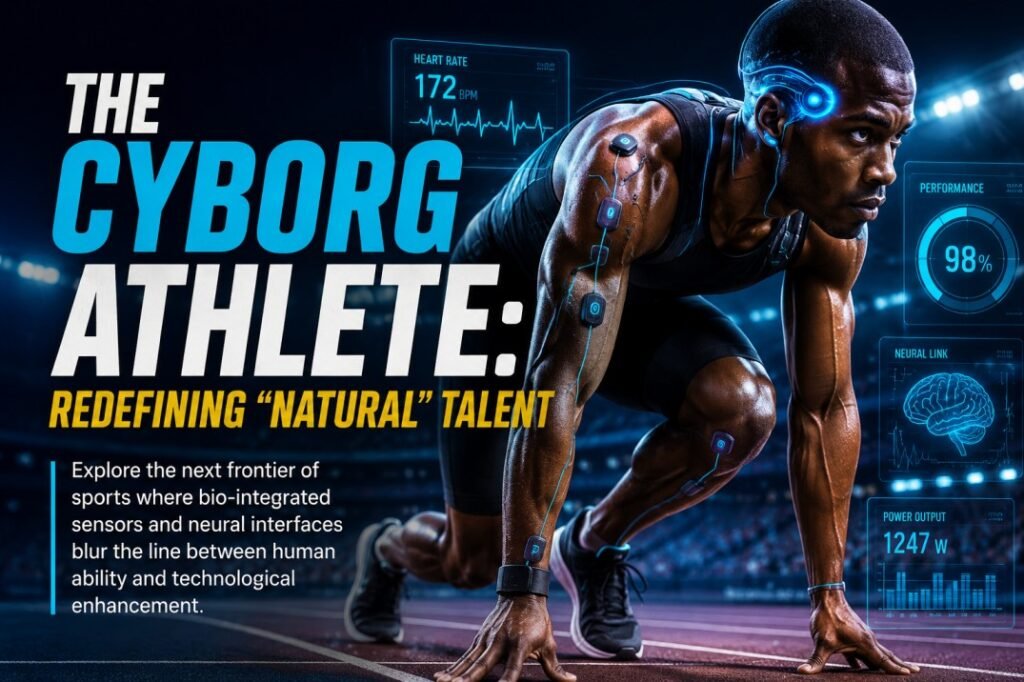
When the Skin Becomes a Dashboard
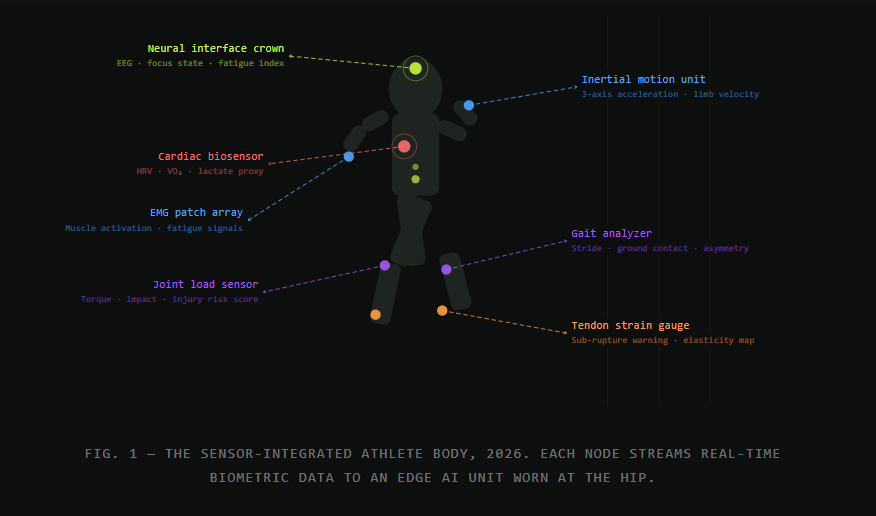
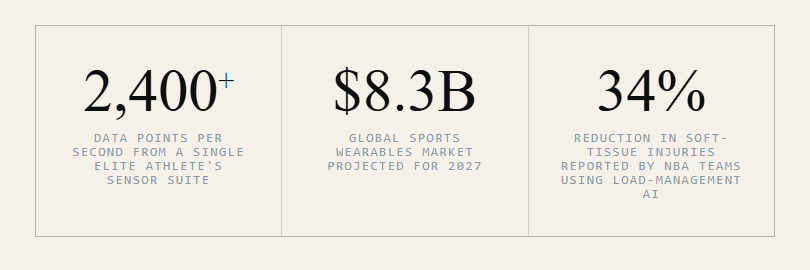
In the spring of 2024, a decathlete competing at a European elite meet wore something no spectator could see: a network of 14 flexible biosensors laminated into his compression suit, feeding a hip-mounted AI unit that processed 2,000 data points per second. By the final event, the system had adjusted his pacing strategy three times, flagging sub-clinical fatigue in his left hamstring before it became a pull. He finished fourth. His hamstring finished fine.
This is not science fiction. It is the unglamorous, incremental, and deeply consequential frontier of modern sport — the place where the human body is becoming, in the language of engineers, a data-generating platform.
The convergence of flexible electronics, edge computing, and machine learning has made it possible to instrument the body in ways that feel almost telepathic. Sensors no thicker than a bandage can now detect muscle fatigue patterns forty minutes before an athlete consciously registers them. Neural interfaces worn on the scalp can read cognitive load and attentional state with unsettling accuracy. Inertial measurement units embedded in insoles can reconstruct three-dimensional gait geometry in real time, flagging asymmetries that correlate with injury risk weeks before pain arrives.
Where Does “Enhancement” Begin?
The discomfort arrives when you try to draw a line. Caffeine is legal. Altitude tents are legal. Custom carbon-fiber running plates embedded in race shoes — legal, until they weren’t, briefly, then legal again. Now consider a neural-feedback headset that trains an archer’s focus state during practice, conditioning their nervous system to enter a performance zone on demand. Legal? Beneficial? Cheating?
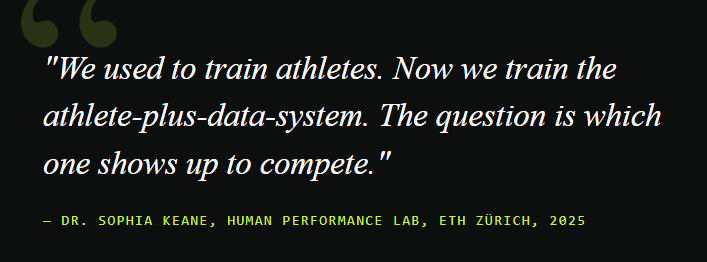
The conventional framework for sport ethics rests on a deceptively simple idea: the performance should reflect the athlete’s natural capacity, developed through training. Every era has bent that definition. The introduction of synthetic track surfaces, altitude simulation, sports nutrition science, and biomechanical coaching all shifted what “natural training” could produce. Technology was always in the loop. What has changed is the intimacy of the integration.

The spectrum, once visualized, reveals that there is no clean dividing line — only a gradient of intimacy, reversibility, and perceived unfairness. A sensor that reads the body feels different from one that commands it. An interface that enhances awareness feels different from one that overrides decision-making. These distinctions, still intuitive, will need to become law.
Reading the Mind at Game Speed
Of all the emerging technologies in elite sport, neural interfaces generate the most visceral discomfort. Not because they are most disruptive today — they aren’t — but because of what they imply about the inner life of the athlete.
Electroencephalography (EEG) headsets, once the province of clinical neurology, have been miniaturized into devices that resemble ordinary headbands. Research groups at several Olympic training centers are using them to correlate neural signatures with performance states: the distinctive brain wave pattern of a tennis player entering “the zone,” the pre-movement neural preparatory signal that precedes an elite sprinter’s reaction to the gun by over 100 milliseconds. The goal is to teach athletes to reliably recreate these states — not through luck or inspiration, but through trained, reproducible neural conditioning.
The next step is more provocative. Transcranial direct current stimulation (tDCS) — applying a mild electrical current to specific brain regions — has shown laboratory results suggesting it can reduce perceived exertion during endurance events, sharpen motor learning speed, and attenuate the fear response in contact sports. Several national cycling federations were quietly investigating its use in 2025. The World Anti-Doping Agency (WADA) currently has no prohibition on it.