Compostable Boots and Battery-Heated Kicks: Athletic Gear’s Material Revolution
Imagine burying your old running shoes in the garden — not out of frustration, but because that’s exactly what the manufacturer intended. Welcome to 2026, where athletic gear is being redesigned from its death backwards.
For decades, the sports gear industry treated sustainability as a marketing footnote. A recycled bottle here, a post-consumer polyester there. The underlying reality remained ugly: around 70 percent of clothing is made from petroleum-based synthetic materials — glorified plastics — that never truly decompose. They shrink into microplastics, seep into waterways, and end up in the food chain. The average pair of running shoes sits in a landfill for 30 to 40 years.
In 2026, a different conversation is finally taking hold. Not “how do we recycle better?” but “how do we make gear that never needs recycling in the first place?” The answers arriving on shelves right now are stranger, more beautiful, and more radical than anything the industry has produced in its history.
The Boots You Can Bury: Under Armour × UNLESS
The most eye-catching story in athletic sustainability this year isn’t a charity partnership or a carbon offset scheme. It’s a shoe you can compost.
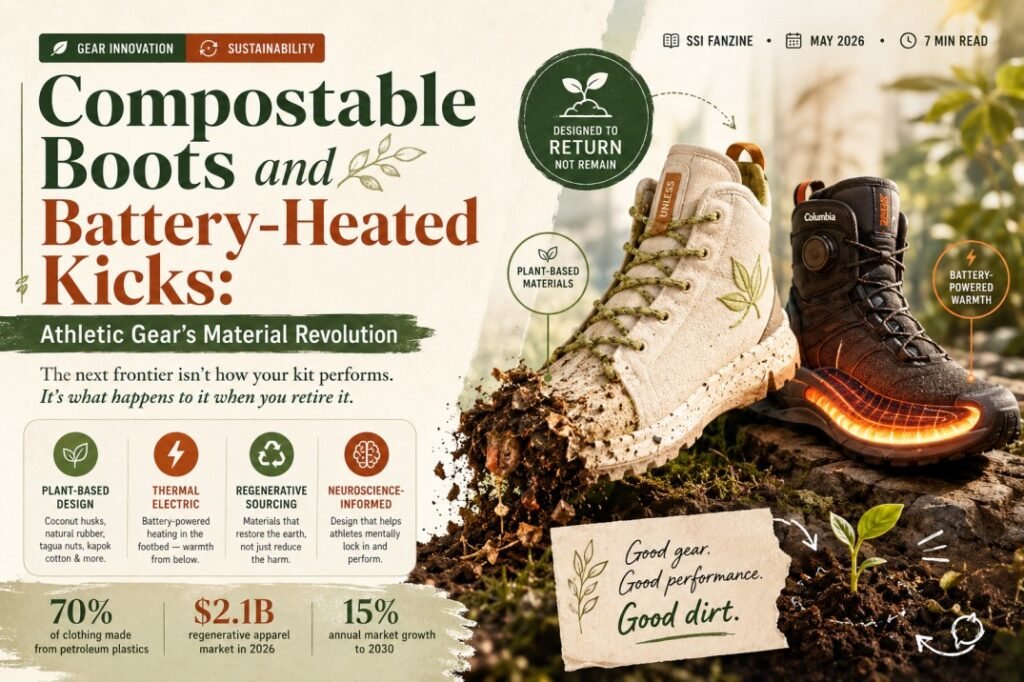
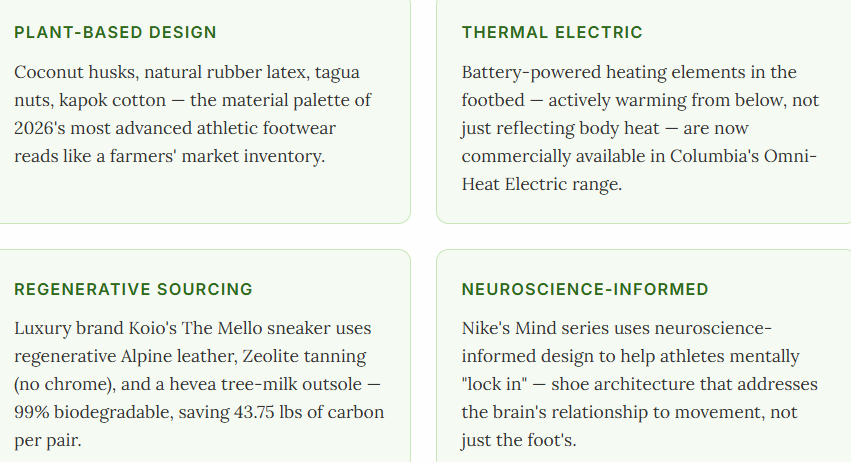
Under Armour’s collaboration with UNLESS — the Portland-based brand founded by former Adidas executive Eric Liedtke — has produced what may be the most philosophically interesting sportswear collection ever made. Every item in the line is constructed entirely from plant-derived materials. No petroleum. No synthetic glues. No plastic of any kind. The shoe liners and soles combine coconut husks with natural rubber latex. Buttons are carved from tagua, a tropical nut sometimes called “vegetable ivory.” Insulation is kapok cotton. The stitching is organic.
“All of our products make good dirt.”
— Eric Liedtke, co-founder of UNLESS and EVP Brand Strategy, Under Armour, speaking to Fast Company, April 2025
That is a line worth sitting with. In an industry accustomed to talking about performance in terms of milliseconds and watts, Liedtke’s pitch is almost disarmingly humble: when you’re done with it, bury it. In an industrial composter, an UNLESS t-shirt decomposes within weeks. In your backyard compost heap, it breaks down over a few months — feeding the soil rather than poisoning it.
Liedtke is quick to dispel the obvious concern: you don’t need to worry about your kit composting mid-training session. The decomposition process requires specific conditions — moisture, microbial activity, and heat — that your wardrobe doesn’t provide. The clothes are designed to outlast their predecessors from conventional brands, built with the same durability standards you’d expect from workwear labels. They just have a second act planned.

Heat on Demand: Columbia’s Battery-Powered Boots
At the opposite end of the material spectrum — but no less extraordinary — is what Columbia Sportswear has done with temperature. Their expanded Omni-Heat suite, released in 2026, includes something that felt like a gimmick when first announced and feels completely logical once you’ve worn it in a Scottish February: battery-powered heating elements embedded directly into the footbed.
“It’s the first visible warmth technology you can actually see — those silver dots are doing real thermal work, not decorative work.”
— Athletic Brands Review, analysing Columbia’s Omni-Heat Thermal Electric range, 2026
The Omni-Heat suite has three tiers. The reflective tier uses a dot-matrix lining to bounce your body’s own infrared heat back at you — an old idea executed beautifully, now refined to wick moisture simultaneously. The insulation tier achieves the industry’s highest heat retention per gram, using 50 percent recycled materials. And the electric tier — the one that sounds like science fiction — puts actual battery-powered warmth under your feet.
For cold-weather athletes, winter hikers, and anyone who has ever lost feeling in their toes at a December fixture, this is not a novelty. It is a practical tool. The battery life, charge times, and thermal output are still being refined — but the technology exists, it works, and it is commercially available right now.
Why This Matters Beyond the Marketing
Circular economy advocate Lauren Phipps put it plainly: “Recycling delays waste. Composting eliminates it.” That distinction — delay versus elimination — is the intellectual core of where the most serious sustainability innovation in sport is going.
Nike’s “Move to Zero” initiative, which focuses on recycled polyester, is laudable. But experts point out that recycled plastics still end up as plastic — just repurposed, not eliminated. The Under Armour × UNLESS model breaks the loop entirely. It also does something economically significant: with pieces starting at $30, it democratises access to genuinely sustainable gear. This isn’t a wealthy person’s virtue signal. It is an attempt to make planet-conscious performance wear as accessible as a Primark hoodie.
The $2.1 billion regenerative apparel market is growing at 15 percent annually through 2030. Seventy-three percent of Gen Z shoppers say they prioritise eco-conscious brands. The economics and the ethics are finally pointing in the same direction.
What Comes Next
Under Armour and UNLESS have already hinted at their second act: the UNLESS “Pulse” capsule, launched in early 2026, expands the regenerative line into new footwear styles and apparel. Nike is rumoured to be deep in development on a compostable outsole that meets elite performance standards — a challenge that has frustrated materials scientists for years. Columbia is expanding the Omni-Heat Electric platform into hiking and climbing applications. And across the industry, regenerative agriculture — sourcing materials from farms that actively restore soil health — is beginning to replace the binary of synthetic versus recycled.