TACKLING ON THE FIELD
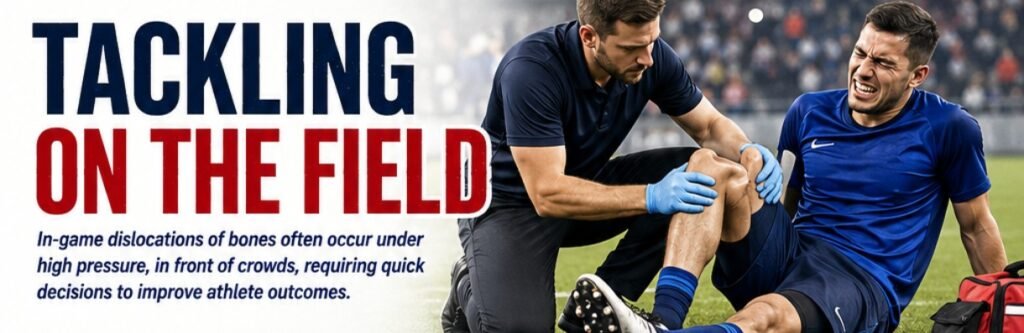
Joint dislocations in sports demand swift action from sideline medical staff to minimize damage and facilitate the recovery process. Sideline management of sports-related joint dislocations challenges medical professionals with the need for immediate evaluation, diagnosis, reduction, and post-reduction care.
These injuries often occur under high pressure, in front of crowds, requiring quick decisions to improve athlete outcomes. When properly handled on-field, most dislocations to the shoulder, elbow, finger, knee, patella, and ankle can be reduced and initially managed without delaying transport to a facility.
Athletes benefit from prompt intervention as it reduces pain, prevents neurovascular compromise, and lowers risks of complications like avascular necrosis. Clinicians must assess benefits versus risks, considering their expertise and potential associated injuries like fractures. Literature from 1980-2013 emphasizes that decisive on-field action enhances comfort and post-injury care.
SHOULDER DISLOCATIONS
Shoulder dislocations, the most common in sports, typically result from abduction, extension, and external rotation forces, leading to anterior displacement in 95-97% of cases.
Athletes present with the arm held in abduction and external rotation, a visible deformity, and inability to adduct the arm. Sideline evaluation includes checking neurovascular status—pulse, sensation, and motor function—before any reduction attempt.
Reduction techniques prioritize gentle maneuvers like the Stimson or external rotation methods, avoiding traction if vascular injury is suspected. Post-reduction, apply a sling and swathe for immobilization, then reassess stability and neurology.
Ice and elevation follow, with transport for imaging to rule out fractures or Hill-Sachs lesions.
ELBOW DISLOCATIONS
Elbow dislocations often stem from falls on an outstretched hand, causing posterior displacement with the olecranon locked behind the humerus.
The athlete holds the elbow flexed and supported, showing gross instability on exam. Key evaluation checks median, radial, and ulnar nerve function plus brachial artery pulses bilaterally.
On-field reduction involves gentle traction and direct pressure on the olecranon while counter-stabilizing the humerus, without hyperextending the joint. Success restores alignment; splint at 90 degrees flexion afterward.
Monitor for compartment syndrome and urgent imaging post-game.
In-game dislocations of bones often occur under high pressure, in front of crowds, requiring quick decisions to improve athlete outcomes.
FINGER DISLOCATIONS
Finger dislocations arise from axial loads or hyperextension in ball-handling sports, commonly at the proximal interphalangeal (PIP) joint.
Look for angular deformity and blocked motion; volar plate injuries often accompany them. Neurovascular exam of digits is critical due to small vessel risks.
Reduction uses longitudinal traction with direct pressure on the base of the proximal phalanx, recreating the injury vector.
Buddy-tape stable reductions immediately, avoiding full extension splints that risk stiffness. X-rays confirm joint congruity before return-to-play decisions.
KNEE DISLOCATIONS
True knee dislocations, rare but high-energy, involve multi-ligament tears from direct blows or twisting.
The tibia displaces anteriorly or posteriorly; athletes hold the leg in deformity with gross laxity. This injury demands vascular assessment—pulses, skin color—as popliteal artery disruption occurs in up to 40% of cases.
Reduction requires two-person traction: one stabilizes the femur, the other applies inline pull on the tibia.
Urgent transport follows, even if reduced, for angiography and ligament repair. Do not test stability on-field to avoid worsening vascular injury.
PATELLA DISLOCATIONS
Patellar dislocations typically occur laterally from valgus stress with quadriceps contraction, common in cutting sports.
The patella sits superior-laterally; athletes feel the knee “giving way” with hemarthrosis. Confirm by attempting to manually relocate while extending the knee.
Reduction is straightforward: gentle pressure on the medial patella while extending the knee.
Immobilize in extension with a knee brace post-reduction, checking for osteochondral fractures via imaging. Recurrent instability warrants bracing protocols.
ANKLE DISLOCATIONS
Ankle and subtalar dislocations result from inversion or eversion twists, often without fracture in pure cases.
Frank deformity with buttonholing through skin signals open injury; neurovascular status of foot compartments is priority. High suspicion for associated fractures requires careful palpation.
Reduction recreates the injury: gentle traction under the heel with anterior ankle pressure restores alignment (Figure 11 reference in source).
Splint in neutral post-reduction, elevating to control swelling. Open dislocations need sterile irrigation if feasible before transport.
POST-REDUCTION PROTOCOLS
After any reduction, confirm stability with gentle range checks, reassess neurovascular integrity, and immobilize appropriately—sling for upper extremity, splints or braces for lower.
Apply ice for 15-20 minutes, elevate, and administer analgesics if available. Document findings meticulously for handoff to emergency care.
Athletes should avoid weight-bearing or use until cleared, with serial neurovascular exams en-route. Radiographs are mandatory to exclude fractures missed on-field.
RISKS AND CONSIDERATIONS
On-field reductions risk iatrogenic injury if fractures exist unrecognized or if neurovascular structures are trapped.
Contraindications include open wounds, clear vascular compromise, or deformity suggesting fracture. Clinician experience dictates intervention; novices should stabilize and transport primarily.
High-energy mechanisms like hip dislocations (flexed knee impact) demand caution, as posterior types predominate with sciatic risks. Always prioritize ABCs (airway, breathing, circulation) first.
TRAINING FOR ATHLETIC TRAINERS
Preparation includes hands-on simulation for reduction techniques and protocol checklists. Multidisciplinary game-day teams enhance decision-making. Regular review of cases refines sideline skills.
In summary, armed with knowledge from systematic reviews, sideline staff can transform dislocations from game-enders to manageable setbacks. Proper execution preserves athlete careers while ensuring safety.
(Reference: ‘In-game Management of Common Joint Dislocations’ by Nathan W Skelley, Jeremy J McCormick, Matthew V Smith)