White House Endorses the Idea — And Sparks a National Conversation
A routine question on Sunday turned into a headline-grabbing moment when the White House said it would be “beautiful” if the Washington Commanders named their new stadium after President Donald Trump. The remark came shortly after reports from ESPN revealed quiet discussions between the administration and the team’s ownership group, suggesting Trump himself is interested in securing naming rights for the upcoming venue.
White House Press Secretary Karoline Leavitt framed Trump as an instrumental figure in reviving the stalled stadium project, stating that the president “made the rebuilding of the new stadium possible.” With that, the debate moved beyond sports and deep into the intersection of politics, identity, and public memory.
Commanders’ Return to DC: A Long-Awaited Homecoming
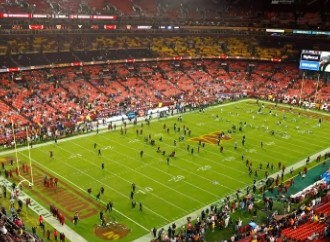
The Commanders’ planned move back to Washington, DC — to the historic site of RFK Stadium — represents both nostalgia and renewal. The team has played in Landover, Maryland, since 1997, but its roots and emotional history remain firmly in the capital.
DC Mayor Muriel Bowser announced the return in April after securing a landmark agreement with federal authorities. The DC Council approved the deal in September, though not without tension. Trump had openly warned that he would oppose efforts unless the team reverted to its former “Redskins” name, a term dropped in 2020 after decades of pressure from Native American organizations.
The new stadium, targeted for a 2030 opening, is seen as a defining project for both DC’s urban redevelopment and the franchise’s cultural reset.
Whether it ultimately becomes “Trump Stadium” could shape how that next chapter begins.
Politics, Identity, and the Power of Naming
Stadium naming has long been driven by corporations, not political legacies. But a presidential name on an NFL venue — especially one as polarizing as Donald Trump — would be unprecedented in modern American sports.
For Trump’s supporters, it would serve as a monument to his influence and involvement in the city’s development. For critics, it risks politicizing a communal sporting space and reopening cultural wounds tied to the team’s former name and broader national divides.
DC officials have largely avoided public comment, reflecting the delicate balance: the stadium is a public-facing project, yet the naming rights rest with a privately owned team led by Josh Harris. For now, the Commanders have not confirmed any negotiations.
Trump’s Sports Visibility: A Broader Strategy
Trump’s presence at major sporting events has grown significantly during his second term. From the US Open men’s final to the Army-Navy Game and UFC events, he has positioned himself at the center of American sporting culture — a strategy that blends visibility, populism, and connection with a broad fan base.
His expected attendance at Sunday’s Commanders–Lions matchup in Landover aligns with that pattern. And with the stadium naming controversy now in full view, all eyes will be on the optics, reactions, and potential signals during his visit.
The Road Ahead: A Stadium Beyond Football
Regardless of what name it ultimately bears, the Commanders’ new stadium is shaping up to be more than a sports venue. It is becoming a battleground for symbolism — about who shapes America’s civic landmarks, how political power intersects with cultural institutions, and what the future identity of Washington’s NFL team will be.
The next steps by the team’s ownership, the White House, and DC officials will determine whether the stadium becomes a unifying civic project — or another emblem of America’s sharp political divide.

 Sohini Mukherjee
16 Oct 2026 · 9:08 PM IST
5 min read
8 Reads
Sohini Mukherjee
16 Oct 2026 · 9:08 PM IST
5 min read
8 Reads 
 Vishesh Shukla
13 Oct 2026 · 11:13 PM IST
2 min read
14 Reads
Vishesh Shukla
13 Oct 2026 · 11:13 PM IST
2 min read
14 Reads