STRENGTH TRAINING WITH RESISTENCE
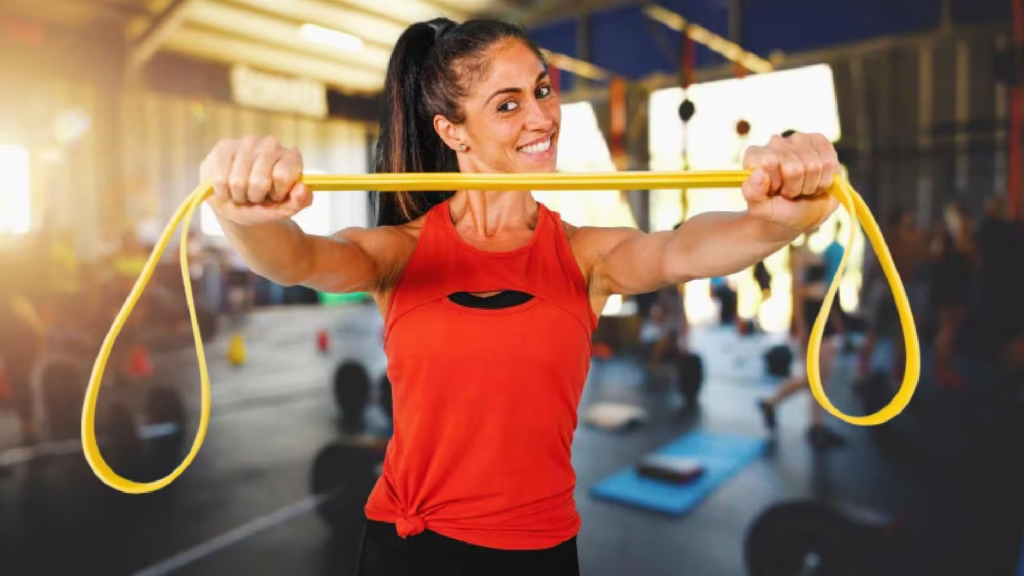
Resistance bands have created their place in the fitness world as a precious tool that brings convenience, versatility and effectiveness to workout routines. Whether you are a fitness novice or a seasoned athlete, incorporating resistance bands can elevate the training experience and yield desired results. Resistance bands are a great way to build strength and flexibility without the use of high intensity or heavy weights. Available in different sizes and colours that can identify the different ways the pressure can be applied on a specific muscle group, they are made of latex or rubber, which provide resistance in both directions stretching and contracting. This dual-action resistance engages muscles throughout the entire movement.
KEY FEATURES:
- Simple-to-use tool
- Used for multipurpose Physical training
- Portable
- Inexpensive
- Widely used
- Used for developing muscle Strength and Power
Allow changes in the external load over a range of motions
BENEFITS:
- Improved functional capacity.
- Increased strength and endurance.
- Increased muscle activation.
- Improved body composition, potency, and quality of life.

DO THEY REALLY WORK?
Well, it’s easy to assume that giant weights are needed to get strong. That’s a myth! In fact, the resistance bands can do certain things that weights simply can’t. Resistance band workouts are beneficial because there is constant tension throughout the entire movement of an exercise. However, when one uses dumbbells and body weight, there’s only tension on the exertion portion of the movement. For instance, when a person does a bicep curl with a resistance band, there is tension on the way up to the curl and also on the way down as he or she returns to the initial position. When you use dumbbells, there’s only resistance on the biceps on the way up. And, resistance is what creates strength. Resistance bands also make it easier to target smaller muscles. Larger muscles frequently take over when you use weights or your body weight. Most importantly, resistance bands can be used by people in rehabilitation or physical therapy to help safely activate all of the smaller muscles, as well as the larger muscles. Elastic resistance training (ERT) as a modality and clinical tool became popular in the 1980s. It’s popularity has been increasing recently.
RESISTENCE BAND EXERCISES FOR UPPER LIMB:


EXERCISES FOR LOWER LIMB:


ELASTIC TRAINING V/S CONVENTIONAL TRAINING:
According to a study done by Silva Lopes et. Al (2019), the strength gained from both types of resistance training yields similar results. But in the case of resistance band training the muscle engagement is different, i.e. deep-seated muscles like Iliopsoas and rotator cuff muscles can be targeted better in the case of elastic resistance training. For example, to execute a horizontal abduction, Theraband resistance was applied at the elbow level (Theraband-at-elbow variation of Wall Slides), slightly distal to the elbow joint increasing the amount of Middle Trapezius muscle activation. The second variation of Wall Slides involved applying Thera-band resistance at the wrist level, or Theraband-at-wrist variation, to increase Infra Spinatus muscle activation and produce an external rotating force.