SSI FANZINE
  • Home
  • Magazine
  • Cricket
  • Soccer
  • Hockey
  • Tennis
  • F1
  • Injury & recovery
  • Miscellaneous
  • Sports Tech
  • Videos
No Result
View All Result
  • Home
  • Magazine
  • Cricket
  • Soccer
  • Hockey
  • Tennis
  • F1
  • Injury & recovery
  • Miscellaneous
  • Sports Tech
  • Videos
No Result
View All Result
SSI FANZINE
No Result
View All Result

The turf & the tear

Artificial turf was introduced as a solution to the limitations of natural grass, but can they pose injury risk?

Sohini Mukherjee by Sohini Mukherjee
May 20, 2026
in Injury & recovery, Sports Fitness, Sports Science Blogs
The turf & the tear

Artificial turf has transformed modern sport. From football and hockey to school playgrounds, synthetic surfaces are now ubiquitous due to their durability and cost-effectiveness. However, a growing body of scientific literature has raised important concerns about injury patterns associated with these surfaces.

The Rise of Artificial Turf

Artificial turf was introduced as a solution to the limitations of natural grass: susceptibility to weather, high maintenance costs, and limited usage capacity.

It first gained attention in 1966, when AstroTurf, a short-pile synthetic turf, was installed in the Astrodome in Houston, Texas. It was however developed by Monsanto and others to address a 1958 study, revealing lack of school green space.

In the 1950s, the Ford Foundation conducted a study. It found out children from rural backgrounds were more active than those from urban areas. The foundation sought to develop a synthetic playing surface that could be used to make urban spaces more appealing and to give children in cities a better quality of play area. In 1964, the first installation of this new playing surface, originally called ChemGrass, was completed at Moses Brown School in Providence, Rhode Island.

The use of AstroTurf and similar products became widespread in the US and Canada in the early 1970s.

Initially, nylon was used to create the original artificial turf surface, however, the material had a tendency to cause friction burns and blisters.

In the 1980s, makers began using polypropylene yarn instead of nylon. A sand infill meant the playing surface could be stabilised to produce more natural reactions for sports use. Unfortunately, the sand caused the problems of grazes and burns.

In the 1990s, another new generation of artificial grass was developed. It was made using polyethylene, which was softer and could be used for making longer and more realistic fibres. It was installed with a granulated rubber infill. These advances resulted in fewer contact burns and grazing.

Modern day processes also use shock-pads, which are made from polyester foam or rubber. These materials are installed underneath the artificial grass.

They are designed to mimic the feel of grass.

Development Timeline

• First Generation: Short, dense nylon fibers (1960s).

• Second Generation: Sand-filled, shorter, curly grass fibers (1970s–80s).

• Third Generation: Longer, upright fibers with sand and rubber infill (1990s–2000s).

• Fourth Generation: Non-infill, even more realistic fibers (2010s).

Its widespread adoption has been particularly prominent in high-density urban areas and regions with extreme climates. Yet, as usage has increased, so too has scrutiny over its health implications.

Types of Injuries Associated with Artificial Turf

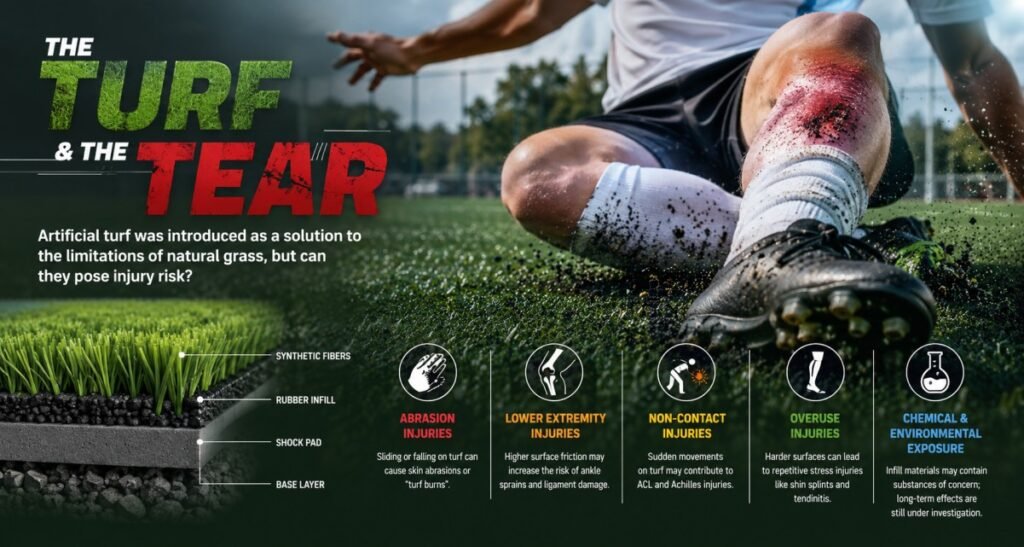
1. Abrasion Injuries (“Turf Burns”)

One of the most well-documented risks is skin abrasion. A systematic review published in the Journal of Science and Medicine in Sport found clear evidence that abrasion injuries occur frequently on artificial turf, especially in sports involving sliding or falling. These injuries, while often superficial, can increase the risk of infection and discomfort, particularly in contact sports.

2. Lower Extremity Injuries

A major area of concern is injury to the lower body—knees, ankles, and feet. A systematic review in The American Journal of Sports Medicine examined injury rates across multiple sports and surfaces, highlighting the importance of understanding lower extremity injury risks on artificial turf versus natural grass. Injury incidence varies in football, but certain injuries—especially ankle sprains and ligament damage—may be more common on turf. One explanation lies in biomechanics: artificial turf tends to have higher surface friction, which can “lock” the foot during rapid directional changes, increasing stress on ligaments.

3. Non-Contact Injuries

Emerging research points to a higher incidence of non-contact injuries—those not caused by collisions but by sudden movement. Studies cited in sports medicine literature suggest that artificial surfaces may contribute to Achilles tendon ruptures and ACL injuries, especially during pivoting actions. Differences in shock absorption and energy return between turf and grass are thought to influence these injury patterns.

4. Overuse Injuries

Artificial turf’s uniform and often harder surface can contribute to repetitive stress injuries like Shin splints, Stress fractures and Tendinitis.

5. Chemical and Environmental Exposure

Beyond musculoskeletal injuries, newer research has raised concerns about chemical exposure: Artificial turf infill materials may contain substances such as heavy metals. Preliminary findings suggest athletes may experience increased exposure through skin contact and inhalation, particularly during play. However, long-term health effects remain under investigation.

Why Does Artificial Turf Influence Injury Risk?

Several biomechanical and environmental factors explain the differences:

Surface stiffness: Turf is often less forgiving than natural grass

Friction coefficient: Higher grip increases torsional stress on joints

Heat retention: Turf can reach very high temperatures, contributing to fatigue and dehydration

Consistency: While uniformity reduces uneven ground injuries, it may increase repetitive stress

The Case for Artificial Turf: Advantages

Despite these concerns, artificial turf offers significant benefits:

1. Durability and Availability

Unlike natural grass, turf can withstand heavy usage and adverse weather, making it ideal for schools and community sports facilities.

2. Lower Maintenance Costs

No watering, mowing, or fertilizing reduces long-term operational expenses.

3. Consistent Playing Surface

Uniformity can reduce unpredictable injuries caused by uneven or poorly maintained natural fields.

4. All-Weather Playability

Matches and training sessions are less likely to be cancelled due to rain or poor ground conditions.

Some studies find no significant difference in overall injury rates between turf and grass. Others highlight higher rates of specific injuries, particularly in the lower extremities.

Experts suggest several ways to reduce injury risk on artificial turf:

Using sport-specific footwear designed for turf

Improving turf design (shock absorption, safer infill materials)

Monitoring field temperature and limiting play in extreme heat

Ensuring proper athlete conditioning and training


Please follow and like us:
fb-share-icon
Tweet
Pin Share
Sohini Mukherjee

Sohini Mukherjee

Related Posts

Racing the Clock: How Injuries to Neymar, Salah, James and Rice Are Quietly Shaping FIFA World Cup 2026
Injury & recovery

Racing the Clock: How Injuries to Neymar, Salah, James and Rice Are Quietly Shaping FIFA World Cup 2026

July 5, 2026
NDA Opens Dedicated Sports Medicine Centre to Boost Cadet Injury Care
Sports Fitness

NDA Opens Dedicated Sports Medicine Centre to Boost Cadet Injury Care

July 4, 2026
Kazakhstan Launches National Sports University with Focus on Esports, AI and Sports Medicine
Sports Science Blogs

Kazakhstan Launches National Sports University with Focus on Esports, AI and Sports Medicine

July 4, 2026
Next Post
Roland Garros 2026: A Comprehensive Preview of Tennis’s Second Grand Slam of the Year

Roland Garros 2026: A Comprehensive Preview of Tennis’s Second Grand Slam of the Year

Indian Rowers Push Limits in Gruelling SAI Pune Camp Ahead of Asian Games 2026

Indian Rowers Push Limits in Gruelling SAI Pune Camp Ahead of Asian Games 2026

MotoGP’s Barcelona Wake-Up Call: Safety Questions After a Chaotic Catalan GP

MotoGP’s Barcelona Wake-Up Call: Safety Questions After a Chaotic Catalan GP

Discussion about this post

Recommended

Pakistan Hockey Allowance Row Deepens as Players Threaten Pro League Pullout

Pakistan Hockey Allowance Row Deepens as Players Threaten Pro League Pullout

6 months ago
Sinner, Alcaraz Set for South Korea Clash

Sinner, Alcaraz Set for South Korea Clash

8 months ago
Why Stakes Are High For Spurs And West Ham

Why Stakes Are High For Spurs And West Ham

1 month ago
Zhang Edges Zhou to Final

Zhang Edges Zhou to Final

5 months ago

Blogs

Prize Money Debate and F1 Driver Market Shake Global Sports Landscape

Invisible Sidelines: Why Youth Sports Are Failing Athletes When It Matters Most

‘Rigged?’ NHL Draft Lottery Sparks Fan Fury After Leafs Land No. 1 Pick

From Mat to Monitor: How Sports Science Is Rewriting India’s Sporting DNA

Upcoming Multi-Sport Action: A Packed Global Calendar Keeps Fans on the Edge

Road To 2030 Commonwealth Games: India’s Bold Sporting Vision Takes Shape

No Result
View All Result
Cristiano Ronaldo Announces 2026 World Cup as His Last: “Yes, It’s My Final One – Let’s Enjoy It”

Cristiano Ronaldo Announces 2026 World Cup as His Last: “Yes, It’s My Final One – Let’s Enjoy It”

July 5, 2026
Alexandra Eala’s Wimbledon Fairytale Inspires a Nation as Filipino Tennis Reaches New Heights

Alexandra Eala’s Wimbledon Fairytale Inspires a Nation as Filipino Tennis Reaches New Heights

July 5, 2026
One Second to Glory: Why Sajan Prakash’s Final Season Could Define His Legacy

One Second to Glory: Why Sajan Prakash’s Final Season Could Define His Legacy

July 5, 2026
Sarthak Chavan Scripts Indian Motorsport History with Landmark Top-Six Finish in Europe

Sarthak Chavan Scripts Indian Motorsport History with Landmark Top-Six Finish in Europe

July 5, 2026
Racing the Clock: How Injuries to Neymar, Salah, James and Rice Are Quietly Shaping FIFA World Cup 2026

Racing the Clock: How Injuries to Neymar, Salah, James and Rice Are Quietly Shaping FIFA World Cup 2026

July 5, 2026
Grigor Dimitrov Rewrites His Wimbledon Story With Gritty Win Over Matteo Berrettini

Grigor Dimitrov Rewrites His Wimbledon Story With Gritty Win Over Matteo Berrettini

July 5, 2026

Highlights

Sarthak Chavan Scripts Indian Motorsport History with Landmark Top-Six Finish in Europe

Racing the Clock: How Injuries to Neymar, Salah, James and Rice Are Quietly Shaping FIFA World Cup 2026

Grigor Dimitrov Rewrites His Wimbledon Story With Gritty Win Over Matteo Berrettini

The Blade’s Edge: India’s Men’s Foil Team Fences its Way to the 2026 Asian Games

India’s Young Paddlers Secure U-19 Asian Championship Bronze After Memorable Run in Bangkok

Marc Marquez Redefines Greatness: Why Beating Valentino Rossi’s Record Is No Longer His Biggest Goal

Trending

Cristiano Ronaldo Announces 2026 World Cup as His Last: “Yes, It’s My Final One – Let’s Enjoy It”
Football

Cristiano Ronaldo Announces 2026 World Cup as His Last: “Yes, It’s My Final One – Let’s Enjoy It”

by Baibhav Mishra
July 5, 2026
0

The King’s Last Bow In the bright lights of a pre-match press conference ahead of Portugal’s clash...

Alexandra Eala’s Wimbledon Fairytale Inspires a Nation as Filipino Tennis Reaches New Heights

Alexandra Eala’s Wimbledon Fairytale Inspires a Nation as Filipino Tennis Reaches New Heights

July 5, 2026
One Second to Glory: Why Sajan Prakash’s Final Season Could Define His Legacy

One Second to Glory: Why Sajan Prakash’s Final Season Could Define His Legacy

July 5, 2026
Sarthak Chavan Scripts Indian Motorsport History with Landmark Top-Six Finish in Europe

Sarthak Chavan Scripts Indian Motorsport History with Landmark Top-Six Finish in Europe

July 5, 2026
Racing the Clock: How Injuries to Neymar, Salah, James and Rice Are Quietly Shaping FIFA World Cup 2026

Racing the Clock: How Injuries to Neymar, Salah, James and Rice Are Quietly Shaping FIFA World Cup 2026

July 5, 2026

Sports Science India Fanzine
India's First Sports Science Magazine.

Quick Links

  • Shop
  • My Account
  • Member Login
  • Register
  • Subscription Plan
  • Terms and Conditions
  • Privacy Policy
  • Shipping Policy
  • Refund and Returns Policy

Featured

  • IPL 2025
  • Indian Super League
  • English Premier League
  • La Liga
  • UEFA Champions League
  • Europa League
  • Serie A
  • Bundesliga
  • Ultimate Fighting Championship
  • I-League
  • Copa America

Contact Info

Sports Science India
Plot No - A17/1A, Unit-7, Surya Nagar,
In front of S.P Vigilance Office,
Bhubaneswar - 751003

+91 78479 22850

ssifanzine@outlook.com

  • About
  • Advertise
  • Careers

© 2025 - SSI FANZINE. All Rights Reserved.

RSS
Follow by Email
Facebook
fb-share-icon
X (Twitter)
Tweet
No Result
View All Result
  • Home
  • Magazine
  • Cricket
  • Soccer
  • Hockey
  • Tennis
  • F1
  • Injury & recovery
  • Miscellaneous
  • Sports Tech
  • Videos

© 2025 - SSI FANZINE. All Rights Reserved.