When the Final Whistle Blows: Motor Neurone Disease and the Sporting Life
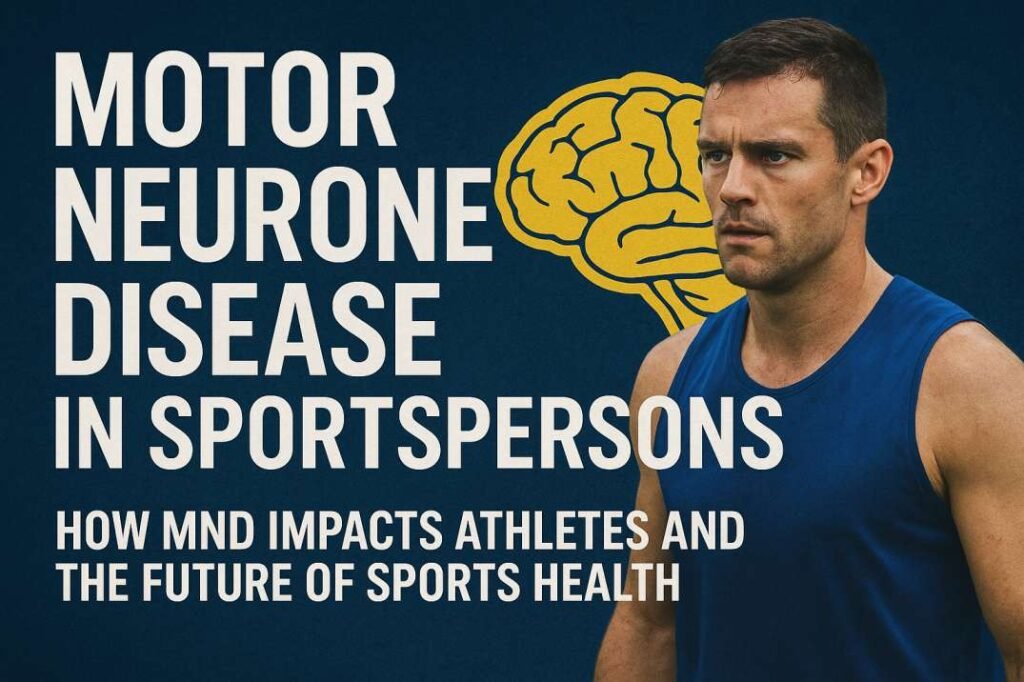
Motor neurone disease (MND, often called ALS in North America) is one of medicine’s most devastating neurodegenerative illnesses: it progressively destroys the nerves that control muscles, stealing speech, walking and eventually breathing.
For elite sportspersons—whose identities, incomes and daily routines are bound to their physical performance—the diagnosis is not only a medical crisis but a social and professional rupture. Recent high-profile cases and fresh research have intensified public attention and scientific effort, underlining both the human cost and the urgent need for better treatments and support.
What MND does — fast facts for non-specialists
MND attacks motor neurons in the brain and spinal cord. Early signs can be subtle—weak grip, tripping, slurred speech—but progression varies widely between individuals. There is no single cause in most cases: about 5–10% of cases are inherited, while the remainder likely arise from a mix of genetic susceptibility and environmental factors.
Current licensed treatments can modestly slow progression in some forms of the disease and improve quality of life, but a cure remains elusive.
Why athletes make the headlines — notable examples
Sportspeople who develop MND often become powerful advocates, because their public profiles draw attention (and funding) to research and care.
- Lou Gehrig — the famous US baseball player from the 1930s whose name became synonymous with the disease in the US.
- Doddie Weir — the beloved Scotland rugby international who campaigned and raised millions through his foundation after his 2017 diagnosis.
- Rob Burrow — the diminutive Leeds Rhinos legend diagnosed in 2019 who used his platform to transform awareness and fundraising in the UK before his death in 2024. His public battle inspired national campaigns and new care facilities.
Recent developments (October 2025) — another former England captain, Lewis Moody, disclosed a diagnosis this week, reigniting debate about how contact sports and long careers may intersect with MND risk.
These stories show how diagnosis can extend an athlete’s influence from pitch to policy—fueling research, changing public perception and delivering practical support to patients and families.
The big scientific question: are contact sports a risk factor?
Multiple studies have examined whether head injury, repetitive trauma or other sporting exposures raise the risk of MND. Results are complex and, at times, contradictory.
Large recent population studies have found an association between traumatic brain injury (TBI) and later ALS in some settings, but investigators warn about reverse causality (early undiagnosed disease leading to accidents) and confounding factors.
Specialist groups stress the relationship is likely complex: TBI or repeated head impacts may be a contributing factor for some people—especially those with genetic vulnerability—but they are not a simple direct cause for most cases.
What this means for sport: the evidence is strong enough that medical teams, unions and governing bodies are taking head-injury prevention, monitoring and long-term follow-up more seriously than ever—but science has not yet pinned down a single mechanism linking playing contact sports with MND in all players.
Treatments and reason for cautious optimism
The therapeutic landscape has shifted from purely symptomatic care to targeted molecular approaches for specific genetic forms of MND.
Notably, antisense oligonucleotide (ASO) therapy for SOD1-linked disease — tofersen (marketed as Qalsody®/Qalsody in some regions) — has recently been approved by regulators in several jurisdictions under accelerated pathways after trials showed reductions in biomarkers and signals of clinical benefit in some patients.
These approvals are milestone events: they prove that gene-targeted therapies can reach patients, even if they address only a fraction of cases (those with SOD1 mutations). Ongoing research is expanding targets, refining delivery and testing whether early intervention can alter long-term outcomes.
For athletes, the implication is twofold:
- genetic testing and precision trials may identify treatable subgroups;
- advances in respiratory care, mobility support, and multidisciplinary rehabilitation remain essential to preserve quality of life even as disease-modifying drugs are developed.
How MND specifically impacts sportspersons — practical realities
- Career and finances: a rapid loss of muscle function ends playing careers and often requires early retirement with consequent financial and psychological effects.
- Identity and mental health: athletes who define themselves through physical performance face a distinct emotional toll; public diagnosis magnifies scrutiny but also opens pathways to purpose (campaigning, foundations).
- Medical complexity: elite athletes often require tailored rehabilitation, respiratory support, speech therapy, and assistive technologies—services that call for multidisciplinary teams and funding.
- Team and governing-body responsibilities: clubs and unions must balance player welfare, concussion protocols, long-term surveillance and support for former players. Recent high-profile cases have accelerated institutional responses in several sports.
Conclusion — what sport, medicine and society should do next
MND remains a condition that abruptly and profoundly reshapes lives. For athletes, the stakes are magnified by public profile and the centrality of physical ability. The best responses are pragmatic and human: tighter head-injury prevention and monitoring; increased access to multidisciplinary care; ongoing funding for genetic and molecular research; and social supports that allow patients to find new purpose beyond the playing field.
High-profile diagnoses—from Lou Gehrig to Doddie Weir, Rob Burrow and the very recent disclosure by Lewis Moody—have shown that athletes can be catalysts for attention, funding and policy change. Scientific advances such as SOD1-targeted therapies provide hope, but they are part of a broader mission: to translate lab breakthroughs into treatments that benefit the whole MND community, not just a genetically defined subset. Until then, sport’s duty of care—during careers and long afterward—must remain a top priority.