Boost For Lower Limbs
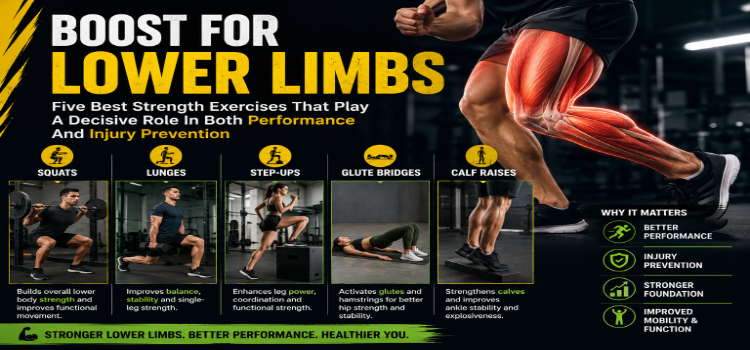
Lower limb strength is central to athletic performance. Whether it is sprinting, jumping, changing direction, landing, or maintaining balance under pressure, the muscles of the hips, thighs, knees, calves, and ankles play a decisive role in both performance and injury prevention. Research and physiotherapy guidelines increasingly emphasise that structured lower-body strengthening can improve stability, reduce fatigue, and lower the risk of common sports injuries such as ACL tears, hamstring strains, patellar pain, shin splints, and ankle instability.
Here are five of the most effective lower-limb strengthening exercises recommended for athletes across sports.
- Squats
Squats remain the foundation of lower-body strength training because they activate multiple major muscle groups simultaneously, including the quadriceps, hamstrings, gluteal muscles, and core stabilisers. They are particularly effective in developing power generation and knee stability.
Athletes who regularly perform squats often demonstrate improved jumping mechanics, sprint acceleration, and force absorption during landing. Squats also help maintain proper knee alignment, which is crucial in preventing ligament injuries.
To perform a proper squat:
Stand with feet shoulder-width apart.
Push the hips backward while bending the knees.
Keep the chest upright and knees aligned with the toes.
Lower until the thighs are parallel to the floor before returning upward through the heels.
Beginners can start with bodyweight squats, while advanced athletes may progress to weighted squats or single-leg variations.
- Lunges
Lunges are one of the best unilateral exercises for athletes because most sporting movements occur on one leg at a time. This exercise improves balance, coordination, hip mobility, and lower-limb symmetry while strengthening the quadriceps, hamstrings, calves, and glutes.
Reverse lunges are often preferred in rehabilitation and sports conditioning because they place slightly less stress on the knees compared to forward lunges.
How to perform:
Step forward or backward with one leg.
Lower the body until both knees reach approximately 90 degrees.
Keep the front knee above the ankle.
Push back to the starting position.
Athletes involved in football, hockey, athletics, basketball, and racquet sports benefit greatly from lunges because the exercise mimics sport-specific movement patterns.
- Step-Ups
Step-ups are highly effective for improving single-leg power, knee control, and glute activation. Physiotherapy and sports conditioning studies show that step-ups strongly engage the quadriceps and gluteus maximus muscles while enhancing balance and coordination.
This movement is particularly valuable for athletes returning from injury because it allows controlled strengthening without excessive joint loading.
How to perform:
Stand in front of a stable box or bench.
Place one foot firmly on the platform.
Drive through that leg to step upward.
Lower back down slowly with control.
Higher platforms increase intensity, while weighted step-ups can improve explosive power and endurance.
- Glute Bridges
Strong gluteal muscles are essential for lower-limb biomechanics. Weak glutes are often associated with knee valgus, lower-back strain, hamstring overload, and reduced sprint efficiency. Glute bridges specifically target the posterior chain, especially the gluteus maximus and hamstrings.
The exercise is especially useful for runners and field athletes because it improves hip extension strength, which is critical during sprinting and jumping.
How to perform:
Lie on the back with knees bent and feet flat on the floor.
Tighten the core and squeeze the glutes.
Lift the hips upward until the body forms a straight line from shoulders to knees.
Lower slowly and repeat.
Athletes can progress to single-leg bridges or weighted hip thrusts for greater resistance.
- Calf Raises
The calf muscles are essential for acceleration, deceleration, jumping, and shock absorption. Weak calves may contribute to Achilles tendon problems, shin splints, ankle instability, and poor running efficiency. Experts increasingly identify calf strength as a critical but often neglected component of athletic conditioning.
Calf raises strengthen both the gastrocnemius and soleus muscles, improving lower-leg endurance and propulsion.
How to perform:
Stand upright with feet hip-width apart.
Rise onto the balls of the feet as high as possible.
Pause briefly at the top.
Lower the heels slowly under control.
Single-leg calf raises and bent-knee variations can further target athletic performance and ankle stability.
Why These Exercises Matter for Athletes
Lower-limb strengthening does more than increase muscle size. These exercises improve:
Joint stability
Force production
Balance and coordination
Movement efficiency
Injury prevention
Athletes involved in running, football, cricket, hockey, basketball, badminton, and combat sports all rely heavily on strong lower limbs for optimal performance. Consistent lower-body strengthening also enhances neuromuscular control, helping athletes maintain proper biomechanics during fatigue.
Experts recommend incorporating lower-limb strength training two to three times weekly, ensuring proper technique, gradual progression, and adequate recovery. Quality of movement remains more important than heavy resistance, particularly in younger athletes and those returning from injury.
(Reference: The Chartered Society of Physiotherapy)