Swimming Makes Historic Shift: First Major Olympic Sport to Fully Reinstate Russian Athletes
In a landmark decision that has reshaped international aquatic sport, World Aquatics has announced that Russian and Belarusian swimmers, divers and water polo players will be allowed to compete in its events without restrictions, including under their national flags and anthems. This marks the first time a major Olympic sport has fully lifted post-invasion participation constraints imposed after Russia’s invasion of Ukraine.
The governing body’s announcement on April 13, 2026 means that senior athletes from Russia and Belarus — long restricted to competing only as vetted neutral athletes — will now enter World Aquatics competitions the same way as athletes from all other countries. Previously, after excluding both countries from events like the World Championships following the 2022 invasion, World Aquatics gradually eased restrictions by first permitting limited neutral participation and later relaxing rules for junior competitors.
World Aquatics President Husain Al Musallam said the organisation was committed to keeping pools and open water “places where athletes from all nations can come together in peaceful competition.” According to the new rules, Russian and Belarusian competitors must undergo four anti-doping tests and background checks before being eligible to compete under their national identities, though the full scope of the checks has not been detailed.
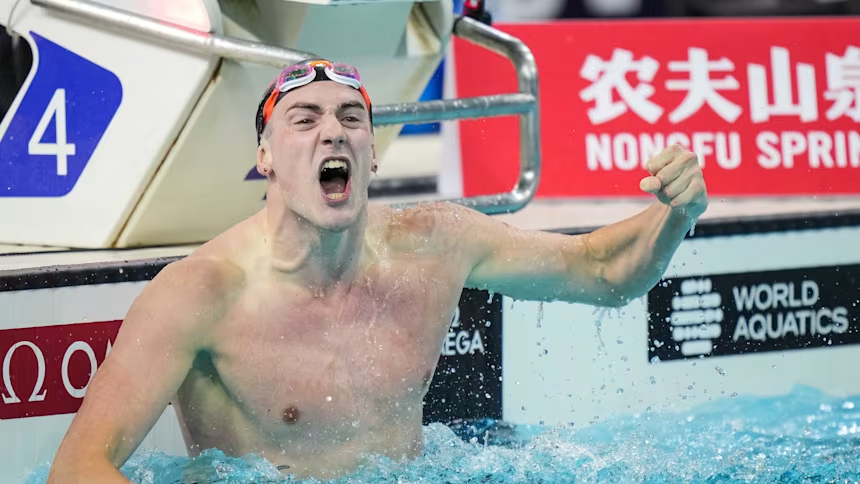
Among the athletes who could benefit from the policy shift is Kliment Kolesnikov, the Russian backstroke specialist who won gold in the men’s 50-metre backstroke at the 2025 World Aquatics Championships in Singapore while competing as a neutral athlete. His performances have been among the standout achievements for Russian competitors under neutral status, underscoring the calibre of talent now set to return under full national designation.
The decision has drawn sharp criticism from Ukrainian officials. Ukraine’s Minister of Youth and Sports, Matvii Bidnyi, described the reinstatement of Russian symbols as “a wake-up call for the entire sports community” and argued that it undermines the principles of fair play amid ongoing conflict. Ukraine’s men’s water polo team even forfeited a World Cup match in Malta, resulting in a 5-0 default win awarded to the Russian squad, in protest of the policy change.
Russian Sports Minister Mikhail Degtyaryov, who also heads the Russian Olympic Committee, welcomed the shift, praising Al Musallam’s leadership and framing the decision as a restoration of orderly sporting ties.
While the decision currently applies only to World Aquatics events — such as world championships and future qualifier meets — it could build momentum for a broader return of Russian and Belarusian athletes at the 2028 Los Angeles Olympics, where full national participation would see them contend for medals and podium honours alongside the world’s elite.
This development follows similar moves in other sports — judo reinstated Russia in November and taekwondo followed in January — but World Aquatics’ action is widely seen as the most significant shift yet within the Olympic movement.
Despite the policy change, details on enforcement of anti-doping and background procedures remain key questions as world sport navigates the intersection of competition, fairness and geopolitical tensions in the run-up to the next Olympic Games.