From the Sidelines to the Spotlight: How Hyderabad’s ‘Mini Brazil’ Is Shaping the Next Generation of Women Footballers
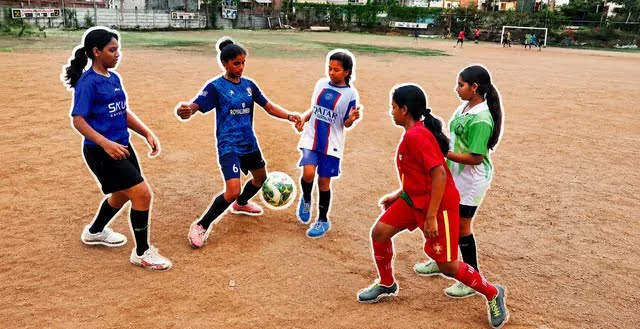
In Secunderabad’s football-crazy Valluvar Nagar, a six-decade-old sporting tradition is no longer limited to boys. Inspired by one trailblazing player, young girls are now rewriting the story of one of India’s most unique football communities.
Football Runs Through Every Generation
In the heart of Valluvar Nagar, a Tamil-speaking neighbourhood in Secunderabad, football is more than just an evening pastime—it’s a family tradition. Every evening, nearly 90 boys and around 10 girls gather on the community ground for training, carrying forward a football culture that has thrived for more than 60 years.
The locality has earned the nickname “Mini Brazil” because of its unmatched passion for the sport. During every FIFA World Cup, the streets are decorated with the flags of footballing nations such as Brazil, Argentina and Portugal, while posters of global stars transform the neighbourhood into a football festival.
But behind the colourful celebrations lies a much deeper story—one of perseverance, community support and changing opportunities for young girls.
One Girl Who Changed Everything
For years, football in Valluvar Nagar was almost exclusively played by boys. That began to change when Ranganathan Keshwardhini, affectionately known as Mary, refused to let rejection define her dreams.
As a child, Mary spent countless evenings standing beside the ground, hoping someone would let her join the game. Despite repeatedly being told that football wasn’t for girls, she continued showing up until she finally earned an opportunity.
Once on the field, she made every chance count.
Supported by her father, a footballer, and her mother, a former hockey player, Mary progressed from local competitions to district-level football before representing Telangana at the national level. Inspired by Portuguese legend Cristiano Ronaldo, she became known for her disciplined defending and exceptional man-marking ability.
Her success became proof that girls from the neighbourhood could compete at the highest levels.
A Community’s Mindset Begins to Change
Mary’s achievements inspired a shift that extended far beyond her own career.
Coach P.D. Joshua recalls that convincing parents to allow their daughters to play football was once one of the biggest challenges. However, after Mary reached the national stage, more families began encouraging their daughters to train.
Before the COVID-19 pandemic, around 20 to 22 girls regularly attended football sessions in Valluvar Nagar. Although the numbers dropped after the pandemic due to academic commitments and family responsibilities, seven to ten girls continue to train consistently alongside boys.
Among them is S. Suhana, who currently represents Rangareddy district and says Mary’s journey encouraged many girls like her to believe football could become more than just a hobby.
Parents have also embraced the change. Many now view football as a platform that improves fitness, confidence, discipline and teamwork while opening doors to sporting careers.
Free Coaching Keeps the Dream Alive
Unlike many private football academies that charge between Rs 2 lakh and Rs 4 lakh for professional training, coaching in Valluvar Nagar remains completely free.
The programme is funded by former players and community elders who continue investing in the next generation. Today, nine certified coaches oversee structured training sessions, ensuring children receive quality football education regardless of their financial background.
Over the years, several players from the locality have earned government jobs and educational opportunities through sports quotas, highlighting the long-term impact of the community’s football culture.
Football as a Tool for Social Change
According to coach P.D. Emmanuel, football has transformed more than sporting careers.
He explains that before organised coaching became common, several youngsters in the area were vulnerable to negative influences, including substance abuse. Regular football training provided discipline, purpose and a positive environment where children could focus on personal growth.
The community’s commitment has turned the local ground into much more than a training facility—it has become a place where values are nurtured alongside sporting talent.
The Journey Continues
Although opportunities for women’s football in India continue to grow, girls still have fewer tournaments and competitive platforms compared to boys. Access to advanced training and exposure also remains a challenge for many talented young players.
Yet Valluvar Nagar continues to stand as an example of how grassroots football can transform communities. What began as a tradition passed from fathers to sons is now becoming a legacy shared equally with daughters.
In Hyderabad’s “Mini Brazil,” football is no longer just a family heirloom—it is a symbol of inclusion, determination and the belief that talent deserves a chance, regardless of gender.