SSI FANZINE
  • Home
  • Magazine
  • Cricket
  • Soccer
  • Hockey
  • Tennis
  • F1
  • Injury & recovery
  • Miscellaneous
  • Sports Tech
  • Videos
No Result
View All Result
  • Home
  • Magazine
  • Cricket
  • Soccer
  • Hockey
  • Tennis
  • F1
  • Injury & recovery
  • Miscellaneous
  • Sports Tech
  • Videos
No Result
View All Result
SSI FANZINE
No Result
View All Result

Snicko Comes to Football: How Cricket’s Famous Technology Is Revolutionising FIFA World Cup Officiating

From confirming the faintest touch in Sweden vs Tunisia to ruling out Croatia’s dramatic equaliser against Portugal, Snicko has emerged as football’s newest technological ally—bringing unprecedented accuracy to VAR decisions at the FIFA World Cup 2026.

Baibhav Mishra by Baibhav Mishra
July 4, 2026
in Sports Feature, Sports Tech
Snicko Comes to Football: How Cricket’s Famous Technology Is Revolutionising FIFA World Cup Officiating

Snicko technology helps VAR detect the slightest ball contact during FIFA World Cup 2026 matches

For decades, the distinctive “Snicko” graphic has been synonymous with cricket. Whenever batters edged the ball and the naked eye failed to detect it, the technology stepped in to settle debates.

Now, football has embraced a similar concept.

The 2026 FIFA World Cup has introduced fans to a cricket-inspired officiating tool that is changing how crucial decisions are made. During the tournament, Snicko-style ball-contact technology has already played a decisive role in two high-profile incidents—first in Sweden’s group-stage victory over Tunisia and later in Portugal’s dramatic knockout win over Croatia.

Far from being a gimmick, the technology has become one of VAR’s most powerful weapons in determining whether a player made the slightest touch on the ball before an offside or handball incident.

What is Snicko in football?

Unlike cricket, where Snicko relies primarily on ultra-sensitive microphones and waveform analysis to detect faint edges, football’s version combines an intelligent match ball with advanced motion sensors.

The Adidas World Cup match ball contains an inertial measurement unit (IMU)—a tiny sensor capable of recording hundreds of data points every second. The chip communicates instantly with the Video Assistant Referee (VAR) system, registering the exact moment the ball is touched.

Whenever television viewers see the familiar spike on the screen, it indicates the precise instant contact was made, even if the touch is too slight to be seen on standard replays.

Sweden vs Tunisia: The moment football discovered Snicko

The first major talking point arrived during Sweden’s opening Group F clash against Tunisia.

Substitute Mattias Svanberg thought he had scored Sweden’s fourth goal, only for the assistant referee to raise the offside flag. Swedish players insisted that Alexander Isak had made the slightest touch before the ball reached Svanberg, which would alter the offside interpretation.

To resolve the controversy, VAR turned to the ball sensor.

The Snicko-style graphic displayed a clear spike exactly as the ball brushed Isak’s foot. That microscopic contact, invisible in conventional replays, confirmed Sweden’s claim.

The goal was awarded after review, making it one of the first major World Cup decisions to be determined by cricket-inspired technology. Sweden eventually cruised to a convincing 5-1 victory.

Portugal vs Croatia: Snicko saves Ronaldo’s World Cup dream

If the Sweden incident introduced the technology, Portugal’s Round of 32 clash against Croatia demonstrated just how decisive it could become.

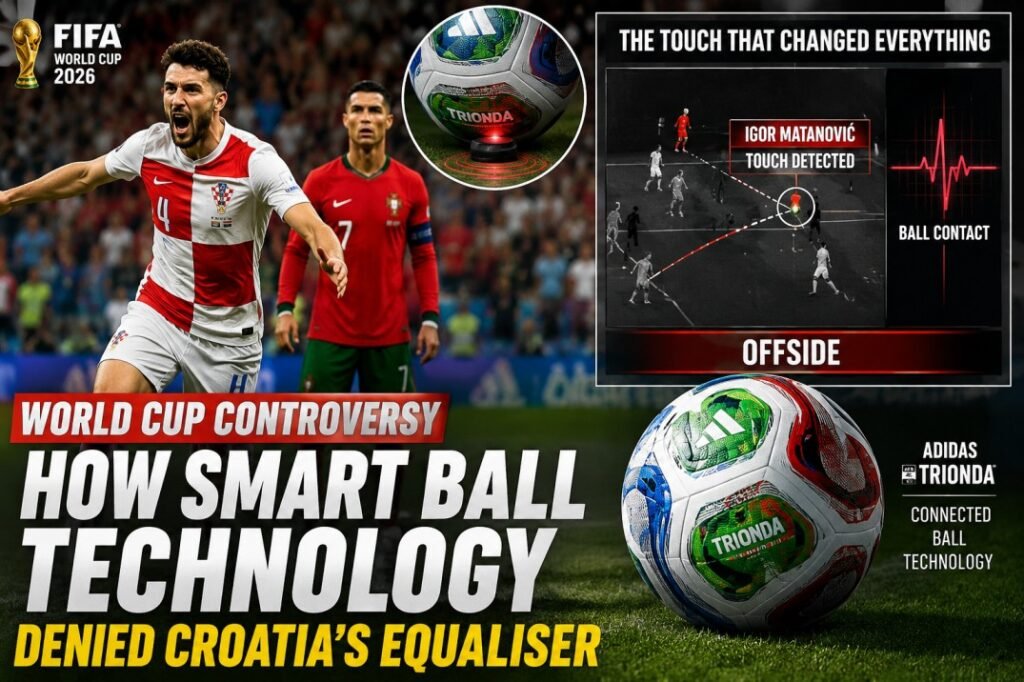
Croatia believed they had forced extra time when Joško Gvardiol scored a dramatic late equaliser.

However, VAR initiated a review after uncertainty over whether Igor Matanović had made a slight flick before the ball reached Mario Pašalić.

Television replays were inconclusive.

The embedded sensor inside the ball, however, detected a tiny touch by Matanović, producing the characteristic “Snicko” spike. That touch meant Pašalić had received the ball from an offside position.

The goal was ruled out.

Portugal held on for a 2-1 victory, keeping Cristiano Ronaldo’s World Cup hopes alive while ending Croatia’s campaign in heartbreaking fashion.

How does the technology actually work?

The system is built around Adidas’ Connected Ball Technology.

Inside every official World Cup ball sits a miniature sensor that records movement and impact at extremely high frequency.

The process works as follows:

  • The sensor detects every contact made with the ball.
  • Data is transmitted instantly to the VAR operations room.
  • Officials compare sensor readings with synchronized broadcast footage.
  • A visible spike confirms the exact moment the ball was touched.
  • VAR uses that evidence while evaluating offside, handball and build-up phases.

The result is far greater certainty during situations where even slow-motion cameras cannot definitively establish whether contact occurred.

Why football needs it

Modern football has become incredibly fast.

Offside decisions often depend on millimetres, while handball and deflection calls can hinge on almost imperceptible touches.

Traditional camera angles sometimes fail to answer the most important question:

Did the player actually touch the ball?

The sensor eliminates much of that uncertainty.

Combined with semi-automated offside technology, limb tracking and VAR, Snicko-style ball detection provides officials with another layer of objective evidence instead of relying solely on visual interpretation.

Not without controversy

Like every major technological advancement in football, Snicko has generated mixed reactions.

Many supporters have praised the increased accuracy and the ability to resolve situations that previously depended on guesswork.

Others argue that football risks becoming excessively dependent on technology, with emotional moments interrupted by lengthy reviews over touches invisible to players and spectators.

The Croatia-Portugal incident perfectly illustrated this divide. While officials could justify the decision using sensor data, many fans questioned whether such microscopic contacts should determine the outcome of World Cup matches.

A glimpse into football’s technological future

The 2026 FIFA World Cup is increasingly becoming a showcase for next-generation officiating.

Semi-automated offside systems, AI-assisted tracking, connected match balls and Snicko-style touch detection are all working together to improve decision-making.

Whether fans embrace every innovation remains to be seen.

But after influencing crucial moments in both Sweden’s victory over Tunisia and Portugal’s knockout triumph over Croatia, one thing is already clear: cricket’s most famous technology has found an unexpected new home on the football pitch.
Please follow and like us:
fb-share-icon
Tweet
Pin Share
Tags: Adidas Trionda ballConnected Ball TechnologyCristiano Ronaldo World CupFIFA VAR innovationsFIFA World Cup technologyfootball officiating technologyfootball Snicko explainedJoško Gvardiol goal ruled outPortugal vs Croatia offsidesemi-automated offsidesmart football technologySnicko in footballSnicko technology FIFA World Cup 2026Sweden vs Tunisia SnickoVAR technology
Baibhav Mishra

Baibhav Mishra

Related Posts

Cristiano Ronaldo Announces 2026 World Cup as His Last: “Yes, It’s My Final One – Let’s Enjoy It”
Football

Cristiano Ronaldo Announces 2026 World Cup as His Last: “Yes, It’s My Final One – Let’s Enjoy It”

July 5, 2026
Racing the Clock: How Injuries to Neymar, Salah, James and Rice Are Quietly Shaping FIFA World Cup 2026
Injury & recovery

Racing the Clock: How Injuries to Neymar, Salah, James and Rice Are Quietly Shaping FIFA World Cup 2026

July 5, 2026
The Blade’s Edge: India’s Men’s Foil Team Fences its Way to the 2026 Asian Games
Fencing

The Blade’s Edge: India’s Men’s Foil Team Fences its Way to the 2026 Asian Games

July 5, 2026
Next Post
Abhijeet Gupta Extends Lead at Pune Grandmaster Chess Tournament

Abhijeet Gupta Extends Lead at Pune Grandmaster Chess Tournament

Archery Association of India Eyes Korean Expert Park Chae-soon for Recurve Head Coach Role

Archery Association of India Eyes Korean Expert Park Chae-soon for Recurve Head Coach Role

Asian Games-Bound Indian Athletes to Compete in One-Day Delhi Meet

Asian Games-Bound Indian Athletes to Compete in One-Day Delhi Meet

Discussion about this post

Recommended

Burgess Benches Dufty for Wigan Clash Over Missed Training Session

Burgess Benches Dufty for Wigan Clash Over Missed Training Session

11 months ago
Marc Marquez Redefines Greatness: Why Beating Valentino Rossi’s Record Is No Longer His Biggest Goal

Marc Marquez Redefines Greatness: Why Beating Valentino Rossi’s Record Is No Longer His Biggest Goal

5 hours ago
Pranav Shines as Indian Players Impress on Opening Day of Chess World Cup

Pranav Shines as Indian Players Impress on Opening Day of Chess World Cup

8 months ago
Hope & Greaves Script Remarkable Fightback to Keep West Indies Alive

Hope & Greaves Script Remarkable Fightback to Keep West Indies Alive

7 months ago

Blogs

Prize Money Debate and F1 Driver Market Shake Global Sports Landscape

Invisible Sidelines: Why Youth Sports Are Failing Athletes When It Matters Most

‘Rigged?’ NHL Draft Lottery Sparks Fan Fury After Leafs Land No. 1 Pick

From Mat to Monitor: How Sports Science Is Rewriting India’s Sporting DNA

Upcoming Multi-Sport Action: A Packed Global Calendar Keeps Fans on the Edge

Road To 2030 Commonwealth Games: India’s Bold Sporting Vision Takes Shape

No Result
View All Result
Cristiano Ronaldo Announces 2026 World Cup as His Last: “Yes, It’s My Final One – Let’s Enjoy It”

Cristiano Ronaldo Announces 2026 World Cup as His Last: “Yes, It’s My Final One – Let’s Enjoy It”

July 5, 2026
Alexandra Eala’s Wimbledon Fairytale Inspires a Nation as Filipino Tennis Reaches New Heights

Alexandra Eala’s Wimbledon Fairytale Inspires a Nation as Filipino Tennis Reaches New Heights

July 5, 2026
One Second to Glory: Why Sajan Prakash’s Final Season Could Define His Legacy

One Second to Glory: Why Sajan Prakash’s Final Season Could Define His Legacy

July 5, 2026
Sarthak Chavan Scripts Indian Motorsport History with Landmark Top-Six Finish in Europe

Sarthak Chavan Scripts Indian Motorsport History with Landmark Top-Six Finish in Europe

July 5, 2026
Racing the Clock: How Injuries to Neymar, Salah, James and Rice Are Quietly Shaping FIFA World Cup 2026

Racing the Clock: How Injuries to Neymar, Salah, James and Rice Are Quietly Shaping FIFA World Cup 2026

July 5, 2026
Grigor Dimitrov Rewrites His Wimbledon Story With Gritty Win Over Matteo Berrettini

Grigor Dimitrov Rewrites His Wimbledon Story With Gritty Win Over Matteo Berrettini

July 5, 2026

Highlights

Sarthak Chavan Scripts Indian Motorsport History with Landmark Top-Six Finish in Europe

Racing the Clock: How Injuries to Neymar, Salah, James and Rice Are Quietly Shaping FIFA World Cup 2026

Grigor Dimitrov Rewrites His Wimbledon Story With Gritty Win Over Matteo Berrettini

The Blade’s Edge: India’s Men’s Foil Team Fences its Way to the 2026 Asian Games

India’s Young Paddlers Secure U-19 Asian Championship Bronze After Memorable Run in Bangkok

Marc Marquez Redefines Greatness: Why Beating Valentino Rossi’s Record Is No Longer His Biggest Goal

Trending

Cristiano Ronaldo Announces 2026 World Cup as His Last: “Yes, It’s My Final One – Let’s Enjoy It”
Football

Cristiano Ronaldo Announces 2026 World Cup as His Last: “Yes, It’s My Final One – Let’s Enjoy It”

by Baibhav Mishra
July 5, 2026
0

The King’s Last Bow In the bright lights of a pre-match press conference ahead of Portugal’s clash...

Alexandra Eala’s Wimbledon Fairytale Inspires a Nation as Filipino Tennis Reaches New Heights

Alexandra Eala’s Wimbledon Fairytale Inspires a Nation as Filipino Tennis Reaches New Heights

July 5, 2026
One Second to Glory: Why Sajan Prakash’s Final Season Could Define His Legacy

One Second to Glory: Why Sajan Prakash’s Final Season Could Define His Legacy

July 5, 2026
Sarthak Chavan Scripts Indian Motorsport History with Landmark Top-Six Finish in Europe

Sarthak Chavan Scripts Indian Motorsport History with Landmark Top-Six Finish in Europe

July 5, 2026
Racing the Clock: How Injuries to Neymar, Salah, James and Rice Are Quietly Shaping FIFA World Cup 2026

Racing the Clock: How Injuries to Neymar, Salah, James and Rice Are Quietly Shaping FIFA World Cup 2026

July 5, 2026

Sports Science India Fanzine
India's First Sports Science Magazine.

Quick Links

  • Shop
  • My Account
  • Member Login
  • Register
  • Subscription Plan
  • Terms and Conditions
  • Privacy Policy
  • Shipping Policy
  • Refund and Returns Policy

Featured

  • IPL 2025
  • Indian Super League
  • English Premier League
  • La Liga
  • UEFA Champions League
  • Europa League
  • Serie A
  • Bundesliga
  • Ultimate Fighting Championship
  • I-League
  • Copa America

Contact Info

Sports Science India
Plot No - A17/1A, Unit-7, Surya Nagar,
In front of S.P Vigilance Office,
Bhubaneswar - 751003

+91 78479 22850

ssifanzine@outlook.com

  • About
  • Advertise
  • Careers

© 2025 - SSI FANZINE. All Rights Reserved.

RSS
Follow by Email
Facebook
fb-share-icon
X (Twitter)
Tweet
No Result
View All Result
  • Home
  • Magazine
  • Cricket
  • Soccer
  • Hockey
  • Tennis
  • F1
  • Injury & recovery
  • Miscellaneous
  • Sports Tech
  • Videos

© 2025 - SSI FANZINE. All Rights Reserved.