SSI FANZINE
  • Home
  • Magazine
  • Cricket
  • Soccer
  • Hockey
  • Tennis
  • F1
  • Injury & recovery
  • Miscellaneous
  • Sports Tech
  • Videos
No Result
View All Result
  • Home
  • Magazine
  • Cricket
  • Soccer
  • Hockey
  • Tennis
  • F1
  • Injury & recovery
  • Miscellaneous
  • Sports Tech
  • Videos
No Result
View All Result
SSI FANZINE
No Result
View All Result

When a Robot Starts Running Like a Sprinter: What Unitree H1 Teaches Us About the Science of Speed
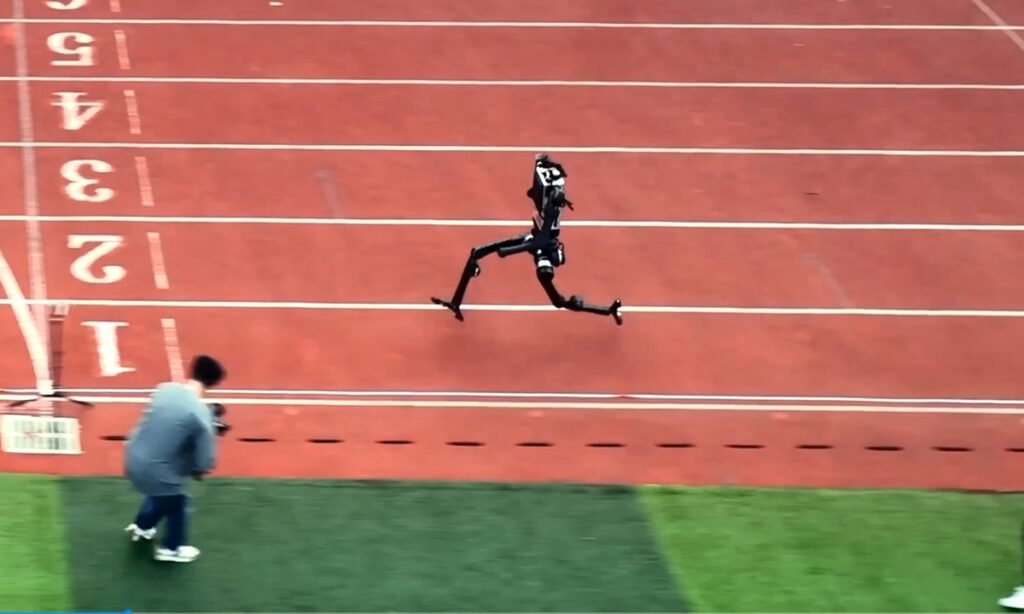
As Unitree’s humanoid machine approaches elite sprint velocity, sports science finds a surprising new laboratory in robotics.

Sohini Mukherjee by Sohini Mukherjee
April 13, 2026
in Sports Science Blogs, Sports Science Plus, Sports Tech
When a Robot Starts Running Like a Sprinter: What Unitree H1 Teaches Us About the Science of Speed

Image Courtesy -@Globaltimes

In track and field, speed has always been a measure of human potential. From the cinder tracks of the early Olympics to the synthetic lanes of modern stadiums, the 100 metres has been the ultimate laboratory for testing the limits of the human body. Now, that laboratory has a new participant — not an athlete, but a machine.

Recently, Unitree Robotics showcased its humanoid platform, the Unitree H1, reaching sprint speeds close to 10 metres per second. For context, that is not far from the average velocity maintained by the fastest human ever to run the distance, Usain Bolt. While the comparison makes for eye-catching headlines, the real story lies deeper — in what this moment reveals about biomechanics, energy transfer, and the future of sports science.

Speed Is More Than Muscles

Elite sprinting is not simply about powerful legs. It is about stride length, ground contact time, joint stiffness, balance, and the precise coordination of dozens of muscle groups firing in milliseconds. Coaches and sports scientists spend years studying slow-motion footage of sprinters to understand how fractions of a second can be gained or lost.

What makes a robot like H1 fascinating is that it has no muscles, no tendons, no fatigue, and no lactic acid. Yet, to run fast, it must replicate the same mechanical principles that govern human sprinting:

  • Minimise time spent on the ground
  • Maximise forward propulsion per stride
  • Maintain dynamic balance at high velocity
  • Control oscillation of the upper body

In other words, to make a robot run fast, engineers have unintentionally recreated the textbook model of sprint biomechanics.

A Moving Biomechanics Experiment

Sports labs often use motion sensors, force plates, and high-speed cameras to analyse athletes. The H1 robot, however, is a fully instrumented system by design. Every joint angle, torque output, and balance correction is recorded in real time.

This turns the robot into something remarkable: a living biomechanics experiment.

Engineers can adjust limb stiffness, stride frequency, or weight distribution digitally — things impossible to tweak in a human athlete. Observing how these changes affect speed offers new insights into the mechanical principles of sprinting that sports science has long theorised but struggled to test cleanly in humans.

The Role of Balance at High Speed

One of the biggest challenges in sprinting is not producing force, but controlling it. At top speed, a sprinter is essentially in a series of controlled forward falls, catching themselves with each stride.

Humanoid robots face the exact same challenge. At 10 m/s, even the slightest imbalance can send a machine crashing to the track. To prevent this, H1 uses real-time stabilization algorithms that mirror how the human nervous system reacts during sprinting.

For sports scientists, this is an intriguing parallel: a robot forced to solve the same balance problems as a world-class athlete.

Energy Efficiency vs. Power Output

Human sprinters generate enormous power for short bursts, but they do so inefficiently in terms of energy cost. Fatigue builds quickly, which is why the 100 m is a perfect distance for maximal speed.

A robot, in contrast, is limited by battery life and motor efficiency. To sprint faster, engineers must optimise how energy is transferred into forward motion — an issue that mirrors how coaches try to improve running economy in athletes.

The overlap between robotics engineering and sprint coaching is becoming unexpectedly clear.

What This Means for Sport

No robot is about to enter the Olympics. But machines like H1 may quietly influence how athletes train.

  • Data from robotic locomotion can inform:
  • Better prosthetic designs for para-athletes
  • Smarter wearable sensors for gait analysis
  • Improved understanding of joint loading and injury prevention
  • New simulation models for sprint training

In a way, robotics may become an advanced extension of sports science laboratories.

A New Perspective on Human Excellence

The most compelling takeaway is not that a robot is getting fast. It is that to make a machine run quickly, engineers must follow the same laws of physics that govern human greatness on the track.

The fact that a humanoid robot needs to mimic the mechanics perfected by elite sprinters is, ironically, a tribute to human athletic evolution. It confirms that the way the best athletes run is not just impressive — it is mechanically optimal.

And perhaps that is the real story: the closer robots get to sprinting like humans, the more we understand just how extraordinary human sprinting really is.


Please follow and like us:
fb-share-icon
Tweet
Pin Share
Tags: balance in sprintingbiomechanicsgait analysishumanoid robot sprintrobotics and sportsrunning economysports sciencesprint mechanicsUnitree H1Usain Bolt comparison
Sohini Mukherjee

Sohini Mukherjee

Related Posts

Recovery Over Reps: Why Modern Athletes Win With Science, Not Just Training
ATHLETICS

Recovery Over Reps: Why Modern Athletes Win With Science, Not Just Training

April 15, 2026
Beyond the Numbers: How Decision Literacy and Psychosocial Load Are Becoming the New Frontier in Sports Science
Sports Science Blogs

Beyond the Numbers: How Decision Literacy and Psychosocial Load Are Becoming the New Frontier in Sports Science

April 14, 2026
The Hidden Brain Revolution: How Neuroplasticity and Cognitive Load Training Are Redefining Athletic Peak Performance in 2026
Sports Science Blogs

The Hidden Brain Revolution: How Neuroplasticity and Cognitive Load Training Are Redefining Athletic Peak Performance in 2026

April 14, 2026
Next Post
India’s Women’s Hockey Team Launch Argentina Tour

India’s Women’s Hockey Team Launch Argentina Tour

McIlroy Wins Back-To-Back Masters Titles, Joins Golf’s Elite Club

McIlroy Wins Back-To-Back Masters Titles, Joins Golf’s Elite Club

Manchester United’s Defensive Woes Put Michael Carrick Under Immediate Pressure

Manchester United's Defensive Woes Put Michael Carrick Under Immediate Pressure

Discussion about this post

Recommended

Rohit Sharma doubtful for PBKS clash after hamstring injury scare

Rohit Sharma doubtful for PBKS clash after hamstring injury scare

3 days ago
Mbappé Scores as 10-Man France Edges Brazil 2-1 in World Cup Warm-Up Friendly

Mbappé Scores as 10-Man France Edges Brazil 2-1 in World Cup Warm-Up Friendly

3 weeks ago
Indian Deaf Cricket Association Reveals New Jersey Ahead of UAE T20 Series

Indian Deaf Cricket Association Reveals New Jersey Ahead of UAE T20 Series

4 months ago
Hardik Pandya: “Injuries Test You Mentally — I Came Back Stronger, Bigger & Better”

Hardik Pandya: “Injuries Test You Mentally — I Came Back Stronger, Bigger & Better”

4 months ago

Blogs

Adam Peaty Holds Off Rising Stars to Win Men’s 100m Breaststroke at 2026 GB Swimming Championships

UCLA Crushes South Carolina To Claim First-Ever Women’s NCAA Title

From Ball Boys To Ball Influencers: How Gen Z Is Hijacking Live Sports Broadcasts

Fujairah Set to Host High-Octane Round 2 of Khaled Bin Mohamed Jiu-Jitsu Championship

India’s Athletics Revolution: From Underdogs to Global Contenders

How Technology is Transforming Modern Sports Training and Performance Across Disciplines

No Result
View All Result
Pride, Pressure and the Playoff Equation: Why This Draw Meant More Than the Scoreline

Pride, Pressure and the Playoff Equation: Why This Draw Meant More Than the Scoreline

April 15, 2026
Chinese Triumphs and Global Stars Define Karate One Premier League Leshan

Chinese Triumphs and Global Stars Define Karate One Premier League Leshan

April 15, 2026
Brilliant RCB Bowling Shines as LSG Fold for 146 in IPL 2026 Showdown

Brilliant RCB Bowling Shines as LSG Fold for 146 in IPL 2026 Showdown

April 15, 2026
Recovery Over Reps: Why Modern Athletes Win With Science, Not Just Training

Recovery Over Reps: Why Modern Athletes Win With Science, Not Just Training

April 15, 2026
From Hockey Legend to Global Fitness Innovator: Moritz Fürste’s Sporting Journey

From Hockey Legend to Global Fitness Innovator: Moritz Fürste’s Sporting Journey

April 15, 2026
Exeter Members To Vote On Takeover By US Backers

Exeter Members To Vote On Takeover By US Backers

April 15, 2026

Highlights

Recovery Over Reps: Why Modern Athletes Win With Science, Not Just Training

From Hockey Legend to Global Fitness Innovator: Moritz Fürste’s Sporting Journey

Exeter Members To Vote On Takeover By US Backers

Ben Stokes Says He Is Lucky To Be Alive After Facial Injury

Sergio Garcia Apologises After Smashing Driver During Masters Final Round

When Was The Last Three-Team Title Race In Scottish Premiership?

Trending

Pride, Pressure and the Playoff Equation: Why This Draw Meant More Than the Scoreline
Football

Pride, Pressure and the Playoff Equation: Why This Draw Meant More Than the Scoreline

by Sohini Mukherjee
April 15, 2026
0

At first glance, the 1-1 result between Kerala Blasters FC and NorthEast United FC at the Jawaharlal...

Chinese Triumphs and Global Stars Define Karate One Premier League Leshan

Chinese Triumphs and Global Stars Define Karate One Premier League Leshan

April 15, 2026
Brilliant RCB Bowling Shines as LSG Fold for 146 in IPL 2026 Showdown

Brilliant RCB Bowling Shines as LSG Fold for 146 in IPL 2026 Showdown

April 15, 2026
Recovery Over Reps: Why Modern Athletes Win With Science, Not Just Training

Recovery Over Reps: Why Modern Athletes Win With Science, Not Just Training

April 15, 2026
From Hockey Legend to Global Fitness Innovator: Moritz Fürste’s Sporting Journey

From Hockey Legend to Global Fitness Innovator: Moritz Fürste’s Sporting Journey

April 15, 2026

Sports Science India Fanzine
India's First Sports Science Magazine.

Quick Links

  • Shop
  • My Account
  • Member Login
  • Register
  • Subscription Plan
  • Terms and Conditions
  • Privacy Policy
  • Shipping Policy
  • Refund and Returns Policy

Featured

  • IPL 2025
  • Indian Super League
  • English Premier League
  • La Liga
  • UEFA Champions League
  • Europa League
  • Serie A
  • Bundesliga
  • Ultimate Fighting Championship
  • I-League
  • Copa America

Contact Info

Sports Science India
Plot No - A17/1A, Unit-7, Surya Nagar,
In front of S.P Vigilance Office,
Bhubaneswar - 751003

+91 78479 22850

ssifanzine@outlook.com

  • About
  • Advertise
  • Careers

© 2025 - SSI FANZINE. All Rights Reserved.

RSS
Follow by Email
Facebook
fb-share-icon
X (Twitter)
Tweet
No Result
View All Result
  • Home
  • Magazine
  • Cricket
  • Soccer
  • Hockey
  • Tennis
  • F1
  • Injury & recovery
  • Miscellaneous
  • Sports Tech
  • Videos

© 2025 - SSI FANZINE. All Rights Reserved.