War on the Pitch: The 2026 Israel-Iran Conflict’s Devastating Ripple Through Global Sports
Bhubaneswar: The outbreak of the 2026 Iran war on February 28 has thrust the Middle East into a full-scale conflict involving U.S. and Israeli airstrikes against Iranian targets, including the assassination of Supreme Leader Ali Khamenei, followed by Iranian missile barrages on Israel and regional U.S. bases. As of late March 2026, the war rages into its fourth week with ongoing strikes, the partial closure of the Strait of Hormuz disrupting global shipping, and casualties mounting on all sides.
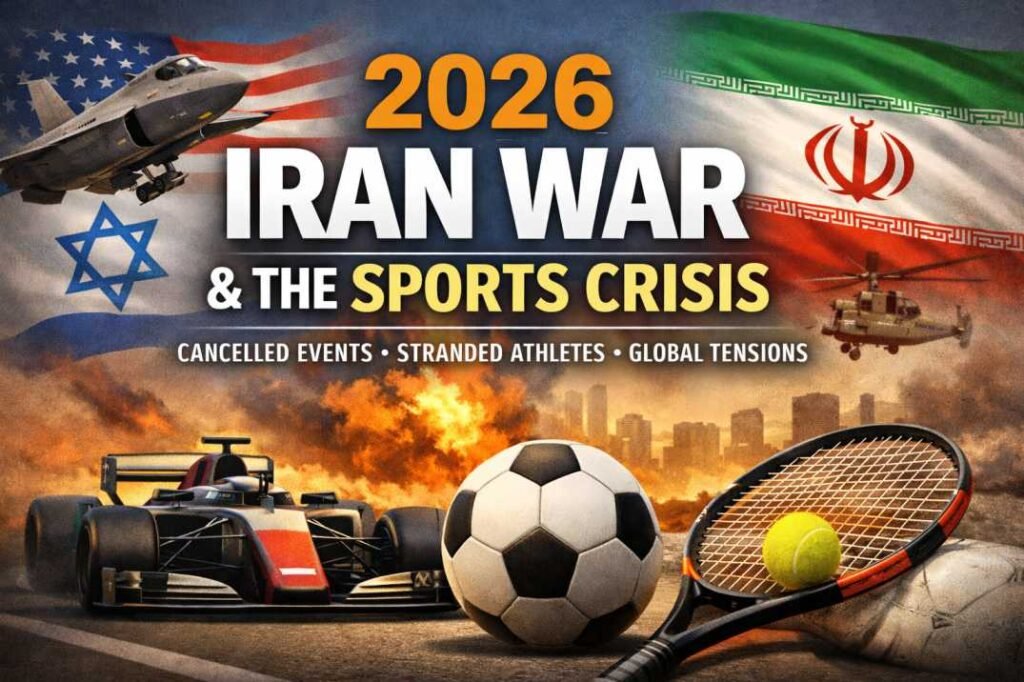
What was once a contained shadow war has exploded into open hostilities, sending shockwaves far beyond the battlefield. Sports — often touted as a unifying force — has been thrust into the chaos. Events across the Gulf have been cancelled or postponed en masse due to security alerts, airspace closures, and travel paralysis. Athletes find themselves stranded, training suspended, and national teams facing existential questions about participation. This is not merely logistical disruption; it is a stark reminder that in an interconnected world, no arena escapes geopolitics.
The Current Crisis: A Volatile Backdrop
The war erupted with coordinated U.S.-Israeli Operation Epic Fury and Roaring Lion strikes that decapitated Iranian leadership and hammered military and nuclear sites. Iran retaliated with ballistic missiles hitting Israeli towns like Dimona and Arad (injuring over 100 civilians), U.S. bases across the Gulf, and even distant targets like Diego Garcia. The Strait of Hormuz remains a flashpoint, with Iran’s attempts to blockade it spiking oil prices and triggering naval confrontations. Hezbollah’s escalation into southern Lebanon has compounded regional instability.
Airspace across the Middle East — from Dubai to Doha — slammed shut for days, stranding thousands and cancelling flights. This chaos has directly collided with the sports calendar, turning hubs like Abu Dhabi and Qatar (long courted as neutral venues) into no-go zones. The conflict’s timing, just weeks before major spring events, has amplified the fallout.
Cancellations and Postponements: A Domino Effect Across Disciplines
The most visible impact has been a cascade of cancellations and rescheduling, prioritizing safety over spectacle:
Motorsport: Formula 1 scrapped the Bahrain and Saudi Arabian Grands Prix (April 2026), citing the conflict. MotoGP postponed its Qatar Grand Prix to November, forcing calendar shifts for Portugal and Valencia. The World Endurance Championship delayed its Qatar season opener from March 28 to October.
Football: All events in Iran, including the Persian Gulf Pro League, were suspended indefinitely. Qatar halted its domestic league (later partially resumed). The AFC postponed West Region Champions League matches and playoffs. The marquee Spain vs Argentina “Finalissima” in Doha was outright cancelled. Even Iraq’s World Cup playoff faced travel-related postponement calls.
Tennis and Others: The ATP Challenger in Fujairah (UAE) was abruptly halted and cancelled after a security alert. Cricket’s England Lions vs Pakistan Shaheens match in Abu Dhabi was scrapped. Basketball’s Euroleague NextGen tournament in Abu Dhabi was terminated mid-game.
Paralympics: Travel chaos prevented Iranian para-skier Abolfazl Khatibi from reaching the Milano Cortina 2026 Winter Paralympics, despite qualification. Israeli athletes faced similar hurdles.
These decisions reflect governing bodies’ (F1, AFC, ATP, IPC) zero-tolerance stance on risk, but they carry heavy financial and competitive costs for hosts and athletes alike.
Athletes and Sportspersons’ Reactions: Fear, Frustration, and Defiance
Individual voices have captured the human toll. Indian badminton star PV Sindhu, stranded for days at Dubai airport en route to the All England Open, withdrew and returned home, later describing the ordeal as “terrifying” and “intense and uncertain.” She posted on social media: “Back home in Bangalore and safe… The last few days have been intense and uncertain, but I’m truly grateful.”
Tennis stars Daniil Medvedev and Andrey Rublev were among dozens left stuck in Dubai post-championships, scrambling for alternative routes to Indian Wells. Cricket’s Jonny Bairstow and others faced similar limbo. The U.S. men’s hockey team withdrew from a World Cup qualifier in Egypt on State Department advice.
On the geopolitical front, reactions turned political. Over 10,000 Iranian athletes signed a letter urging the UN, IOC, and IPC to ban U.S. and Israeli teams from all international events, calling for their suspension from Olympic bodies. Iran’s women’s football team, competing in Australia’s AFC Women’s Asian Cup, refused to sing the national anthem — a bold act of protest — prompting state media to label them “wartime traitors.” Several players sought and received asylum in Australia.
Israel’s national gymnastics team suspended all training, citing “significant uncertainty” and “considerable stress.” Iran’s Football Federation president Mehdi Taj voiced despair over the 2026 FIFA World Cup: “We cannot be expected to look forward to the World Cup with hope.” Even U.S. President Donald Trump weighed in, deeming Iranian participation “inappropriate” for safety reasons despite FIFA’s insistence on inclusion.
These statements reveal a spectrum: personal fear and logistical nightmares for neutral athletes, defiant political stands from those directly impacted, and institutional anxiety over national representation.
Geopolitics, Psychology, and the Fragility of Sports Diplomacy
Beyond headlines lies deeper disruption. The Middle East’s emergence as a sports powerhouse — F1 races, football friendlies, tennis hubs — relied on perceived neutrality and lavish infrastructure. That model now lies in tatters, exposing over-reliance on volatile regions. Travel logistics, once seamless via Dubai or Doha, have become choke points, revealing sports’ vulnerability to global supply chains.
Psychologically, the toll is profound. Athletes in conflict zones (Israeli squads) grapple with suspended routines and safety fears; those from Iran face divided loyalties amid regime pressure and war trauma. The Iranian women’s footballers’ anthem protest and asylum bids underscore how sports can become platforms for resistance or escape. Broader calls for boycotts echo Russia’s 2022 Olympic isolation but risk politicizing athletics further, straining the Olympic Truce ideal (which the IOC has quietly sidelined here).
Economically, billions in hosting revenue, sponsorships, and tourism are at risk. Oil price spikes from the Hormuz crisis indirectly squeeze budgets. For Iran, war damage to infrastructure threatens long-term sports development. Globally, it forces federations into real-time crisis management, prioritizing athlete welfare over tradition.
Future Impact: A Reckoned Calendar and Shifting Power Dynamics
If the war drags on — with Trump hinting at prolonged negotiations yet possible ground operations — the 2026 FIFA World Cup (hosted in the U.S., Canada, Mexico) faces its greatest test: Iran’s qualified team may withdraw or be barred amid safety and political fallout. Rescheduling ripples (MotoGP, F1) could compress calendars into 2027, disadvantaging smaller nations.
Longer-term, Gulf states may lose their hosting allure, pushing events toward safer Asia-Pacific or European venues. Heightened security protocols will raise costs everywhere. Iran’s sporting isolation could deepen, while Israeli athletes navigate boycotts or visa hurdles. The IPC and IOC face precedent-setting decisions on conflict-zone participation.
Optimistically, swift resolution could see rapid recovery — Qatar resuming play quickly offers a model. Yet the precedent is set: sports calendars are no longer immune to distant wars.
The Way Ahead
The 2026 Israel-Iran war has stripped away the illusion of sports as an apolitical sanctuary. Cancellations have scarred the immediate calendar, athletes’ raw reactions have humanized the crisis, and the deeper insights reveal systemic fragility. Looking ahead, the future of global athletics hinges on whether diplomacy can outpace escalation. Until then, every postponed race, stranded star, and defiant anthem protest serves as a poignant reminder: when missiles fly, even the games must pause — but the human spirit, tested on and off the field, endures. The pitch may fall silent, yet the world watches, hoping for peace before the next whistle.