AI in Sports Management: Friend, Tool or Threat? Experts Decode the Future at SSI Conclave 2025
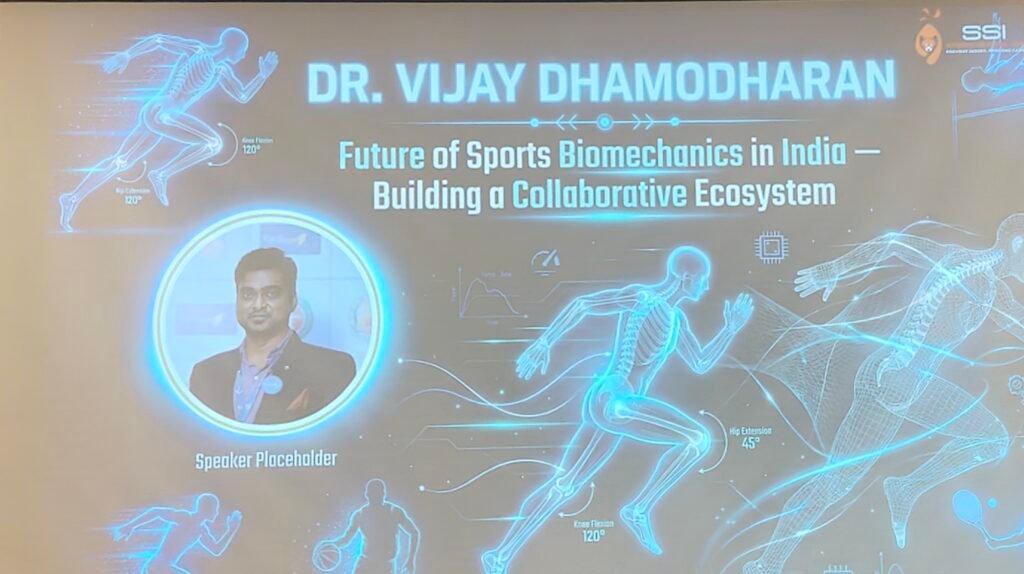
The session on “AI in Sports ManagementAI” at the SSI Sports Science Conclave 2025 brought together three powerful voices — Prof. Mahaya Mohanty, Dr. Bhaskar Basu, and Prof. Girish Balasubramanium — each offering a distinct yet complementary view on how Artificial Intelligence is transforming the way sports is trained, managed, and performed. The discussion moved beyond hype, focusing instead on awareness, responsible usage, data-driven decisions, and the irreplaceable role of human instinct.
Prof. Mahaya Mohanty: Awareness, Limits and Responsible Use of A
Opening the session, Prof. Mahaya Mohanty stressed that knowledge of digital systems and AI-based subscriptions is no longer optional. She highlighted the urgent need for awareness, stating that people must first understand what they are using before trusting it.
She pointed to emerging smart AI tools that can predict potential injuries simply by analysing posture and movement patterns, calling it a major breakthrough for preventive sports science. However, her core message was one of balance and caution.
“AI is our friend if we are friends with it. If we cheat at our work, it will be heavy on us,” she remarked.
Using a powerful metaphor, she said,
“First a person drinks wine, then wine drinks the person,”
drawing a parallel to how uncontrolled dependence on AI can reverse control.
Referring humorously to the movie Robot, she warned that technology must serve humans — not replace human judgment. Having previously served as a moderator at this very conclave, she closed with a strong reminder: “Awareness must stay with us always.”
Dr. Bhaskar Basu: AI as a Performance Multiplier
Calling his participation at the SSI Conclave an “enriching experience,” Dr. Bhaskar Basu positioned AI as a powerful ally in sports — if used correctly.
He explained that AI’s biggest application today lies in training, performance analysis, and recovery management. From player analytics and workload monitoring to individual recovery prediction, AI is now shaping both individual and team performance at the elite level.
Coaches, he noted, are increasingly using data-driven scouting and selection models to pick the right players. AI can also predict player tendencies, fatigue levels, and recovery needs, offering highly individual-specific insights that were never possible before.
But Dr. Basu’s strongest message went beyond technology:
He urged the next generation to step out, play outdoor sports, and combine data with real physical experience, ensuring that AI complements — not replaces — human effort.
Prof. Girish Balasubramanium: Trust Data, But Don’t Kill Instinct
Describing the session itself as a “unique initiative,” Prof. Girish Balasubramanium acknowledged that AI is no longer optional in sports management. However, he made it clear that blind trust in AI can be dangerous.
He agreed that AI’s biggest impact is in analysing player performance, movement patterns, and fitness metrics, but drew a clear line when it came to decision-making authority.
“I won’t go only by AI for team selection. I will always add personal judgment to it,” he said.
Highlighting the irreplaceable value of instinct, he cited the iconic example from the 2007 T20 World Cup, when MS Dhoni trusted his gut and handed the final over to Joginder Sharma, a move that no AI model could have confidently recommended — yet it worked.
While he welcomed AI in match analytics, he remained cautious about over-dependence on AI for injury prevention, stressing that human observation still matters deeply.
“Refining players and optimizing performance may be aided by AI, but that old-school sporting instinct cannot be replaced,” he concluded.
Conclusion: AI Is Powerful, But Humans Must Remain in Control
The session delivered a balanced and forward-looking message:
AI is not the enemy of sports — but neither can it be the sole decision-maker. From injury prediction and performance analytics to squad selection and workload management, AI is rapidly becoming a backbone of modern sports management.
Yet, as all three experts agreed in different ways, awareness, ethical use, and human judgment must remain at the center. When used wisely, AI becomes a powerful friend. When misused or overtrusted, it risks becoming a silent threat.
At the SSI Sports Science Conclave 2025, the message was clear:
The future of sports management belongs to those who can balance data with instinct, technology with ethics, and intelligence with wisdom.