

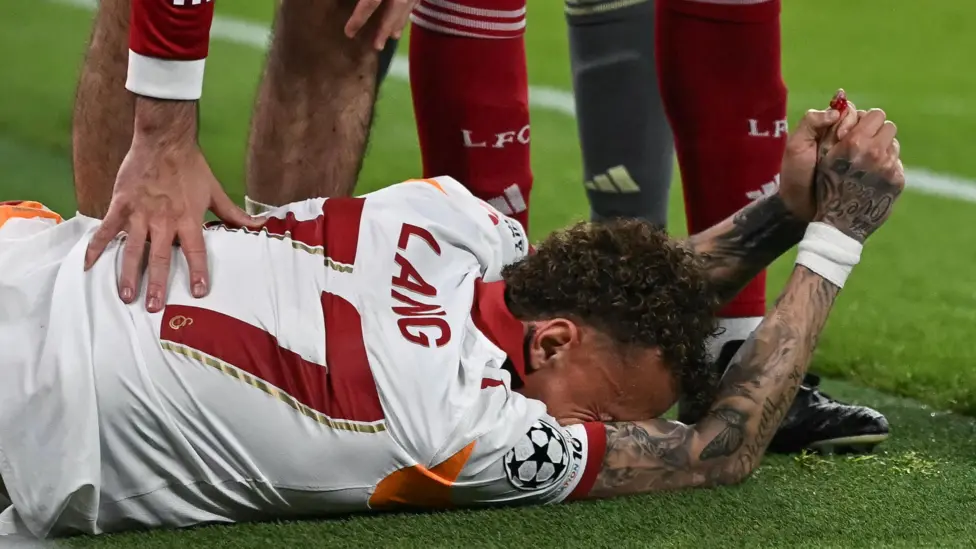
A commanding European night for Liverpool FC in the UEFA Champions League was ultimately eclipsed by a moment of misfortune that no one inside Anfield saw coming.
For Galatasaray S.K. and their winger Noa Lang, the evening turned from a high-stakes knockout clash into a distressing episode defined by a freak and painful injury.
A Sudden Turn: When Routine Became Serious
It happened in an instant. While chasing play near the touchline, Lang collided with the advertising hoardings—something players do countless times without consequence. But this time, the impact resulted in a deep and severe cut to his thumb, immediately alarming those nearby.
There was no delay in reaction. Teammates signalled frantically to the bench as medical staff rushed on. The usual roar of Anfield gave way to an uneasy hush, as it became clear this was no ordinary knock.
The Injury: Rare, Painful, and Urgent
What made the incident particularly unsettling was its nature. Unlike muscle pulls or ligament damage, Lang’s injury was a serious laceration, severe enough to require urgent surgical intervention.
He was treated on the pitch for several minutes before being stretchered off and taken straight to hospital. The decision for surgery followed quickly, underlining the extent of the damage.
In a sport where physical contact is constant, such injuries remain rare—making the moment even more shocking for players and spectators alike.
Game Takes a Backseat
While Liverpool progressed comfortably on the scoreboard, the result quickly became secondary. The focus shifted to Lang’s condition, with concern replacing competition.
For Galatasaray, the defeat was compounded by uncertainty. A hand injury, particularly one involving surgery, can have lingering effects—not just physically, but in terms of a player’s rhythm and confidence on return.
A Stark Reminder
Football is often defined by goals, tactics, and moments of brilliance. But nights like this serve as a reminder of its unpredictability.
Lang’s injury wasn’t born out of a reckless challenge or a heated duel—it came from the margins of the pitch, in a moment that seemed routine until it wasn’t.
And long after the final whistle, it is that moment—not the goals—that continues to define the night at Anfield.


















Discussion about this post