China to Host Second Humanoid Robot Half-Marathon After Historic First-Ever Race Beijing Plans April 2026 Event With Stricter Tech Rules and Autonomous Categories
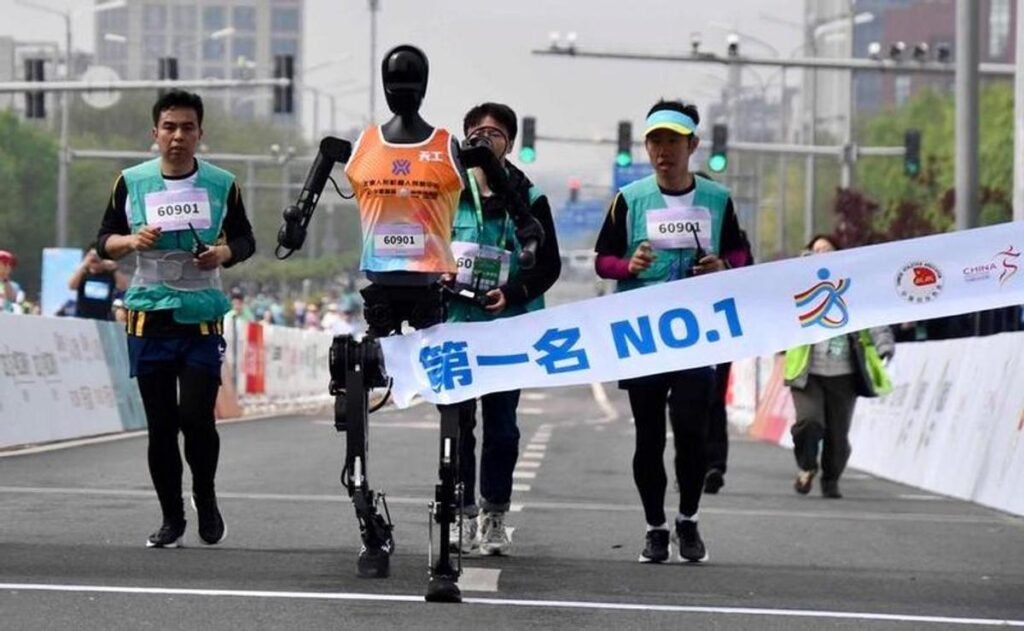
Beijing: After capturing global attention with the world’s first humanoid robot half-marathon, China is set to take the concept a step further by hosting a second edition in April 2026, aiming to push the boundaries of robotics, artificial intelligence and endurance engineering.
The upcoming race will once again see humanoid robots running alongside human athletes on a regulation 21.1-kilometre half-marathon course. While both humans and robots will follow the same route, dedicated lanes and safety barriers will be maintained to ensure smooth conduct of the event.
New Rules to Test True Robotic Independence
Organisers have confirmed that the 2026 edition will introduce stricter competition guidelines, focusing on autonomy, balance, energy efficiency and perception. Unlike the inaugural race, the next marathon will feature separate categories for fully autonomous robots and remotely assisted models, encouraging teams to reduce human intervention.
Special awards such as Best Endurance, Best Gait, Best Design and Best Perception will be introduced to recognise technological breakthroughs in humanoid locomotion and decision-making.
Lessons From the 2025 Milestone Race
The first humanoid robot half-marathon, held in April 2025, marked a turning point in robotics experimentation. Over 20 humanoid robots took part alongside thousands of human runners, making it the first event of its kind anywhere in the world.
While the spectacle drew massive interest, the race also exposed technological limitations. Only a handful of robots managed to complete the full distance, with most struggling due to battery drain, balance issues and overheating. The fastest humanoid robot completed the course in over two and a half hours, well behind elite human runners.
Beyond the Marathon: China’s Robotics Push
The marathon forms part of a broader push to advance humanoid robotics beyond laboratory environments. Recent demonstrations have shown robots achieving longer continuous walking distances and participating in multi-sport competitions, underlining rapid progress in mechanical endurance and AI-driven movement.
Officials and engineers view such events not merely as sporting showcases but as real-world stress tests, helping accelerate the deployment of humanoid robots in industrial, service and public-space roles.
Latest Update
With preparations underway for the April 2026 race, robotics firms and research teams are expected to unveil more refined, energy-efficient and autonomous humanoid designs. The next marathon is likely to serve as a global benchmark, measuring how close humanoid robots are to matching human-like endurance and adaptability