ATP’s Extreme Heat Rule Finally Becomes Reality After Years of Warning Signs
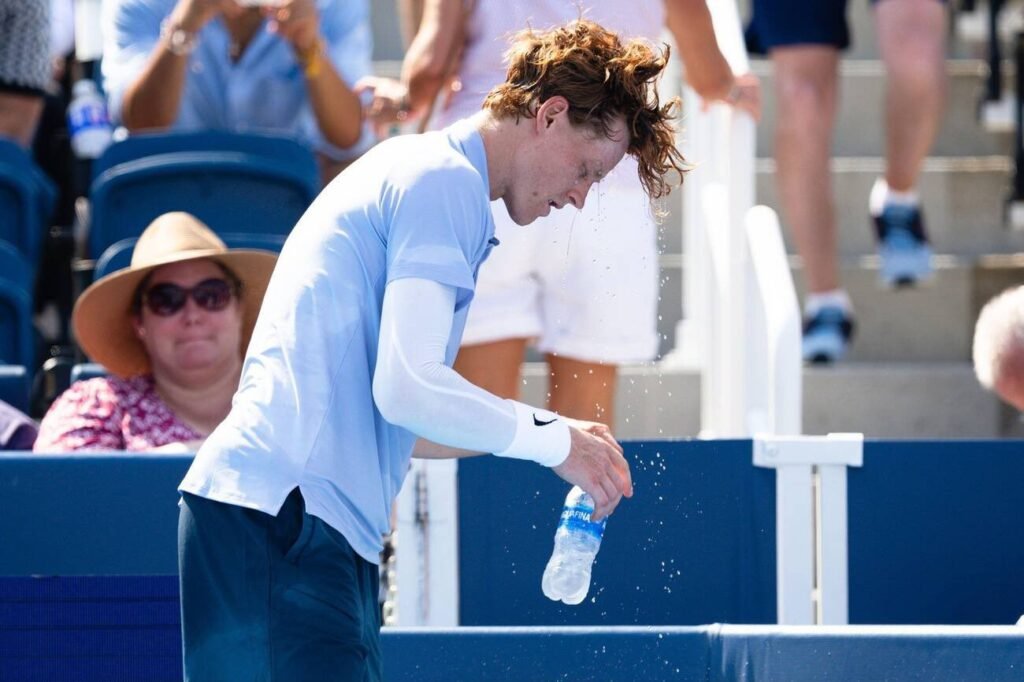
The ATP Tour’s decision to introduce a formal extreme heat policy from the 2026 season has been widely welcomed across the tennis world, ending years of debate and mounting concern over player safety. What was once viewed as an eventual necessity has now become official, following repeated episodes of players struggling, collapsing or retiring in punishing weather conditions.
For a long time, the spate of retirements, visible distress among leading stars and growing pressure from players had made it clear that the issue was no longer about if a rule change would happen, but when. The 2025 season only accelerated that inevitability.
The clearest warning came during the Shanghai Masters in October, where extreme heat and suffocating humidity pushed players to their physical limits. Defending champion Jannik Sinner was forced to abandon his title defence after severe leg cramps left him barely able to walk in his third-round match against Tallon Griekspoor. Novak Djokovic, a 24-time Grand Slam champion, later described the conditions as “brutal” after vomiting during a hard-fought victory, while Holger Rune openly questioned how much players were expected to endure before play could be halted.
Those scenes were not isolated. Casper Ruud, Tomas Machac, David Goffin, Terence Atmane, Hamad Medjedovic and Wu Yibing all retired mid-match in the opening rounds as temperatures hovered around 30°C and humidity frequently exceeded 80 per cent. The draw was blown wide open, but more importantly, the tournament exposed a system stretched to its limits.
The momentum for change had been building well before Shanghai. In August, Arthur Rinderknech collapsed on court during a match at the Cincinnati Open in similarly extreme conditions, alarming fellow players and medical staff. That incident reinforced a growing belief that leaving heat-related decisions to discretionary, case-by-case judgments was no longer sufficient for a global tour increasingly affected by climate extremes.
Until now, the ATP relied on on-site supervisors, medical teams and local authorities to decide whether play should be suspended due to heat. While safeguards existed, critics argued they lacked consistency and clarity. Behind the scenes, however, the governing body had already begun reviewing its approach, consulting players, tournaments and medical experts — a process that has now resulted in a landmark policy shift.
At the core of the new regulation is the Wet Bulb Globe Temperature (WBGT) index — a more comprehensive measure of heat stress that accounts for humidity, sunlight and wind, rather than relying solely on air temperature. The ATP said this provides a consistent and transparent framework, replacing the previous case-by-case decisions taken by referees and tournament organisers.
Under the new rules, if WBGT readings reach 30.1°C, players competing in best-of-three singles matches will be allowed a 10-minute cooling break after the second set, provided at least one player requests it. The break allows players to hydrate, change clothing, shower briefly and receive coaching under medical supervision.
Should conditions worsen further, with WBGT levels rising above 32.2°C, play will be suspended entirely until conditions become safe again — a measure seen as crucial not just for players, but also for officials, ball persons and spectators exposed to extreme heat.
The policy aligns the ATP more closely with the WTA Tour and Grand Slam events, where heat-stress protocols have been in place for years. It follows growing calls from players and stakeholders for clearer safeguards as global temperatures continue to rise.
From 2026, the regulations will apply across all ATP-sanctioned tournaments worldwide, signalling what many view as a significant and overdue step in prioritising player welfare on the men’s tour.