Why England’s ‘Golden Generation’ Never Lifted a Major Trophy
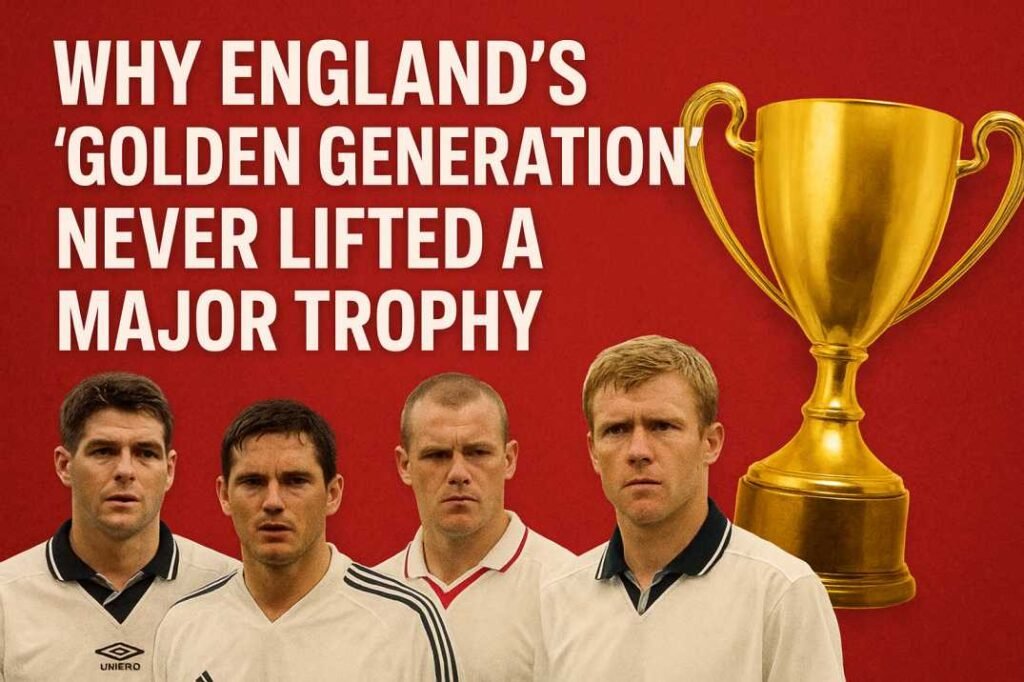
England’s so-called ‘Golden Generation’—Steven Gerrard, Frank Lampard, Wayne Rooney, David Beckham, Paul Scholes, and others—shone brilliantly at club level but repeatedly fell short on the international stage. Despite reaching three consecutive major quarter-finals between 2002 and 2006, the squad never advanced past the last 16 in the 2010 World Cup or qualified for Euro 2008. So, what went wrong?
Club Rivalries and the Ego Factor
Former captain Steven Gerrard has bluntly described the group as “egotistical losers,” reflecting the persistent club cliques that plagued team unity. Rivalries between Manchester United, Chelsea, Liverpool, and Arsenal often outweighed national allegiance.
“We weren’t friendly or connected,” Gerrard told the Rio Ferdinand Presents podcast. “We never at any stage became a really good, strong team.” Lampard added that personal competitiveness often kept players socially separate, even if there was no real animosity.
Yet other nations, like Italy in 2006 and Spain between 2008–2012, overcame similar club rivalries to achieve major success, suggesting that England’s issues ran deeper than personal tensions alone.
Tactical Limitations and Midfield Misfires
Despite a midfield boasting Gerrard, Lampard, and Scholes, England’s rigid 4-4-2 system under Sven-Goran Eriksson, and later Steve McClaren and Fabio Capello, stifled creative potential. Gerrard and Lampard struggled to coexist centrally, while Scholes was often pushed out wide. Former teammates and pundits have suggested alternative formations, such as a 3-5-2, might have unlocked the squad’s full potential.
Even with tactical tweaks, England often faced opposition stacked with world-class talent: Ronaldinho, Ronaldo, Zidane, Vieira, Xavi, and Iniesta were just a few of the stars who outshone England at crucial moments. Former goalkeeper David James emphasizes: “Sometimes other teams are simply better than us. We weren’t good enough, despite having great players.”
Injuries, Pressure, and Off-Field Distractions
Injury woes consistently disrupted England’s campaigns, sidelining key figures at pivotal moments. Meanwhile, the psychological pressures of penalty shootouts and tournament environments compounded the challenge.
Off-field distractions, including media scrutiny of players’ families—the so-called WAG phenomenon—and regimented, isolating training camps, added to the strain. David James recalls the 2010 World Cup in South Africa: “We were in a beautiful hotel, but it was right in the middle of the training facility. We couldn’t escape football.”
Players like Scholes also retired early from international duty to focus on family, highlighting the personal sacrifices required at the highest level.
The Takeaway: Talent Isn’t Everything
England’s Golden Generation reminds us that world-class talent alone does not guarantee international glory. A combination of egos, tactical rigidity, injuries, psychological pressures, and stellar opponents all played a role in their repeated disappointments.
As Gerrard puts it: “The culture within England didn’t allow us to become a truly connected team. That’s the missing piece.”
For football fans, it’s a poignant reminder that team cohesion, strategy, and mental resilience are just as vital as individual brilliance.