Manipur talents behind India U-17 football glory
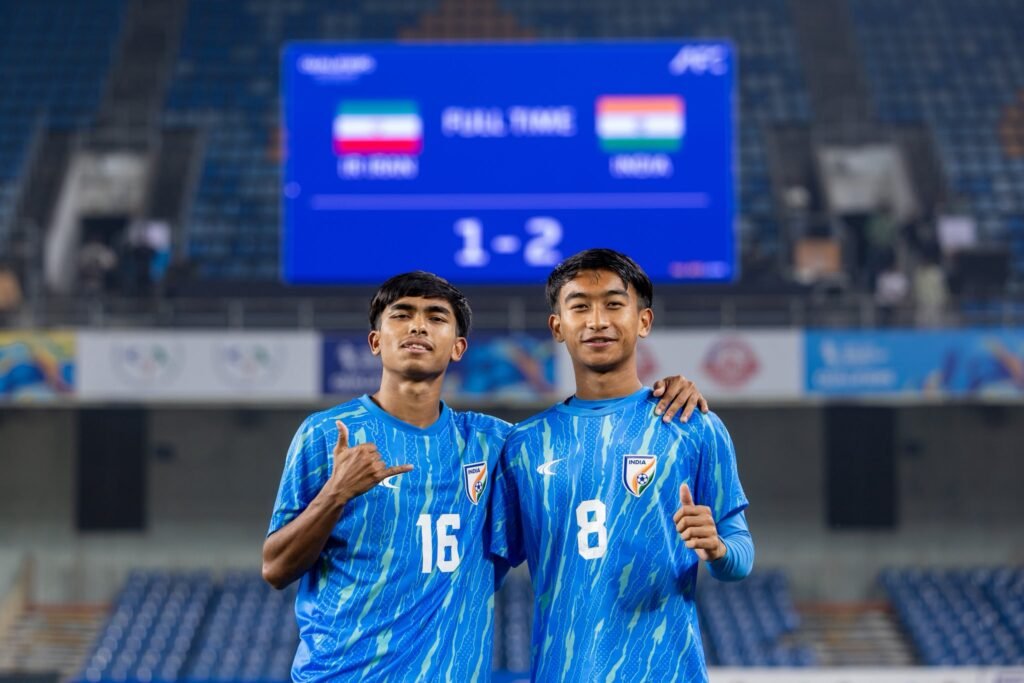
India’s Under-17 football team scripted a landmark moment in national sport on Sunday night, defeating Asian giants Iran 2–1 in their final AFC U-17 Asian Cup 2026 qualifier at the EKA Arena in Ahmedabad to seal their spot in next year’s finals in Saudi Arabia. But beyond the scoreline, the victory carried a deeper significance—both goals came from players hailing from conflict-scarred Manipur, representing communities divided by over two-and-a-half years of unrest.
Iran struck first in the 19th minute, silencing the home crowd. Moments before half-time, Dallalmuon Gangte, a Kuki youngster, converted a penalty to draw India level. In the second half, Gunleiba Wangkheirakpam, a Meitei forward, finished a swift counter-attack to secure a historic 2–1 win and India’s qualification.
For the first time in years, the names Kuki and Meitei shared space in headlines without the weight of violence. On social media, Meitei and Kuki pages celebrated their respective heroes—but also acknowledged something far larger: India’s victory, and hope for Manipur.
“We hope this unity in sport brings peace to Manipur soon,” wrote the Meitei Heritage Society on X, celebrating the moment.
The AIFF’s 23-member squad includes nine players from Manipur—seven Meitei and two Kuki—further reinforcing the state’s unmatched contribution to Indian football. This marks just the third time in 20 years that India has qualified for the AFC U-17 Asian Cup finals. A top-four finish in Saudi Arabia could open the door to a dream: qualification for the 2027 FIFA U-17 World Cup in Qatar.
Football returns to a wounded state
Since ethnic clashes erupted in May 2023, Manipur has remained divided by buffer zones policed by central forces. Over 58,000 displaced residents still live in 351 relief camps. Travel between the hills and valley is nearly impossible; development remains uncertain despite recent government packages; and life in the camps continues under extreme hardship.
Yet there is one activity that does not need permissions, barricades or negotiations: football.
Barefoot children play inside cramped relief camp courtyards. Grounds in Imphal, once abandoned, now host matches again. Community leaders say anger has given way to exhaustion—a desire to return to normal life. In that fragile space, football has offered release, distraction and hope.
Players from both communities have trained together since August at the India U-17 national camp in Goa. Thousands of kilometres away from home, they shared jerseys, rooms, meals—and a purpose.
On Sunday night, a Meitei pass found a Kuki forward, and India scored. For 90 minutes, identity lines vanished.
A hill district rising as a talent hub
Beyond the spotlight, Manipur’s Senapati district is quietly emerging as a powerhouse of young football talent. Improved training facilities, government-installed synthetic turfs, grassroots coaching and NGO support are helping shape future stars.
Players such as Yuno Richard, who trains twice daily, and youngsters like Lnkunang Keimai, inspired by Cristiano Ronaldo, represent a generation that sees football not as leisure—but as a pathway to opportunity and national pride. Coaches say the region holds immense potential across multiple sports.
A victory larger than sport
Two teenagers from Manipur—one Kuki and one Meitei—scored the goals that sent India to the Asian Cup. In a state where over 3,000 looted firearms remain unrecovered, where trauma and displacement remain daily realities, and where peace has felt distant, this match delivered something precious: a moment when unity felt possible.
For Manipur, football has always been more than a game. On Sunday night, it became a bridge.
For 90 minutes, divisions fell silent. India won. Hope scored.