Verstappen’s Multi-Series Challenge, Antonelli’s Rise and the Changing Face of Formula 1

Max Verstappen’s recent venture outside Formula 1 into endurance racing has reignited discussions about how modern F1 drivers engage with global motorsport. Alongside that high-profile appearance, questions about Mercedes’ management of rising star Kimi Antonelli, the potential return of V8 engines and how driver size affects performance have grabbed attention as the sport evolves in 2026.
Verstappen and the Allure of Other Disciplines
Verstappen’s participation in the Nürburgring 24 Hours — where his team led before a driveshaft failure — was a rare sight in the current F1 era and raised eyebrows across the paddock. Historically, few active F1 drivers pursue serious competition in other racing categories during the season. Only the likes of Fernando Alonso in the past, who competed in the Indianapolis 500 and the World Endurance Championship while still contracted to F1, or Nico Hülkenberg at the 24 Hours of Le Mans, have followed similar paths in recent decades. The rarity stems largely from standard contracts that restrict outside racing to limit injury risk and scheduling conflicts. Verstappen’s dominance and bargaining power with Red Bull have given him a unique exception to that norm, reflecting both his stature and a desire to diversify his motorsport engagement.
The Mercedes Project: Antonelli’s First Full Season
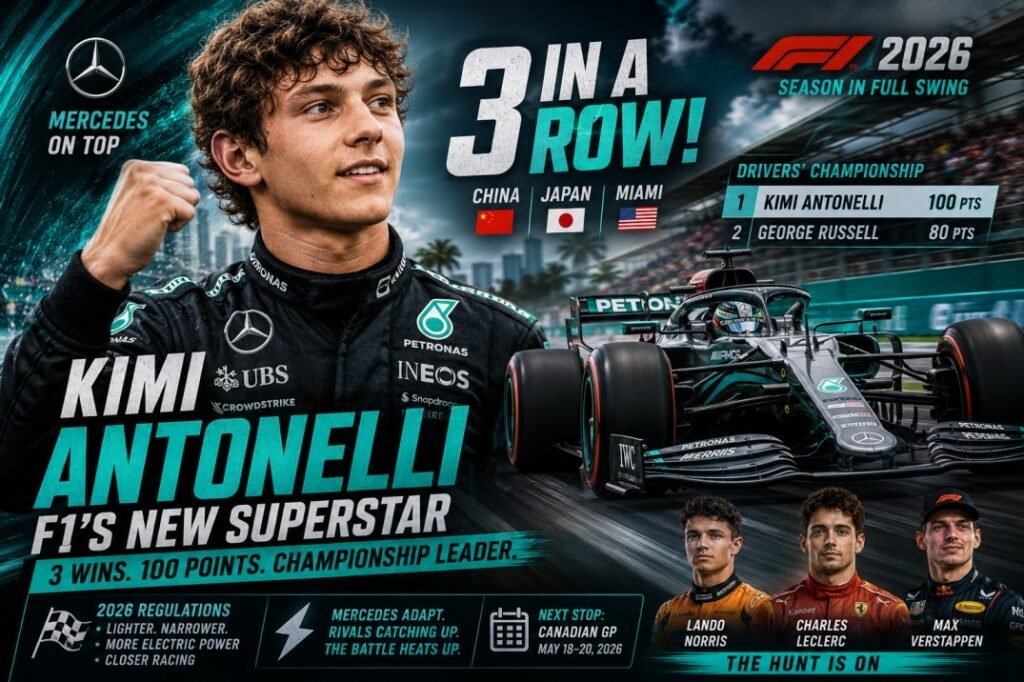
Kimi Antonelli’s performance with Mercedes this season has been among the standout narratives of the championship. The 19-year-old has translated early promise into strong results, including multiple race victories and a growing points lead in the drivers’ standings. His rise has been underpinned by an experienced support structure, including veteran race engineer Pete Bonnington, whose previous work with figures such as Lewis Hamilton has been credited with bringing discipline and insight to the rookie’s campaign.
Toto Wolff, Mercedes’ team principal, has emphasized balancing confidence with pressure management as Antonelli continues to mature. That approach appears validated as the Italian consistently battles at the front amid stiffer competition and strategic complexity.
V8 Engines and the Nostalgia Debate
Debate over engine regulations remains central to F1’s identity and listening to fan and driver sentiment underscores contrasting views on the current hybrid era. Critics of the existing power units often point back to the naturally aspirated V8 period for its raw sound and perceived simplicity. While this older era had its competitive highlights — such as multiple winners and close title fights — it was also marked by phases of one-team dominance, particularly later in the 2010-13 cycle. Ultimately, discussions about engine formats involve broader topics such as costs, relevance to road-car technology and entertainment value.
Height, Weight and Performance Equity
Modern F1 regulations have evolved to mitigate performance advantages based on driver physique. Current minimum car weight rules include the driver, removing much of the historic disadvantage heavier drivers faced. In earlier eras, significant weight differences could cost measurable lap time, but today the emphasis on equity largely neutralizes that effect. Still, physical dimensions can influence cockpit packaging and aerodynamic flow, meaning taller drivers occasionally confront unique challenges that engineers must manage efficiently.
Formula 1 in 2026 is defining itself not just through on-track competition but through how drivers engage with the sport and broader motorsport culture. Verstappen’s endurance outing, Antonelli’s rapid development, the enduring engine debate and refined technical regulations all contribute to a season where tradition and progress intersect in compelling ways.