AI Umpires Have Arrived: How MLB’s ABS Challenge System is Revolutionizing Officiating in 2026
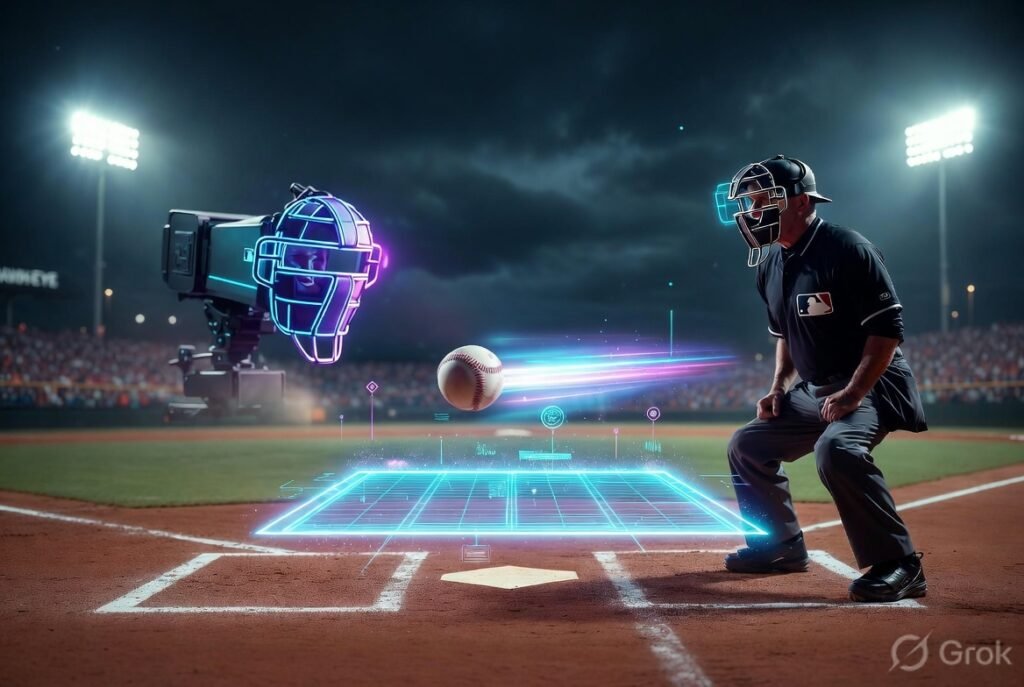
Major League Baseball has taken one of its boldest technological leaps in decades with the official rollout of the Automated Ball-Strike (ABS) Challenge System for the 2026 season. Powered by T-Mobile’s 5G network and Hawk-Eye technology, the system allows players to challenge ball and strike calls in real time while keeping human umpires at the center of the action.
This hybrid model represents a middle ground between full automation and traditional officiating, addressing long-standing complaints about inconsistent strike zones without completely removing the human element.
How the ABS Challenge System Works
Each MLB ballpark uses 12 Hawk-Eye cameras to track every pitch with remarkable precision — accurate to within one-sixth of an inch. The system creates a personalized strike zone for every batter based on their height: the top of the zone sits at 53.5% of the player’s measured height (without cleats), and the bottom at 27%.
Key Rules:
- Each team starts with two challenges per game.
- Only the batter, pitcher, or catcher can initiate a challenge by tapping their helmet immediately after the pitch.
- No input from dugouts or other players is allowed.
- Successful challenges are retained; failed ones are lost.
- Results appear on stadium videoboards and TV broadcasts within seconds.
Early Performance: Accuracy and Success Rates
In the opening weeks of the 2026 season, teams achieved an overall challenge success rate of approximately 53-61%, with fielders (primarily catchers) performing significantly better than batters. Catchers have overturned calls at rates around 59-64%, while batters hover near 46-47%.
This data highlights two important points:
- Human umpires remain highly accurate on most calls.
- The system is successfully correcting meaningful borderline pitches that previously decided games.
Impact on Strategy, Psychology, and Performance
The ABS system has introduced fascinating new dynamics:
- Pitcher-Batter Psychology: Pitchers can attack the edges more confidently, knowing a precise zone exists. Batters, aware of the consistent zone, are showing improved discipline — swinging less at borderline pitches. Early trends show rising walk and strikeout rates, along with a slight dip in batting averages.
- Game Management: Teams are becoming far more situationally aware. Challenges are now treated as a precious resource, often saved for high-leverage at-bats. Dugouts are noticeably quieter, as players have a direct recourse instead of arguing with umpires.
- Pace of Play: Challenges add roughly 15 seconds each but have not significantly slowed games. Many analysts argue the system ultimately improves flow by reducing prolonged arguments.
Science and Technology Behind the System
Hawk-Eye technology, long trusted in tennis and cricket, has been enhanced with Statcast integration. Upgraded cameras capture ball movement at 300 frames per second, delivering reliable 3D tracking. The system’s precision is helping standardize what was previously a subjective zone, potentially leading to fairer competition across different umpiring crews.
Potential for Adoption in Other Sports
The success of MLB’s hybrid model could influence other bat-and-ball or racket sports. In cricket, it could refine DRS (Decision Review System) for lbw decisions. Indian sports like kabaddi or field hockey might explore similar AI-assisted officiating for subjective calls. Even tennis, which already uses Hawk-Eye, could evolve toward challenge-limited systems for line calls.
For sports science professionals in India, this development offers valuable lessons in biomechanical tracking, decision-making under pressure, and technology-assisted performance optimization.
The Road Ahead
While debates continue — some purists miss the “human element,” while others want full automation — early feedback has been largely positive. The ABS Challenge System is proving that technology and tradition can coexist, making the game fairer and more strategic.
As the 2026 season progresses, teams that best master the psychology and timing of challenges may gain a crucial competitive edge.