

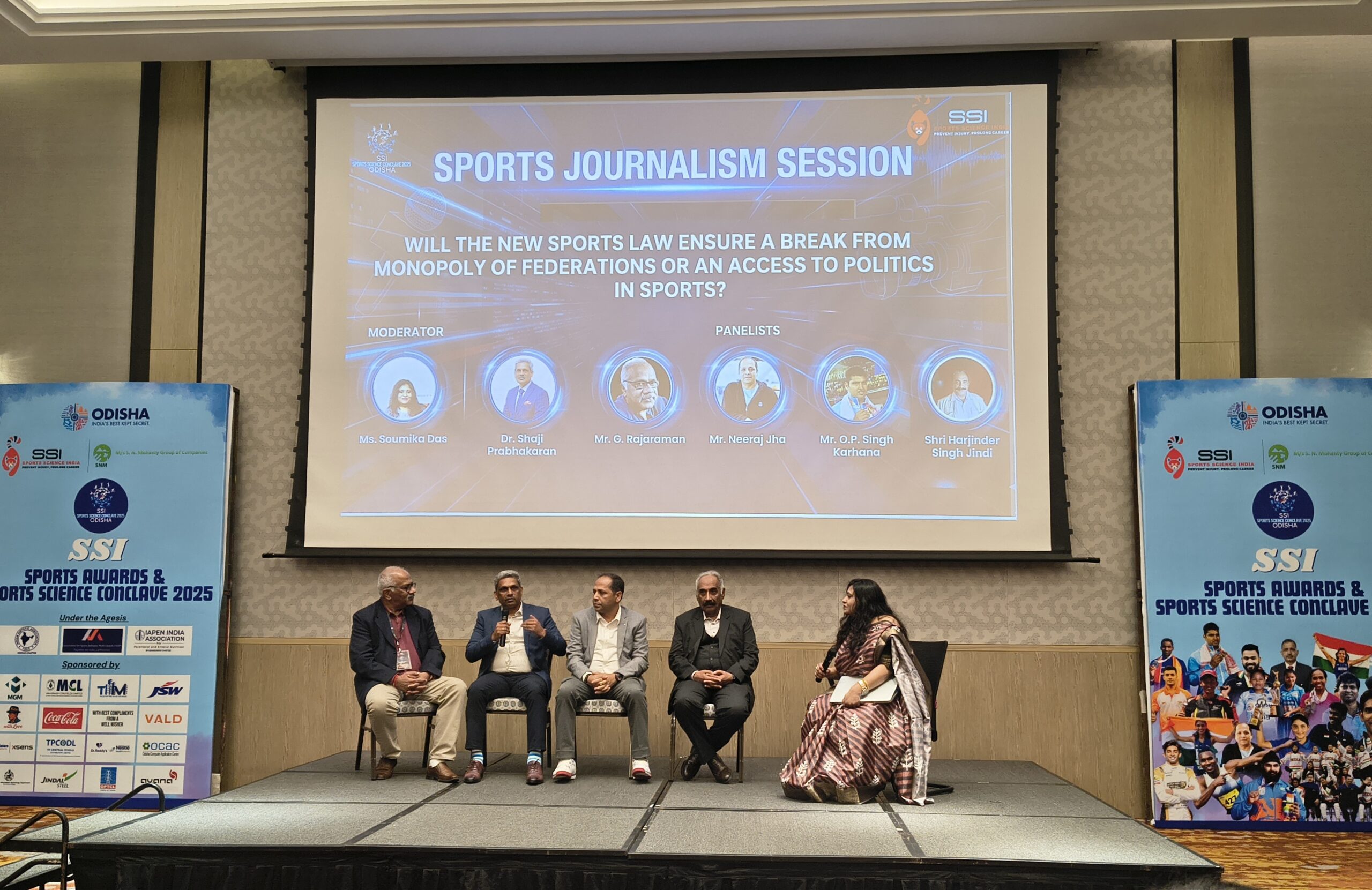
As India sharpens its ambition to host the 2036 Olympic Games, the spotlight is no longer only on medals, infrastructure, or athletes — it is firmly on governance. At the SSI Sports Science Conclave 2025, a gripping Sports Journalism Session put the proposed National Sports Governance Act, 2025 under the microscope, asking one fundamental question:
Is this law a long-awaited reform to end monopolies and bring transparency — or will it open the doors wider to political control in sport?
What followed was an unfiltered, nuanced, and at times uncomfortable conversation on power, accountability, money, athletes’ rights, and the future of Indian sport.
Why Now? The Olympic Dream Demands Clean Governance
Setting the tone, the moderator framed the core concern:
With India eyeing the Commonwealth Games and preparing seriously for a bid to host the 2036 Olympics, was this the right moment for a sweeping sports law?
The argument was clear — global sporting ambition requires transparent systems, professional administration, and legal accountability. Without governance reform, infrastructure and talent alone cannot deliver Olympic success.
“This Law Was Needed Years Ago”
Veteran sports journalist G Rajaraman made it clear that the law is not premature — it is long overdue.
He highlighted that:
• Over 300 sports-related legal cases are pending
• Since 1975, Indian sports has functioned largely through guidelines and restrictions
• Until now, there was no formal Act passed by Parliament
“Today, for the first time, we have a formal National Sports Governance structure in the making. That itself is a historic shift.”
For him, regulation was no longer optional — it had become unavoidable.
From ‘Sports Code’ to ‘Sports Law’: A Historic First
Indian football administrator Dr Shaji Prabhakaran brought critical legal clarity to the debate.
“Till now, India never had a sports law. We only had a sports code — and that too was never passed by Parliament.”
Calling the new Act historic, he said its biggest promise lies in uniformity:
• Every sport will now follow a similar governance structure
• This can potentially reduce disruption, legal disputes, and arbitrary functioning
However, he added a sharp reality check:
“Whether it will truly transform Indian sport, only time will tell. Laws don’t define character — people and their ethics do.”
He also noted that across the world, governments use sport to send a message of development to the masses — and India is unlikely to be any different.
The Real Test: Independence and Implementation
While the intent of the law drew cautious optimism, Neeraj Jha, Head of Sports at Warner Bros. Discovery, placed the spotlight where it mattered most — implementation.
His chief concern:
• How independent will the new system truly be?
• If the governing board is shaped by government representatives, every change in power could mean a shift in control
• Federations could suddenly find themselves operating under a central authority
“Implementation is the real challenge. If the government dictates everything, then it also has to live up to that responsibility.”
He also pointed to major structural shifts:
• Separate federations for each sport could improve clarity
• Women’s representation is likely to improve
• Even powerful bodies like the BCCI will fall under this law, creating an unprecedented shift in Indian sport
Yet, he emphasized:
“Money is only one part. Sport ultimately runs on people — and people like Jindi who build systems from the ground up.”
Politics, Doping & the IOC Red Flag
The sharpest warning came from Harjinder Singh Jindi, General Secretary of the Ice Hockey Association of India.
While he acknowledged the good intent of the law, he flagged three dangerous fault lines:
• Political interference
• India’s worsening doping crisis
• Possible backlash from the International Olympic Committee (IOC) over governance interference
He revealed how:
• In past elections, nominations were allegedly withdrawn under pressure
• Out of 15 planned sports body elections, only four actually took place
“If we expect transparency from federations, the government must also be transparent.”
When a Bronze Medal Gets No Applause
In one of the most emotional moments of the session, Jindi spoke about Indian women’s ice hockey:
“When our women won bronze at the Asia Cup, there wasn’t even a congratulatory social media post.”
The lack of recognition, he said, directly affects:
• Funding
• Visibility
• Player morale
• Growth of the sport
He stressed that the new law must not remain limited to governance alone — it must actively push:
• Faculty development
• Facility development
• Grassroots expansion
“If you calculate districts and real sporting needs, the budget will shoot into billions. The question is — how will this really be implemented?”
Can the National Board End Conflicts?
When asked whether the proposed National Sports Board can truly resolve contradictions and disputes, Rajaraman offered a philosophical answer:
“When Pandora’s box was opened, the last thing that came out was hope.”
Yes, challenges are many. But if the system is:
• Fair
• Transparent
• Professionally run
— then even a fractured ecosystem can begin to heal.
Cricket vs the Rest: The Unequal Marketplace
Rajaraman also exposed the deep financial imbalance in Indian sport:
• Cricket is self-sustaining
• Ice hockey survives on infrastructure built in a few states
• Most Olympic sports depend on government support
“If someone like Jindi wants to grow his sport, where does he go? To the government. And once money comes in, influence also follows.”
That dependency is where fears of political control grow stronger.
Will the New Tribunal Solve Legal Chaos?
On the question of a separate sports tribunal, Jindi summed up the frustration perfectly:
“A sports secretary once asked — should we spend our time developing sport or only fighting court cases?”
With different courts giving different rulings, he believes a tribunal can:
• Speed up justice
• Reduce contradictions
• Free federations from endless litigation
But he also reminded:
“Players are not always innocent either. Federations are blamed for everything — but success has many fathers, and failure has none.”
Citing Neeraj Chopra, he added pointedly:
“Today everyone claims credit, but it was the federation that stood behind that journey.”
The Final Word: Law Alone Will Not Win India Gold
As the discussion drew to a close, the moderator underlined the core truth:
• Law alone will not build champions
• Infrastructure must modernise
• Athlete safety, dignity, fitness, and well-being must become non-negotiable
• Sporting systems must treat athletes not as tools — but as national assets
The message was clear:
India’s Olympic dream will not be secured only by legislation — but by how honestly, independently, and efficiently that law is implemented on the ground.
Conclusion: A Turning Point for Indian Sport
The Sports Journalism Session at the SSI Sports Science Conclave 2025 made one thing undeniable — Indian sport stands at a historic governance crossroads.
The National Sports Governance Act, 2025 can either:
• Break long-standing monopolies
• Clean up opaque power structures
• Strengthen athlete protection
Or
• Deepen political control
• Trigger international backlash
• Create new conflicts instead of resolving old ones
The difference will be decided by implementation, integrity, and intent.
India’s road to Olympic gold does not begin on the podium — it begins in how fearlessly it reforms its sporting foundations today.









Discussion about this post