FIFA’s New Red Card Rule Explained: What Is the Prestianni Law?
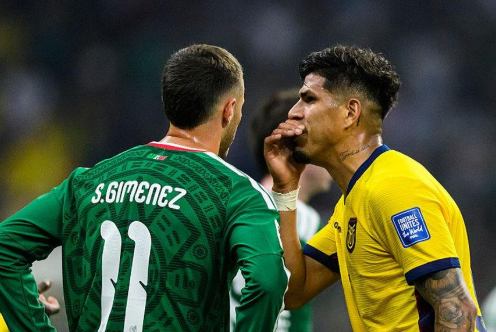
The 2026 FIFA World Cup has introduced one of the tournament’s most debated rule changes, with referees handing out straight red cards to players who cover their mouths while confronting opponents. The regulation, popularly known as the ‘Prestianni Law’, is aimed at increasing transparency and curbing abusive, discriminatory and offensive language on the pitch.
Why is it called the ‘Prestianni Law’?
The rule traces its origins to an incident earlier this year involving Benfica winger Gianluca Prestianni, who was accused of directing abusive remarks at Vinícius Júnior during a UEFA Champions League clash. During the altercation, Prestianni covered his mouth, making it difficult for cameras and match officials to verify what was said.
The controversy prompted FIFA President Gianni Infantino to push for stricter regulations. Football’s law-making body, the International Football Association Board (IFAB), subsequently approved a provision allowing competitions to issue a straight red card when a player deliberately covers their mouth while verbally confronting an opponent.
Strict enforcement at the World Cup
Teams were informed about the new regulation before the tournament, and referees have wasted little time enforcing it.
Paraguay’s Miguel Almirón became the first player dismissed under the new rule after covering his mouth during a heated exchange with Türkiye’s Mert Müldür. Ecuador defender Piero Hincapié later became the second player to receive a straight red card for the same offence during his team’s Round of 32 defeat to Mexico.
Under the law, the offence results in an immediate sending-off and an automatic one-match suspension, leaving the player’s team to finish the match with 10 men.
FIFA’s objective
FIFA believes the rule will discourage players from attempting to conceal abusive, racist or discriminatory comments during confrontations. By ensuring players’ lips remain visible, match officials and disciplinary panels are expected to have better evidence when reviewing incidents after games.
Not everyone is convinced
While FIFA has embraced the measure, it has divided opinion across football.
Some believe the regulation is an important step toward improving accountability and tackling discriminatory behaviour. Others argue that an automatic red card is too harsh and could be exploited during emotionally charged moments in matches.
UEFA has already indicated that it will not adopt the automatic red-card version of the rule in its own competitions, opting instead for a more flexible approach where referees can judge incidents individually.
With two players already dismissed under the regulation, the ‘Prestianni Law’ has quickly become one of the defining talking points of the 2026 FIFA World Cup, highlighting FIFA’s determination to stamp out abusive conduct while also igniting debate over how far football’s lawmakers should go in policing on-field behaviour.