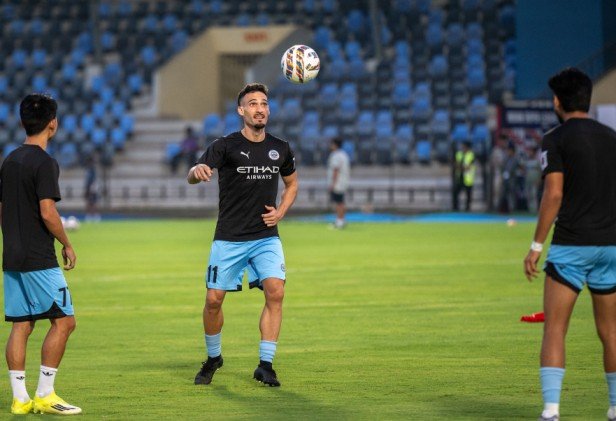
CFG Exit From Mumbai City FC Highlights Indian Football’s Deepening Uncertainty

The decision of City Football Group (CFG) — owners of English Premier League giants Manchester City — to exit Mumbai City FC has become the most visible symbol yet of Indian football’s ongoing crisis, as club football in the country remains stuck in prolonged uncertainty.
CFG, which acquired a 65 per cent stake in Mumbai City FC in 2019, has pulled out of the Indian Super League (ISL) club amid growing concerns over the league’s future. Sources indicate that Mumbai City FC have bought back CFG’s shares, with ownership likely returning to the club’s original Indian promoters, including Bollywood actor Ranbir Kapoor and businessman Bimal Parekh. While the club will continue to function and train as usual, the broader implications of CFG’s departure are far-reaching.
Indian club football has effectively been in limbo, following the expiry of the Master Rights Agreement (MRA) between Football Sports Development Limited (FSDL) and the All India Football Federation (AIFF) on December 8. Since then, repeated meetings, discussions and email exchanges between the federation and clubs have failed to produce a clear roadmap for the league, leaving teams uncertain about formats, schedules and commercial arrangements.
The uncertainty has stalled the ISL this season due to the absence of a confirmed commercial partner, placing clubs under severe financial strain. In an attempt to revive the competition, AIFF has proposed alternative formats for the 2025–26 season, including zonal groupings and a reduced league model aimed at cutting travel and operational costs. However, consensus remains elusive.
CFG’s exit is particularly symbolic because its entry into Indian football six years ago was once seen as a turning point. When the global football conglomerate announced its investment in Mumbai City FC in 2019, it was widely hailed as one of the most positive developments in Indian football history. Mumbai City FC became the only ISL club to be part of an international multi-club network, raising expectations of professionalism, global best practices and continental competitiveness.
On the pitch, the partnership delivered results. Mumbai City FC emerged as one of the most successful clubs in ISL history, winning four major titles, including two League Winners’ Shields and two ISL Cups. Yet, despite sporting success, the instability off the field has proved too significant for even a global investor like CFG to ignore.
The exit has intensified fears that Indian football is losing credibility among international stakeholders. Several clubs are reportedly reassessing their financial commitments, while players and staff remain in uncertainty over contracts and competition timelines. Administrators acknowledge that reviving the league will be a challenge if a workable solution is not found quickly.
While Mumbai City FC’s future appears secure under Indian ownership, CFG’s withdrawal stands as a stark warning. It underlines a reality where on-field achievements cannot compensate for governance gaps, commercial ambiguity and administrative deadlock.
As Indian football searches for stability, the departure of City Football Group may be remembered not merely as a change in ownership, but as a defining moment that exposed the urgent need for structural reform — before more such exits deepen the crisis further.