How Smart Ball Technology Denied Croatia’s Dramatic Equaliser Against Portugal
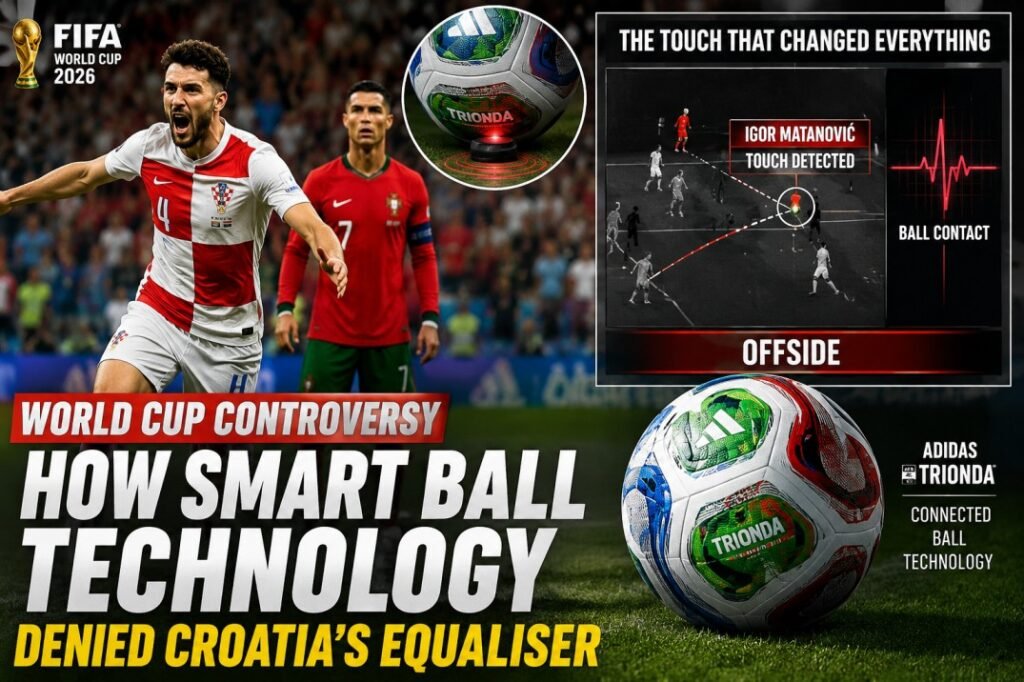
Croatia’s heartbreaking exit from the FIFA World Cup 2026 has put football’s newest officiating technology under the spotlight after a dramatic stoppage-time equaliser against Portugal was ruled out following a VAR review aided by the smart Adidas Trionda match ball.
The controversy unfolded deep into added time when Joško Gvardiol found the net, seemingly sending the Round of 32 clash into extra time. However, after an extended review, officials disallowed the goal for offside. The decisive evidence came from FIFA’s Connected Ball Technology, which detected the slightest touch by Croatia forward Igor Matanović during the build-up. That touch meant teammate Mario Pašalić was in an offside position when he received the ball, invalidating the goal.
The Adidas Trionda ball is fitted with an Inertial Measurement Unit (IMU) sensor that records every contact with the ball hundreds of times per second. The data is synchronised with FIFA’s semi-automated offside system, enabling officials to identify even imperceptible touches that are difficult to spot with conventional video replays. During broadcasts, the sensor’s readings are displayed through a “heartbeat” graphic to illustrate the exact moment of contact.
While FIFA defended the decision as technically correct, the incident has reignited debate over whether ultra-precise technology is improving the game or stripping away its emotional spontaneity. Croatian players and fans were left devastated after seeing what they believed was a dramatic equaliser erased by a touch invisible to the naked eye.
Despite the controversy, Portugal advanced to the Round of 16 with a 2-1 victory, while the incident is likely to remain one of the defining talking points of the 2026 World Cup and a landmark example of technology’s growing influence on football.