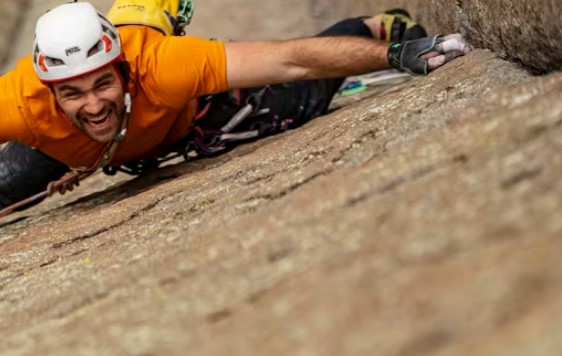
Dangling 500 feet above the Wyoming plains, Jesse Dufton jammed his fingers into the cracks of El Matador, the legendary route on Devil’s Tower. Each move was a leap of faith — not because of the height, but because he can’t see.
Born with cone-rod dystrophy, a degenerative eye condition, Dufton has been legally blind since childhood and now perceives only flashes of light. Yet, with his wife and climbing partner Molly Dufton guiding him through a headset from far below, he made history — becoming the first blind climber to scale the vertical pillar of El Matador.
“I got you. Go on buddy,” Molly’s calm voice echoed through his earpiece as he fought fatigue and fear. For Dufton, every inch upward was a test of trust, touch, and tenacity. “I’m not terrified,” he told CNN Sport. “I’m only stressed when I think I might fall off — or when the gear isn’t good.”
The couple’s climb — documented in Climbing Blind II by BritRock Films — captures a partnership forged in absolute trust. Together, they’ve tackled over 2,000 routes worldwide, from Scotland’s Old Man of Hoy to Morocco’s Lesser Atlas Mountains.
Using a two-way radio system, Molly guides Jesse through terrain he cannot see, describing holds, gear placements, and rest points. “It feels almost normal now,” she says. “But in the beginning, the responsibility was huge.”
For Dufton, climbing is more than sport — it’s defiance. “I don’t want my genetic fate to decide my life,” he says. “If you never take risk, you condemn yourself to missing out.”
Even after “several massive falls,” he calls El Matador “the hardest route I’ve ever attempted.” But quitting isn’t an option for him. His endurance, he says, is his superpower — and his relationship with Molly, his lifeline.
“In climbing, you literally put your life in your partner’s hands,” Dufton says. “The trust is absolute.”
Insight:
Jesse Dufton’s ascent of El Matador is more than a climbing milestone — it’s a metaphor for resilience. By relying on sound, touch, and instinct instead of sight, he’s redrawn the boundaries of what’s possible, reminding the world that vision isn’t defined by eyesight — it’s defined by purpose.
 Sohini Mukherjee
20 Oct 2026 · 8:23 PM IST
3 min read
10 Reads
Sohini Mukherjee
20 Oct 2026 · 8:23 PM IST
3 min read
10 Reads