How British India Ruled the Olympic Turf
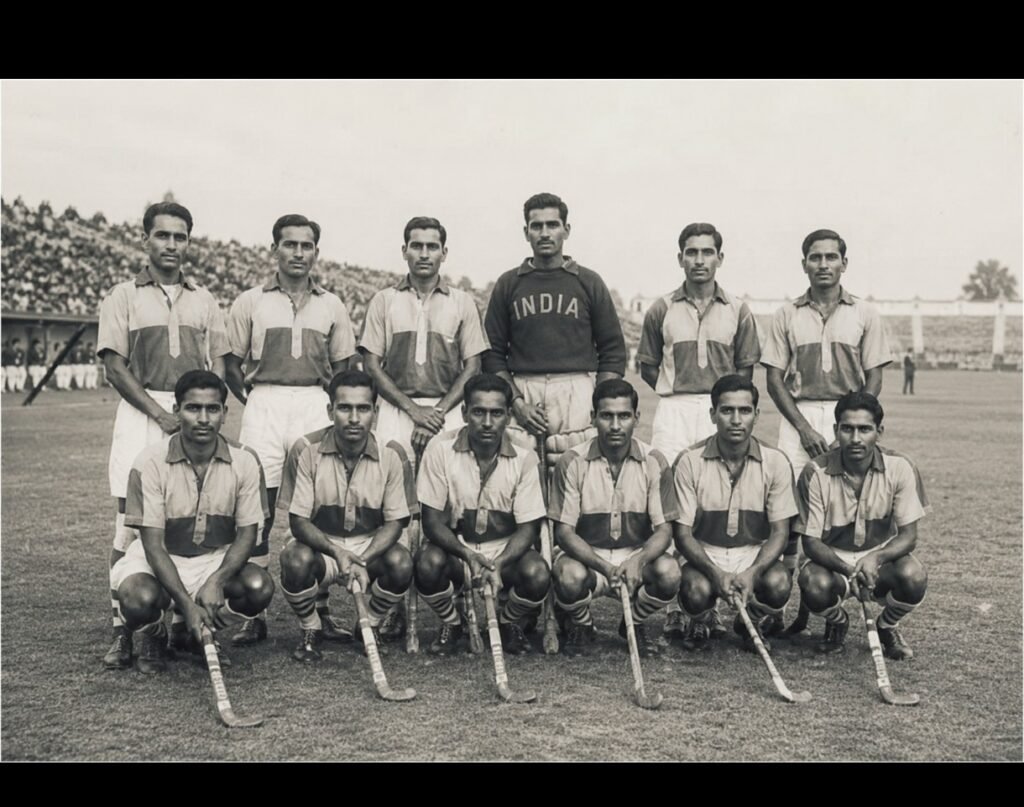
Imagine an India that did not yet have a national flag of its own at the Olympic Games. There was no independent Indian republic, no tricolour flying as the symbol of a sovereign nation, and no national sporting system as we know it today.
Yet, on the hockey field, India was already beating the world.
Between 1928 and 1936, British India won three consecutive Olympic hockey gold medals. The margins were sometimes astonishing: 3–0 against the Netherlands, 24–1 against the United States and 8–1 against Germany. At the centre of this golden era stood a player whose name would eventually become synonymous with Indian hockey — Dhyan Chand.
This was not merely the beginning of India’s Olympic success.
It was the beginning of India’s identity as a sporting power.
A British sport that became India’s own
Hockey did not originate in India. The modern game arrived and spread during the British period, particularly through the British Army and colonial institutions. By the late 19th century, hockey clubs and tournaments were developing in cities such as Calcutta.
But what began as a colonial sport gradually became something much bigger.
Indian players developed a style built around close control, quick passing and intricate dribbling. The sport began attracting players from different communities and regions, creating teams that, in many ways, reflected the diversity of India itself.
By 1925, the foundations of an organised Indian hockey structure were being laid with the formation of the Indian Hockey Federation.
And then came the first international warning.
1926: The world gets its first glimpse
In 1926, an Indian Army hockey team travelled to New Zealand.
It played 21 matches, winning 18, drawing two and losing just one. The team scored 192 goals, with a young Dhyan Chand emerging as its standout player.
Dhyan Chand was not yet the global icon he would become.
But the world was beginning to notice.
The Army connection was important. Dhyan Chand had joined the Army as a teenager, and it was there that his hockey developed. The same institution that had helped spread the game across colonial India was inadvertently helping produce the player who would transform Indian hockey forever.
1928: Amsterdam and India’s first Olympic gold
Hockey returned to the Olympic programme in 1928, and India made its debut.
The result was immediate.
India went through the tournament unbeaten and reached the gold-medal match against hosts the Netherlands. The final ended:
INDIA 3–0 NETHERLANDS
India had its first Olympic gold.
Dhyan Chand scored twice in the final, while his tournament tally reached 14 goals in five matches, making him the leading scorer.
Think about what that meant.
India was still under British rule. Yet an Indian team had travelled to Europe and defeated the host nation in an Olympic final.
There was no independent India to celebrate.
But there was already an Indian sporting identity emerging on the world’s biggest stage.
The team was bigger than one man
It is tempting to tell the entire story through Dhyan Chand.
But the 1928 team was a fascinating representation of India’s sporting diversity.
ESPN’s historical account notes that the Olympic squad included nine Anglo-Indians and four Muslims, underlining how hockey had brought together players from different communities during the freedom struggle.
The team also included captain Jaipal Singh Munda, who was later an important political figure and a member of the Constituent Assembly.
So while India was politically divided by colonial rule and increasingly demanding self-government, the hockey field was producing a different picture — players from different backgrounds playing under one Indian sporting identity.
1932: When 24–1 stopped being a score and became a statement
Four years later, India arrived at the Los Angeles Olympics as defending champions.
The result against the United States was almost unbelievable.
INDIA 24–1 USA
Twenty-four goals.
One conceded.
Dhyan Chand scored eight.
His younger brother Roop Singh scored 10.
That means the two brothers accounted for 18 of India’s 24 goals.
It was not simply another Olympic victory. It demonstrated how far ahead Indian hockey had moved.
And there was another extraordinary story behind the journey.
Travelling to Los Angeles was expensive, and India’s participation faced financial difficulties. Historical Olympic material records that the team travelled with financial support obtained through borrowing. Yet it returned with another gold medal.
From financial uncertainty to Olympic domination — Indian hockey was building a legend.
1936 Berlin: The final chapter of the golden trilogy
Then came Berlin.
The 1936 Olympics were staged in Nazi Germany, with Adolf Hitler’s regime using the Games as a massive propaganda spectacle.
India arrived as two-time Olympic champions.
And this time, Dhyan Chand was the captain.
India moved through the tournament with extraordinary results:
India 4–0 Hungary
India 7–0 USA
India 9–0 Japan
India 10–0 France
Then came the final.
Germany stood between India and a third consecutive Olympic title.
The result?
INDIA 8–1 GERMANY
Dhyan Chand scored three goals.
India had completed the golden hat-trick.
The Indian team scored 38 goals during the Berlin tournament and conceded only one.
And the man leading them was now much more than a talented hockey player.
Dhyan Chand had become India’s first genuine sporting superstar.
The Hitler story — legend versus fact
Few stories from Indian hockey have travelled as far as the supposed meeting between Dhyan Chand and Adolf Hitler.
The popular version says Hitler was so impressed by Dhyan Chand’s hockey that he offered him a position in the German Army.
It makes for a spectacular story.
But it is not supported by reliable historical evidence.
The Indian Express, drawing on researchers and historical accounts, notes that Dhyan Chand never actually met Hitler personally, and the alleged offer of a German Army position is considered an urban myth.
For a historical sports story, that distinction matters.
The truth is already extraordinary enough.
India defeated Germany 8–1 in Berlin, in front of the world, and Dhyan Chand scored three times.
No myth is needed.
A magician with a hockey stick
Dhyan Chand’s reputation eventually became almost mythical.
His control, dribbling and passing were so extraordinary that stories emerged about opponents checking his stick to see whether a magnet was hidden inside it.
That story too is difficult to verify and is generally treated as folklore. �
Indian Express
But the numbers are real.
Across his three Olympic campaigns, Dhyan Chand helped India win:
1928 — Gold
1932 — Gold
1936 — Gold
He played 12 Olympic matches and scored 33 goals, according to the Indian Express’s historical account.
Olympedia also records his extraordinary individual performances, including his eight-goal haul against the USA in 1932 and his three goals against Germany in the 1936 final.
The most remarkable part? India was still not free
This is where the story becomes bigger than sport.
The three Olympic gold medals came in:
1928 — British India
1932 — British India
1936 — British India
India would gain independence only in 1947.
So these victories belonged to athletes representing a country that did not yet possess political sovereignty.
There is something deeply fascinating about that contradiction.
The political struggle for independence was gathering momentum. Mahatma Gandhi’s movements had shaken British rule. The demand for self-government was growing.
And thousands of kilometres away from India’s political battlefields, Indian hockey players were creating another kind of challenge — one measured not in speeches or protests, but in goals.
They were showing the world that India could compete.
And win.
Then came 1948: Gold under the Tricolour
The symbolism became complete one year after Independence.
At the 1948 London Olympics, independent India entered the Games under its own national identity.
And who stood in its way in the final?
Great Britain.
India won 4–0.
This time, the gold medal was not won by British India.
It was won by independent India.
The hockey stick had travelled from the colonial era into the age of the republic.
The numbers that tell the story
3 — consecutive Olympic gold medals before Independence
1928 — India’s Olympic debut in hockey
14 — Dhyan Chand’s goals at the 1928 Olympics
24–1 — India’s famous victory over USA in 1932
8 — Dhyan Chand’s goals in that match
10 — Roop Singh’s goals against USA
8–1 — India’s 1936 final victory over Germany
3 — Dhyan Chand’s goals in the 1936 final
33 — Dhyan Chand’s Olympic goals across 12 matches
4–0 — India’s 1948 victory over Great Britain in the final
Before the Tricolour, there was the hockey stick
Indian hockey’s pre-Independence story is often reduced to one name: Dhyan Chand.
But the story is bigger.
It is about Jaipal Singh Munda, Roop Singh, Richard Allen, Michael Rocque, Lal Shah Bokhari, and many other players who helped build an Indian hockey tradition before the country became a republic.
It is about a sport that travelled into India through colonial institutions but eventually became a vehicle for Indian excellence.
It is about a team that crossed oceans when travelling internationally was expensive and difficult.
It is about three Olympic finals won before Independence.
And above all, it is about a generation of Indian players who walked onto international fields carrying the name India — even when India itself had not yet become the country it would eventually be.
The tricolour would come later.
The hockey stick arrived first.
And long before India became politically free, Indian hockey had already taught the world how difficult it was to defeat India.