One Day. Three Medals. One Olympic Story.
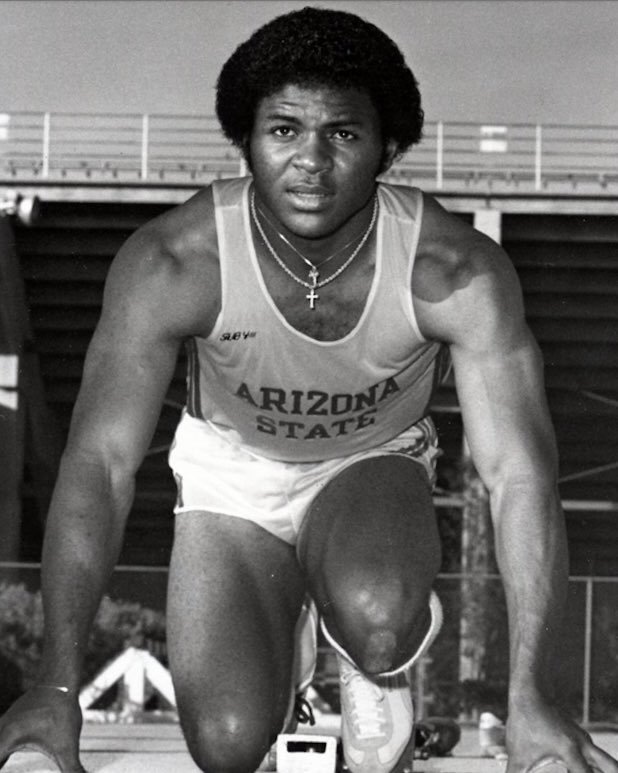
There are Olympic moments that are remembered because of the medal.
Then there are moments remembered because of the way the medal was won.
And sometimes, an entire day manages to produce both.
August 11, 1984, was one such day.
At the Los Angeles Olympics, the world’s finest athletes were competing under enormous pressure, knowing that a single race, a single exchange or even a single throw could define their place in sporting history.
On that day, three athletes connected to Arizona State University — Ron Brown, Ria Stalman and Leslie Deniz — became part of a remarkable Olympic chapter.By the end of it, they had collected two gold medals and one silver.But the medal tally only tells half the story.The real drama unfolded on the track and inside the throwing circle.
A Fourth-Place Finish Wasn’t the End for Ron Brown
For American sprinter Ron Brown, the Los Angeles Games had already delivered a painful lesson.
He had narrowly missed the individual 100m podium, finishing fourth.
For many athletes, that could have been the end of the Olympic dream.
For Brown, it was simply another opportunity waiting to arrive.
That opportunity came in the men’s 4×100m relay, where Brown joined Sam Graddy, Calvin Smith and Carl Lewis in an American quartet carrying enormous expectations.
The United States was the favourite, but relay races are never won on reputation. They are won through speed, precision and the delicate art of passing the baton without losing momentum.
When Brown received the baton, he delivered.
He covered his second leg in a reported 9.19 seconds, helping put the United States firmly in control before Calvin Smith and Carl Lewis brought the race home.
Then came the number that mattered.
37.83 seconds.
The United States had won Olympic gold — and had done it in world-record time.
The previous world record stood at 37.86 seconds. The American quartet had lowered it by three hundredths of a second.For Brown, the disappointment of fourth place in the individual sprint had been replaced by Olympic gold.For Lewis, it was even more historic. The relay victory gave him his fourth gold medal of the Los Angeles Games, putting him alongside Jesse Owens as one of the athletes to win four athletics golds at a single Olympics.
But while the sprinters were rewriting the record books, another drama was beginning elsewhere in the stadium.
Then Everything Changed in the Discus Circle
The women’s discus final produced a story that was even more dramatic.
Two athletes with Arizona State connections were competing for Olympic glory — Ria Stalman of the Netherlands and Leslie Deniz of the United States.
Stalman started strongly, producing a throw of 64.50 metres to take the early lead.But Deniz refused to let her stay there.
With the competition reaching its decisive stages, the American produced a 64.86m throw in the fifth round.Suddenly, Deniz was in front.The Olympic title appeared to be within her grasp.But there was still one throw left.
One final opportunity.
And Stalman used it perfectly.With the gold medal seemingly slipping away, the Dutch thrower stepped into the circle for her final attempt and launched the discus 65.36 metres.
It was enough.
The lead changed hands again.And this time, the competition was over.Ria Stalman was Olympic champion. Leslie Deniz had won silver.
The margin?
Just 50 centimetres.
That tiny distance separated Olympic gold from silver.
An Arizona State 1–2 on the Olympic StageThe result carried an extraordinary connection.
Stalman and Deniz were both former Arizona State Sun Devils. Now, on the biggest stage in world sport, they had finished first and second in an Olympic final. Arizona State’s historical records identify the result as a landmark moment for its women’s track and field programme.
One represented the Netherlands.The other represented the United States.But their sporting journey had passed through the same university.And on that August day in Los Angeles, they turned that shared connection into a piece of Olympic history.For Deniz, it was a silver medal earned after briefly taking control of the competition.
For Stalman, it was a gold medal secured with her very last throw.That is what makes the moment so memorable.The competition wasn’t decided by a comfortable margin. It wasn’t decided early.It went down to the final attempt.
The Numbers Behind the Historic Day
- The essential figures tell the story in a few lines:
- Ron Brown: Gold, men’s 4×100m relay — 37.83 seconds
- U.S. relay team: World and Olympic record
- Ria Stalman: Gold, women’s discus — 65.36m
- Leslie Deniz: Silver, women’s discus — 64.86m
- Difference between discus gold and silver: 0.50m
- Bronze medallist: Florenţa Crăciunescu of Romania — 63.64m
Three athletes.
Two events.
Two gold medals.
One silver.
And one unforgettable Olympic day.
A Story Worth Remembering From India
This isn’t an Indian Olympic story.
There were no Indian athletes involved, and the medals belonged to athletes representing the United States and the Netherlands.
So why revisit it for an Indian Independence Day special?
Because sporting history does not always have to be about our own flag to teach us something about our own sporting journey.India’s Independence Day is a moment when we look back at how far the country has travelled — and sport is an important part of that journey.For Indian sports fans, stories from Olympic history can offer something more than nostalgia. They show what happens when athletes are given the opportunity, preparation and belief to compete at the highest level.
The lesson from Los Angeles in 1984 is beautifully simple.
A race can change in seconds. A competition can change with one throw. And sometimes, an athlete gets only one final opportunity to change history.Ron Brown had already missed the individual 100m podium.He came back and helped produce a world-record relay.Leslie Deniz found herself in front of an Olympic final with one round remaining.Ria Stalman had one final throw to reclaim the lead.
She took it.
Forty-Two Years Later, the Moment Still SpeaksThe 1984 Olympics are now part of sporting history.The stadium has changed.The athletes have moved into another chapter of their lives.The world of sport has changed beyond recognition.But the basic equation remains the same.Pressure. Opportunity. One moment.
On August 11, 1984, Ron Brown found his moment on the track.
Leslie Deniz found hers in the discus circle.And Ria Stalman found hers when she needed it most — with the Olympic title resting on her final attempt.That is why this isn’t simply a story about three medals.It is a story about what sport does best: turning a few seconds, a few centimetres and a single opportunity into history.And perhaps that is the most fitting thought to carry into an Independence Day celebration — whether the flag is yours or not, the sporting spirit is universal.
One day. Three medals. One Olympic story.