Three Women Under 2:15: How the Chicago Marathon Made Running History
A Chicago Marathon Result That Changed Distance Running
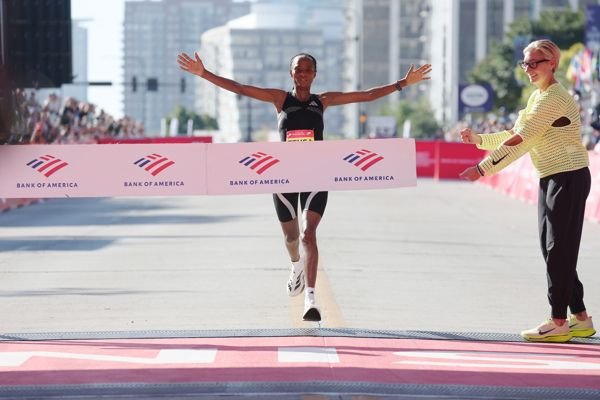
The 2026 Chicago Marathon delivered a remarkable moment in women’s distance running. On October 11, Ethiopia’s Hawi Feysa won in 2:13:33, Kenya’s Sharon Lokedi finished second in 2:14:07, and fellow Kenyan Brigid Kosgei took third in 2:14:55. All three broke the two-hour-and-15-minute barrier, marking a historic achievement in women’s marathon running.
The result was more than a close finish. It highlighted the growing depth of elite women’s marathon competition, with three athletes producing outstanding performances in one of the world’s most prestigious road races.
Hawi Feysa’s Late Surge Seals Back-to-Back Titles
Ethiopia’s Hawi Feysa entered Chicago as the defending champion and delivered another outstanding performance. She crossed the finish line in 2:13:33, improving her personal best by 84 seconds and securing her second consecutive Chicago Marathon victory.
The race was far from easy. Feysa faced sustained pressure from Lokedi through the closing stages, with the pair battling closely before Feysa made her decisive move with roughly a mile remaining.
Her victory strengthened her position among the leading marathon runners in the world and demonstrated her ability to perform under pressure on one of the sport’s fastest courses.
Sharon Lokedi and Brigid Kosgei Complete the Historic Podium
Kenya’s Sharon Lokedi produced an impressive performance, finishing in 2:14:07. The two-time Boston Marathon champion remained in contention deep into the race and challenged Feysa before settling for second place.
Brigid Kosgei, the former women’s marathon world-record holder, finished third in 2:14:55. The Kenyan runner, who won the Chicago Marathon in 2018 and 2019, added another strong performance to her career.
The final results told the story:
1st — Hawi Feysa (Ethiopia): 2:13:33
2nd — Sharon Lokedi (Kenya): 2:14:07
3rd — Brigid Kosgei (Kenya): 2:14:55
Their combined performances established a major milestone for women’s marathon running, with all three athletes finishing below the 2:15 mark in the same race.
The contest began at a demanding pace, with the lead group passing the 5-kilometre mark in 15:36. Feysa and Kosgei were prominent during the early stages, while Lokedi gradually worked her way into contention.
By halfway, the leading runners were still closely grouped. At 30 kilometres, Lokedi was leading Feysa, with Kosgei also in the mix. The battle eventually narrowed to Feysa and Lokedi, who continued to push each other into the final miles.
Feysa’s acceleration in the closing stretch finally broke the contest open. She created a gap that Lokedi could not close, securing the victory and a place in Chicago Marathon history.
What This Means for Women’s Marathon Running
The Chicago result is significant because it demonstrates the depth of competition at the very top of the women’s marathon. This was not one runner producing an isolated performance; three athletes broke the same demanding time barrier in a single race.
Feysa’s personal best, Lokedi’s strong finish and Kosgei’s return to the podium highlight the strength of the international field. Their performances raise expectations for future major marathons and show how competitive the women’s event has become.
The race also underlined the importance of more than early speed. Tactical patience, pacing, endurance and the ability to respond under pressure all played a role in deciding the final result.
A Historic Finish in Chicago
The 2026 Chicago Marathon will be remembered for one extraordinary achievement: three women finishing under 2:15 in a single marathon.
Hawi Feysa claimed the title in 2:13:33, Sharon Lokedi followed in 2:14:07, and Brigid Kosgei completed the podium in 2:14:55. Together, they delivered a landmark moment for women’s distance running and set an exciting benchmark for the next generation of marathoners.