DECODING COUNTER-MOVEMENT JUMP
The Counter-movement Jump (CMJ) is one of the most widely used tests in sports science for assessing lower-body explosive power. It is a simple yet highly effective method that allows coaches, trainers, and sports scientists to evaluate an athlete’s neuromuscular performance and readiness.
Because of its practicality and reliability, the CMJ has become a standard testing method in many professional and amateur sports environments. It provides valuable insights into an athlete’s physical capabilities, particularly in sports where jumping, sprinting, and rapid changes in direction are essential components of performance.
The countermovement jump involves a preparatory downward movement followed immediately by an explosive upward jump. This initial downward motion is known as the countermovement phase and plays a crucial role in enhancing the force production of the jump.
During this phase, the muscles undergo a rapid stretch before contracting powerfully, a process known as the stretch-shortening cycle. This physiological mechanism allows the muscles and tendons to store elastic energy, which is then released during the upward phase of the jump, resulting in greater jump height and power output compared to a jump performed without a preparatory movement.
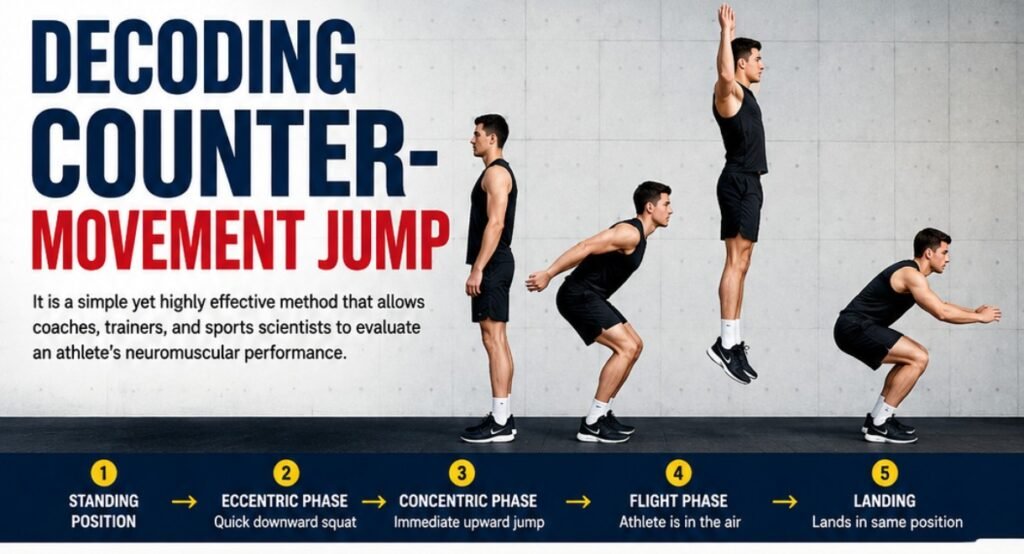
The CMJ typically consists of several distinct phases. The movement begins from an upright standing position, after which the athlete quickly bends at the hips, knees, and ankles to lower their center of mass.
This is followed by an immediate transition into the upward propulsion phase, where the athlete extends the lower limbs explosively to jump vertically.
After take-off, the athlete enters the flight phase, where measurements such as flight time and jump height can be recorded. Finally, the athlete lands back on the ground, ideally maintaining balance and proper posture to ensure safety and consistency in testing.
One of the primary reasons the CMJ is so widely used is its ability to measure multiple aspects of athletic performance. It is particularly effective for assessing explosive strength, which is essential in sports such as basketball, volleyball, football, and rugby.
In addition to measuring power, the CMJ can also provide information about neuromuscular coordination and the athlete’s fatigue levels. For example, a reduction in jump height over time may indicate accumulated fatigue or insufficient recovery, making the CMJ a useful monitoring tool throughout training cycles and competitive seasons.
The test can be performed using a variety of equipment depending on the level of accuracy required. Force platforms are considered the gold standard because they provide detailed data on force production, power output, and movement patterns.
However, simpler and more accessible tools such as contact mats, infrared timing systems, mobile applications, and video analysis software are also commonly used. These tools can still provide reliable measurements of jump height and flight time, making the CMJ accessible even in environments with limited resources.
To ensure accurate and reliable results, it is important that the testing procedure is standardized.
Athletes are usually instructed to keep their hands on their hips if the test is being conducted without arm swing, as this removes the influence of upper-body momentum and allows for better comparison of lower-body power.
In some variations, athletes are allowed to use their arms, which generally results in higher jump heights due to the additional momentum generated.
Regardless of the method used, consistency in technique, rest intervals, and testing conditions is essential to obtain meaningful data.
BASIC MOVEMENT PHASES:
• Standing position • Quick downward squat (eccentric phase) • Immediate upward jump (concentric phase) • Flight phase • Landing
THE TEST MAY BE PERFORMED:
• With arm swing (higher jump height) • Without arm swing (more standardized testing)
The CMJ is also valued for its efficiency and ease of administration. The test requires minimal time to perform and does not cause significant fatigue, meaning it can be incorporated into regular training sessions without negatively affecting performance.
This makes it particularly useful for tracking changes in performance over time. Coaches often use CMJ data to evaluate the effectiveness of strength and conditioning programs, identify performance improvements, and detect early signs of overtraining.
CMJ PERFORMANCE CAN BE MEASURED USING VARIOUS TOOLS:
• Force platforms (gold standard) • Contact mats • Infrared platforms • Accelerometers • High-speed cameras • Video analysis software
Force plates provide the most precise measurements, but simpler tools can still provide reliable data.
TESTING PROCEDURE
A standard CMJ testing protocol includes:
• Athlete stands upright on testing surface. • Athlete performs a quick downward movement. • Athlete jumps vertically as high as possible. • Athlete lands in same position. • Minimum three trials are performed. • Average score is calculated.
Despite its many advantages, the CMJ does have certain limitations. The accuracy of the test can be influenced by factors such as the athlete’s motivation, technique variations, and familiarity with the movement.
In addition, while advanced equipment such as force plates provide detailed data, they can be expensive and may not be available in all training environments.
For this reason, practitioners often use the CMJ alongside other performance tests to gain a more comprehensive understanding of an athlete’s physical condition.
In conclusion, the Countermovement Jump remains one of the most valuable and widely used tools in sports performance testing. Its ability to provide quick, reliable, and meaningful data about lower-body power and neuromuscular function makes it an essential component of modern athletic assessment.
By regularly incorporating CMJ testing into training programs, coaches and sports scientists can better monitor performance, manage fatigue, and optimize athletic development. Its simplicity, combined with its scientific validity, ensures that it will continue to play a significant role in sports science.