Lenovo’s AI-Powered 3D Player Avatars Are About to Change How We Watch the World Cup

When the first kick of FIFA World Cup 2026 is taken on June 11, somewhere in the data centres supporting the broadcast, a precise digital replica of that player — every centimetre of their body geometry scanned and modelled — will come to life.
Lenovo, one of the world’s largest technology companies and an official FIFA partner, has spent months creating what they call AI-enabled 3D player avatars for the tournament. The process begins with individual body scans of every participating player, producing digital models of such precision that the dimensions and proportions of each athlete are captured with remarkable accuracy. The avatars are then brought to life during matches, their digital doubles moving in sync with the real player on the pitch.
The result is something that football broadcasting has never had before: a digital layer over the physical game, accurate to the individual, available in real time, and capable of things that a camera — however well positioned — simply cannot do.
What the Technology Actually Does
To understand why this matters, it helps to think about the limits of conventional broadcast. No matter how many cameras you deploy around a stadium, you are always watching the game from a fixed perspective — or a selection of fixed perspectives that a director switches between. The camera cannot move through the pitch. It cannot show you what a striker sees as a cross comes in from the right. It cannot freeze a single frame and rotate the scene to view an offside call from eight different angles simultaneously.
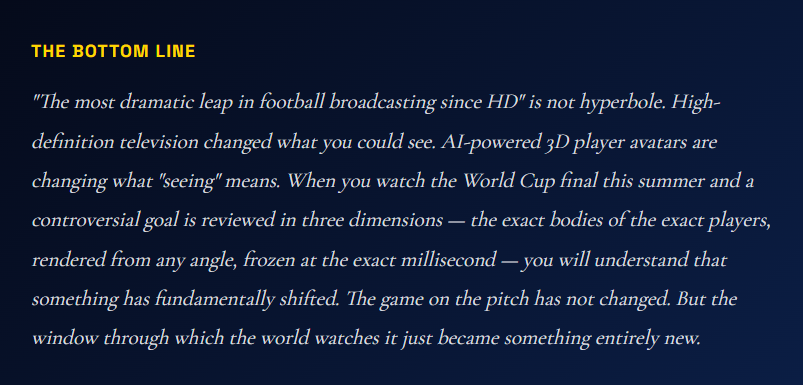
An AI-generated 3D avatar model can do all of these things. Because the digital representation is a fully realised three-dimensional object — not a flat image — it can be rendered from any angle, frozen at any moment, placed in any simulated environment, and layered with data that would be invisible on conventional footage.

“With each avatar uniquely tailored to depict the dimensions and proportions of the players, the technology focuses on capturing players’ physical attributes with remarkable precision — opening a world of possibilities not just for FIFA and its officials, but for fan experience and commercial engagement.”
— Lenovo official statement on FIFA World Cup 2026 avatar technology, April 2026
Officiating Will Never Look the Same
The officiating implications are arguably the most immediately consequential. The World Cup 2026 is already being described as the most data-driven major sporting event in history. Player tracking systems generate positional data at 25 frames per second from on-pitch cameras. Skeletal tracking captures body joint positions at 100 frames per second. Ball tracking via the adidas Trionda match ball — which carries a built-in motion sensor — links ball trajectory to player positioning with sub-frame precision.
Into this architecture, Lenovo’s 3D avatars add a layer that makes the data visible and humanly comprehensible. When an offside call is reviewed, a broadcast graphic showing a flat line across a 2D frame will be replaced by a three-dimensional scene: two avatars — the attacker and the last defender — frozen in their exact positions, rotatable by the viewer, accurate to the individual’s physical geometry rather than a generic body shape.
The difference matters. A centimetre-level offside decision made using a generic body silhouette is less reliable than one made using a model that precisely reflects Kylian Mbappé’s actual shoulder geometry or Erling Haaland’s actual hip position. When the margin is a shoulder blade, it matters whether the model belongs to that specific player or an approximation.
“The 2026 FIFA World Cup will not only mark the tournament’s return to North America — it will also become the stage where soccer tests its own future. What is at stake goes far beyond the sporting spectacle.”
— PanAmerican World, December 2025, on the technology architecture of World Cup 2026
What Fans Will Actually Experience
For the viewer at home — or the growing number watching via streaming platforms that are fighting a ferocious battle for sports rights in 2026 — the avatar technology promises to change what “watching the game” actually means.
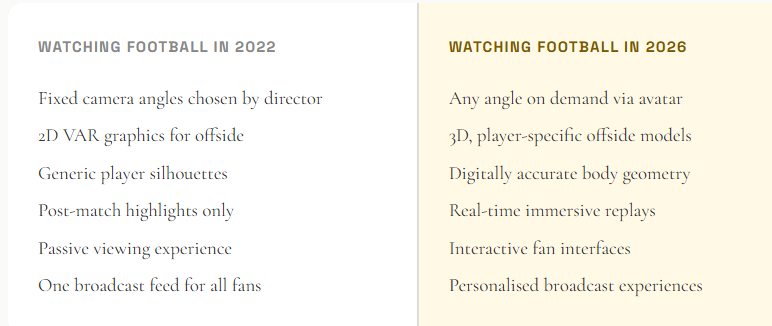
Companies like Genius Sports are already using multi-angle camera systems and skeletal data to generate real-time 3D re-creations of match moments. The combination with Lenovo’s player-specific avatars — bodies that are accurate to the individual rather than generic — takes this further. A fan watching on a streaming platform could, in theory, rewatch a goal from the goalkeeper’s exact perspective, with the goalscorer represented by their actual digitally replicated body.
The World Cup as a Technology Laboratory
FIFA has always used World Cups as proving grounds for technology that subsequently becomes standard across all of football. Goal-line technology debuted at Brazil 2014. Semi-automated offside was field-tested across multiple competitions before becoming the norm. VAR’s chaotic introduction at Russia 2018 led to the calmer, more consistent implementations we see in 2026.
What is being deployed in June 2026 will, within five to ten years, be the standard by which all major football is broadcast. The Premier League, La Liga, the Champions League — all will eventually follow. The 2026 World Cup is where broadcasters and FIFA are proving it can be done, at scale, across 104 matches in three countries, under the biggest spotlight in sport.
The Business Behind the Beauty
For Lenovo, the partnership with FIFA is not purely about the love of the game. The 3D avatar system is an enterprise asset management platform — a demonstration that Lenovo’s AI and data infrastructure can handle one of the most complex real-time visualisation challenges in the world. Small and medium businesses watching the tournament are not just the audience; they are the pitch for the technology. “It opens up a world of possibilities not just for FIFA and its officials, but for businesses looking to enhance their customer engagement strategies,” the company’s statement noted.
The commercial logic is real. Digital twins, created from body scan data and animated by AI, are already being used by fashion brands for virtual try-ons, by medical companies for surgical planning, and by architects for building visualisation. Lenovo is demonstrating — to the largest TV audience in the world — that this technology is mature, scalable, and sports-ready.