Why Is Australia So Good at Sport? The Answer Goes Far Beyond Talent
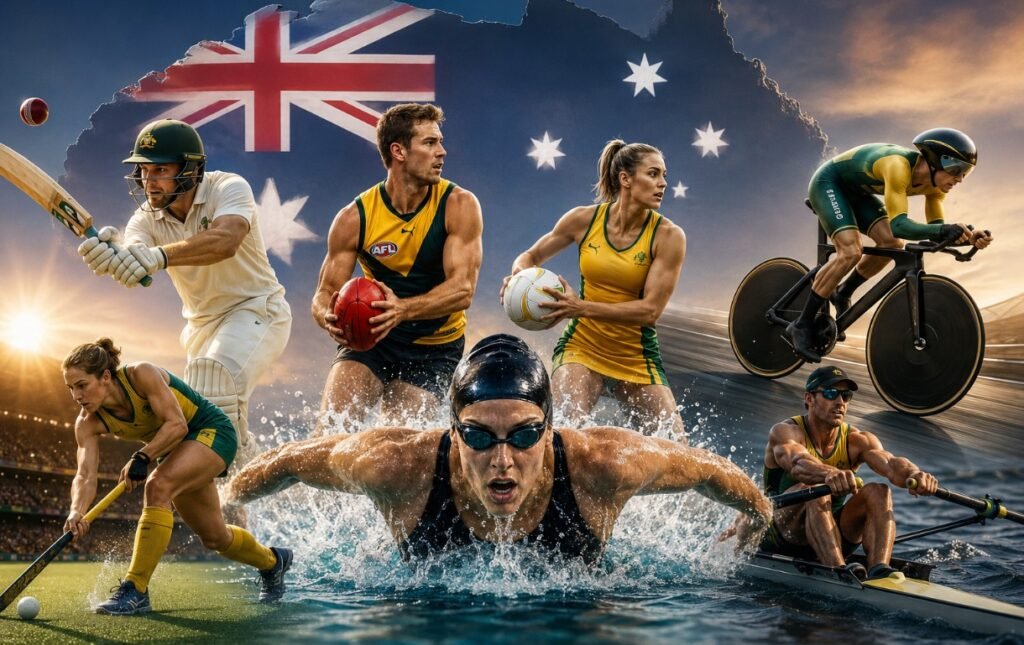
Australia is not a sporting superpower because it has one great game. From swimming and cricket to cycling, hockey, rowing, sailing, athletics and football codes, its success comes from a system designed to find talent, develop it and keep pushing the limits of performance.
There is something unusual about Australian sport.
The country has a population of only around 27 million, yet it repeatedly punches above its weight on the world stage.
It happens in the swimming pool.
It happens on the cricket field.
It happens on the athletics track, the cycling track, the hockey pitch and the water.
It even happens on snow and ice — a remarkable achievement for a country better known for beaches and sunshine.
At the 2026 Winter Olympics in Milano Cortina, Australia finished with five medals, including three golds, continuing a run in which it has medalled at every Winter Olympics since 1994. Recent success has been driven by targeted investment in freestyle skiing and snowboarding, specialised facilities and even unconventional talent-conversion programmes.
So, what is Australia doing differently?
The answer is not simply that Australians are naturally athletic.Australia has built an ecosystem around sport.It Starts Before the Athlete Becomes a Star.One of the biggest reasons Australia produces elite athletes is that sport begins at the grassroots.Sport is not treated purely as entertainment. It is deeply integrated into Australian community life. The Australian Sports Commission says 81% of Australians surveyed believe sport contributes to positive child development and education, while 73% see it as a positive influence in their local community.
That creates an enormous pool of young people who are exposed to different sports.
A child may begin with swimming.
Another may play cricket.
Someone else might try athletics, hockey, netball, cycling or an Australian football code.The important part is that the journey does not necessarily stop at participation.For talented athletes, there are pathways to take the next step..And Australia has spent decades building those pathways.
The AIS Changed The Game
The biggest piece of the puzzle is arguably the Australian Institute of Sport (AIS).
Australia established the AIS in 1981, and it became one of the foundations of the country’s modern high-performance sporting system.
Today, the Australian Sports Commission describes the national high-performance system as a network involving the AIS, eight state and territory institutes and academies, national sporting organisations and government-supported programmes.
This is important because elite sport is rarely just about finding the most talented 15-year-old.
The real question is:
What happens after you find them?
Australia has developed a system to answer that question.
From Potential to Podium
The AIS uses its Foundations-Talent-Elite-Mastery (FTEM) framework to map athlete development.
In simple terms, it tries to understand the entire journey:
Foundation → Talent → Elite → Mastery
The framework is designed to help coaches, teachers, parents and sporting organisations identify where athletes are in their development and what support they need next.That sounds technical.But its impact is straightforward.Australia is trying not merely to discover talented athletes — it is trying to systematically turn potential into high performance.
And that is a huge difference.
Australia Treats Sport Like Science
This might be the country’s biggest competitive advantage.Elite Australian sport is increasingly built around science and evidence. The AIS supports research and innovation in areas including sports medicine, physiology, nutrition, psychology, biomechanics and performance analysis. Its stated goal is to make sure Australian athletes benefit from the latest evidence and innovations and that this knowledge actually reaches everyday training.
That means an Australian athlete’s preparation can involve far more than simply spending more hours practising.
It can involve questions such as:
How efficiently is the athlete moving?
How should they recover?
What should they eat?
How much should they train?
How can injuries be prevented?
How can technique be improved?
How can psychology affect performance?
How can technology help coaches make better decisions?
That philosophy has been particularly visible in swimming.
A 2024 Guardian analysis of Australia’s swimming success described the Dolphins’ approach as “performance by design”, highlighting the emphasis on athlete support, coaching, training environments and detailed preparation. Australia won seven swimming golds at the Paris Olympics and finished second behind the United States in the swimming medal table.
The lesson is bigger than swimming.
Australia tries to make elite performance repeatable.
The Secret Isn’t Just Money — It’s Where the Money Goes
Government investment also matters.
The Australian Government supports sport from grassroots participation through to elite competition, while the Australian Sports Commission provides funding for high-performance programmes, participation, athlete pathways, wellbeing, research and innovation.
The distinction is crucial.
It isn’t simply about spending money on athletes once they have already become champions.
Investment goes into the wider structure around them.
Facilities.
Coaches.
Sports scientists.
Medical teams.
Talent identification.
Training centres.
Research.
Development pathways.
That creates an environment in which an athlete can concentrate on becoming better rather than trying to build an entire performance system alone.
And Then There Is The Culture
You cannot explain Australia’s sporting success through government programmes alone.
There is a cultural factor.
Australians are extraordinarily engaged with sport.
The Australian Sports Commission reports that in 2024-25, 53% of Australian adults watched a live sporting event, while 32% attended a live sporting event.
- And success itself creates another cycle.
- An Australian wins.
- Children watch.
- The athlete becomes a role model.
- More children become interested.
- Participation increases.
- More talent enters the system.
- And eventually another champion appears.
The Australian Sports Commission says 56% of Australians who became more active, started a sport or sought information about a new sport in 2024-25 were inspired by Australians succeeding internationally or by Olympic, Paralympic and Commonwealth Games athletes and events.
Success creates participation. Participation creates talent. Talent creates more success.
That is the cycle.Australia Doesn’t Rely On One Sport.This is where the Australian model becomes especially fascinating.Cricket is powerful.But Australia isn’t only a cricket country.Swimming is arguably its biggest Olympic medal engine..Athletics has produced generations of champions.Cycling has become an Olympic medal factory.Rowing and sailing have long been major strengths.Hockey has produced internationally successful men’s and women’s teams.Netball has developed one of the world’s strongest national programmes.
Then there are AFL and rugby league — two enormous domestic sporting ecosystems.
The breadth matters.
A country that succeeds in only one sport can be explained by history, geography or tradition.A country that repeatedly succeeds in different types of sport suggests something more systematic.Australia has the infrastructure to develop different kinds of athletes.
Endurance athletes.
Sprinters.
Swimmers.
Cyclists.
Team-sport players.
Power athletes.
Winter-sport specialists.
That is a much harder achievement.
Even Australia’s Winter Success Has A Lesson
Perhaps the best example of Australia’s approach is the Winter Olympics.
Australia has obvious disadvantages.
It is not a traditional snow-sport powerhouse.
Yet it has built programmes around selected winter disciplines and invested heavily in areas where it believes it can become competitive.
The result?
Australia has now become a regular Winter Olympic medal contender.
The country’s recent winter success has involved specialised training initiatives, dedicated facilities and talent conversion — including athletes moving from other sports into skiing and snowboarding.
That tells us something important.
Australia doesn’t necessarily ask:
“What sport are we traditionally good at?”
It increasingly asks:
“Where can our athletes become world-class?”
That is a very different way of thinking.Australia’s Sporting Culture Also Has A Huge Professional EngineThere is another advantage that Olympic medal tables cannot fully capture.Australia has professional domestic competitions that create enormous sporting ecosystems.
The AFL.
The NRL.
The Big Bash League.
The WBBL.
The A-League.
Professional cricket.
Professional netball.
Professional hockey.
These competitions provide young athletes with visible career pathways and expose them to high-level coaching, competition and performance standards.
And the pathway can begin very young.
A recent example came from the NRL, where the Manly Sea Eagles launched an elite academy involving teenagers aged 15 to 18, working closely with schools and providing positional coaching, football-IQ sessions and mentoring from professional players.
That is the same philosophy appearing again:Identify early. Develop systematically. Connect the pathway.But Australia Isn’t Great At EverythingThis is important.Calling Australia “good at every sport” would be inaccurate.
The country’s rugby union programme, for example, has experienced serious problems, including declining participation, financial difficulties and poor international results.
That actually strengthens the larger argument.Australia’s success is not automatic.When a sport’s governance, participation, funding or development pathway weakens, results can suffer.The Australian sporting machine works best when all the parts are functioning together.
The Real Australian Advantage
So, is it the weather?
Partly.
Is it the beaches?
They certainly help swimming and water sports.
Is it genetics?
That would be far too simplistic.
Is it money?
Investment matters, but money alone does not produce champions.
The more convincing explanation is the combination.
The Australian Sports Commission itself describes Australia’s international success as being linked to government support at different levels and a strong high-performance system led by the AIS. It also points to advances in sports science and medicine, coaching, organisation and sustained investment in elite athletes.
That may be the simplest explanation of all.
Australia Doesn’t Have A Secret. It Has A System.That is why Australia’s sporting story is so fascinating.The country isn’t producing champions by accident.A swimmer can enter the system through a local club and eventually reach an elite programme.A young athlete can progress through talent identification and specialist coaching.A cyclist can move through a high-performance pathway.A winter athlete can benefit from a programme designed specifically around Australia’s competitive opportunities.A team-sport player can move from school or community competition into an academy and eventually a professional league.The systems differ by sport.But the philosophy is remarkably similar.Find the talent.Give it a pathway.Surround it with experts.Use science to improve it.Invest in it.And keep searching for the next athlete
That is why Australia continues to punch above its population size.
And perhaps the most important lesson for other sporting nations is this:
Australia’s greatest sporting asset may not be its athletes at all.
It may be the system that keeps producing them.