Chinese Robot Beats Usain Bolt’s 100m Mark: The Race That Shows Why Robots Need to Learn How Humans Move
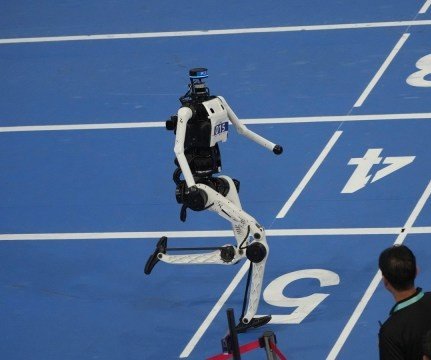
A machine has entered Usain Bolt territory
For more than 17 years, Usain Bolt’s 9.58-second 100m world record has stood as one of the defining performances in athletics. Now, a humanoid robot has gone faster — at least on the clock.
China’s Tiangong Ultra, developed by the Beijing Humanoid Robot Innovation Center, completed 100 metres in 9.39 seconds during a preliminary heat at the 2026 World Humanoid Robot Games in Beijing. The time was 0.19 seconds faster than Bolt’s human world record, set at the 2009 World Championships in Berlin.
But there is an important distinction: this is not a new human athletics world record. It is a robot performance being compared with the human benchmark.
The numbers that made headlines
Tiangong Ultra: 9.39 seconds
Honor’s Lightning: 9.47 seconds
Usain Bolt’s human world record: 9.58 seconds
Tiangong Ultra’s time at the inaugural 2025 robot games: 21.50 seconds
Unitree robot: 12.41 seconds in the race
The improvement is extraordinary. Tiangong Ultra has gone from 21.50 seconds to 9.39 seconds over the same distance in roughly a year.
It was not a straightforward victory
The race itself offered an interesting glimpse into the current state of humanoid robotics.
Tiangong Ultra initially trailed Honor’s Lightning but accelerated in the closing stages to overtake its rival. Lightning finished in 9.47 seconds, meaning two robots in the heat were faster than Bolt’s 9.58-second mark.
Yet the finish also exposed the machines’ limitations.
Unlike a human sprinter, which can gradually slow down after crossing the line, the robots struggled to stop cleanly. Both crashed into protective padding at the end of the track, with Tiangong Ultra also veering dangerously towards the side of the course.
That contrast explains why the headline number is only one part of the story.
Why teaching robots to run matters
Running is an unusually demanding task for a machine.
A humanoid robot must repeatedly shift its weight, maintain balance, coordinate its joints, control its feet and react to tiny changes in movement — all while moving at high speed.
For robotics companies, therefore, a sprint is not merely a sporting spectacle. It is a test of motion control and mechanical intelligence.
The same technologies required to make a robot run efficiently can potentially improve its ability to walk through factories, carry objects, navigate uneven surfaces and perform physical tasks around humans.
That is why competitions such as the World Humanoid Robot Games are becoming more significant. The event is not restricted to running. Robots are being tested across sports as well as practical tasks that resemble real-world work. More than 2,000 robots from 16 countries are taking part in the 2026 edition.
Speed is impressive. Control is the real challenge.
The Tiangong Ultra performance also highlights an important question: Can robots do more than perform one spectacular movement?
Breaking 10 seconds is visually impressive, but a useful humanoid robot must also be able to stop, turn, pick up an object, recognise its surroundings and complete complicated tasks without human intervention.
At the Beijing games, robots are therefore being evaluated in areas beyond athletics, including activities involving object handling, packaging, warehouse-style operations and precise physical actions. Some competitions require robots to operate autonomously.
This may ultimately prove more important than a 9.39-second sprint.
China’s bigger robotics race
The development also fits into China’s wider push to establish humanoid robotics as a major technology industry.
The rapid improvement from Tiangong Ultra’s 21.50-second run last year to 9.39 seconds this year demonstrates how quickly robotic hardware and control systems are evolving. Earlier testing had also seen Honor’s Lightning record a 9.32-second 100m, with a reported peak speed of 14.5 metres per second.
The goal is not necessarily to create robots that can beat athletes at every sport. The larger objective is to develop machines capable of moving through human environments and performing useful physical work.
The real finish line is still ahead
Tiangong Ultra may have beaten Bolt’s time on the stopwatch, but Usain Bolt’s achievement remains untouched in human athletics.
The more meaningful achievement belongs to robotics: a machine that ran the same distance in less than 10 seconds, after taking more than twice as long just a year earlier.
The next question is no longer simply “How fast can a robot run?”
It is “How intelligently can it move?”
And that could be the question that determines whether humanoid robots remain impressive machines on a racetrack — or become genuinely useful machines in the real world.
Key Record & Facts
Event: World Humanoid Robot Games 2026
Location: Beijing, China
Robot: Tiangong Ultra
Developer: Beijing Humanoid Robot Innovation Center
100m time: 9.39 seconds
Human benchmark: Usain Bolt — 9.58 seconds
Runner-up: Honor Lightning — 9.47 seconds
Previous Tiangong time: 21.50 seconds in 2025
Key takeaway: The breakthrough demonstrates rapid progress in robotic speed, balance and movement control, while also exposing the machines’ current limitations in stopping and precision.