P. T. Usha’s 1984 Olympic Heartbreak: The 0.01-Second That Made History
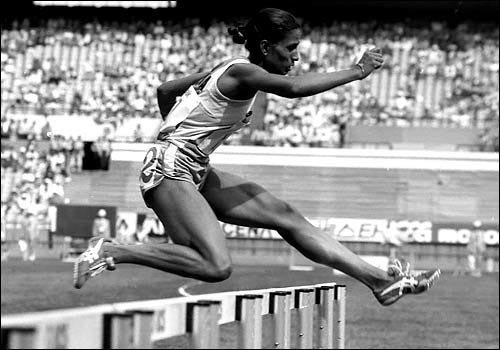
P. T. Usha and the 1984 Olympics: A Race Against History
Sometimes, the distance between victory and defeat is measured not in metres, but in fractions of a second. For Indian athletics legend P. T. Usha, that fraction came at the 1984 Los Angeles Olympics, where she finished fourth in the women’s 400-metre hurdles final, missing the bronze medal by just 0.01 seconds.
Usha clocked 55.42 seconds on August 8, 1984. Romania’s Cristina Cojocaru took bronze in 55.41 seconds, while American Judi Brown won silver in 55.20 seconds. Morocco’s Nawal El Moutawakel claimed gold in 54.61 seconds.
The result was heartbreaking. Usha had come extraordinarily close to becoming India’s first Olympic medallist in track and field, but the photo finish placed her just outside the podium.
Yet that race would become one of the defining moments in Indian sports history. It showed the country that an Indian woman could compete at the highest level of global athletics and challenge some of the world’s best runners.
The Rise of the Payyoli Express
Born on June 20, 1964, in Kerala, P. T. Usha grew into one of India’s most celebrated track athletes. Known as the “Payyoli Express,” she became famous for her speed, determination and ability to compete across sprinting and hurdling events.
Her development was shaped by her coach, O. M. Nambiar, who helped guide her from a promising young runner into an international competitor. Their partnership became an important part of her journey, built on disciplined training and a long-term commitment to athletics.
Usha first competed at the Olympics in Moscow in 1980, when she was still a teenager. Although that appearance did not bring a medal, it gave her valuable experience on the international stage.
At the 1982 Asian Games in New Delhi, she won silver medals in the 100 metres and 200 metres. The following year, she continued to establish herself in Asian athletics, setting the stage for her breakthrough performance at Los Angeles 1984.
The 400-Metre Hurdles: A Historic Olympic Final
The women’s 400-metre hurdles is a demanding event that combines speed, endurance, rhythm and precise technique. Athletes must maintain their pace while clearing ten hurdles over a full lap of the track. A small mistake or a slight loss of momentum can make the difference between a medal and missing the podium.
At the 1984 Olympics, Usha rose to the occasion. She advanced through the rounds and won her semifinal in 55.54 seconds, securing her place in the final.
That achievement was significant in itself. Usha became the first Indian woman to reach an Olympic final, breaking new ground for women in Indian sport.
The final brought together some of the strongest competitors in the event. Usha delivered a remarkable performance, recording 55.42 seconds. But the finish was so close that the difference between bronze and fourth place came down to one hundredth of a second.
The 0.01-Second Olympic Heartbreak
The final result was difficult to accept. Usha had run the race of her life, but Cojocaru finished just ahead of her to take bronze.
In athletics, 0.01 seconds is almost impossible to perceive with the naked eye. It is a fraction of time that can separate an athlete from a place on the podium, despite years of preparation and sacrifice.
For India, the result carried a mix of pride and disappointment. Usha had reached a stage few Indian athletes had reached before, but an Olympic medal remained just beyond her grasp.
Her performance was not a failure. She had competed against the best in the world, set a personal best of 55.42 seconds and established a benchmark for Indian women’s athletics.
The 1984 Olympic final became a reminder of how fine the margins can be in elite sport—and how an athlete’s achievement cannot be measured by a medal alone.
P. T. Usha’s 55.42-Second Legacy
Usha’s 55.42-second performance remained a landmark in Indian athletics for decades. The time stood as the Indian national record in the women’s 400-metre hurdles for 42 years, until Vithya Ramraj broke it in 2026.
That longevity underlines the scale of Usha’s achievement. Her Olympic run was not simply a near miss; it set a standard that generations of Indian athletes would chase.
Her career continued well beyond Los Angeles. At the 1985 Asian Athletics Championships in Jakarta, Usha won five gold medals and one bronze, further strengthening her reputation as one of Asia’s leading athletes. At the 1986 Asian Games in Seoul, she won four gold medals and one silver.
These accomplishments helped turn her into a sporting icon. While the Olympic bronze remained elusive, her success across Asian competitions proved that her talent and determination extended far beyond a single race.
From Olympic Heartbreak to Inspiration
The story of P. T. Usha’s 1984 Olympics is often remembered for the medal she narrowly missed. But focusing only on the result overlooks what she achieved.
She helped change perceptions of Indian women in elite athletics. Her performance demonstrated that Indian athletes could reach Olympic finals and compete closely with established international rivals.
Her journey also became an example of perseverance. Usha continued competing after Los Angeles and built an impressive record in Asian athletics. In later years, she contributed to the sport through the Usha School of Athletics in Kerala, helping nurture young athletes.
Her legacy is not limited to the time on the scoreboard. It lives on in the runners who followed her, the barriers she helped break and the belief that Indian athletes could aim for the highest levels of international competition.
P. T. Usha’s 1984 Olympic Story: More Than a Medal
More than four decades later, the 1984 Olympic final remains one of the most memorable moments in Indian athletics. P. T. Usha missed bronze by 0.01 seconds, but her performance opened a new chapter for Indian women in track and field.
The race offered both heartbreak and hope. It showed how cruelly narrow the margins of elite sport can be, while proving that determination and talent can carry an athlete onto the world stage.
P. T. Usha may have finished fourth in Los Angeles, but her place in Indian sports history was never decided by that result. Her 55.42-second run became a symbol of ambition, resilience and the pursuit of excellence.
Sometimes, an athlete misses the medal but changes the history of a sport. P. T. Usha did exactly that.