India’s Kabaddi Gold Mission Begins: Star-Studded Squads Named for Asian Games 2026
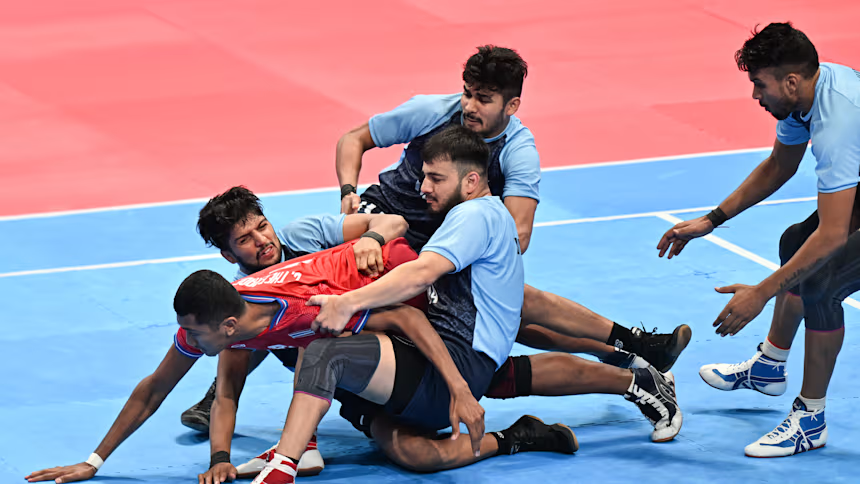
India has unveiled its kabaddi squads for the Aichi-Nagoya Asian Games 2026, and the selection sends out a clear message: the defending champions are not travelling to Japan merely to compete — they are going there to defend both gold medals.
The Asian Games will take place from September 19 to October 4, with the kabaddi competition scheduled from September 21 to 26 at the Nagoya City Trade and Industry Centre. India will field 12-member men’s and women’s squads.
The biggest talking point is the balance between established international names and players who have recently made their mark in the Pro Kabaddi League.
Men’s Squad: New Firepower, Old Experience
India’s 12-member men’s squad is led by a formidable attacking group featuring Ayan Lohchab, Devank Dalal, Ashu Malik and Arjun Deshwal, while experienced all-rounder Pawan Sehrawat adds another dimension to the team.
India Men’s Kabaddi Squad
Ashu Malik
Ayan Lohchab
Devank Dalal
Arjun Deshwal
Sunil Kumar
Jaideep Dahiya
Rahul Sethpal
Gaurav Khatri
Sumit Sangwan
Ankit Jaglan
Pawan Sehrawat
Aslam Inamdar
Lohchab and Dalal finished as the top two raiders in the previous Pro Kabaddi League season, making their inclusion one of the most anticipated aspects of the squad. Their recent form gives India two attacking weapons capable of changing the momentum of a match within a few raids.
At the other end, Sunil Kumar is expected to be a key figure in defence, with Sumit Sangwan, Jaideep Dahiya, Rahul Sethpal, Gaurav Khatri and Ankit Jaglan providing depth.
Four Hangzhou Gold Medallists Retained
The 2026 men’s team is considerably different from the side that won gold at the Hangzhou Asian Games in 2023.
Only four members of that victorious squad have retained their places: Arjun Deshwal, Sunil Kumar, Pawan Sehrawat and Aslam Inamdar.
That makes the 2026 selection an interesting combination of continuity and transition. India has retained players with proven Asian Games experience while bringing in a younger generation that has been performing strongly on the domestic circuit.
The Pawan Sehrawat Factor
Pawan Sehrawat remains one of India’s most recognisable kabaddi names. His experience at major international tournaments could prove particularly valuable when matches become tight.
Alongside him, Aslam Inamdar gives the team another experienced all-round option. Both players were part of India’s previous Asian Games gold-winning campaign.
Women’s Team: Ritu Negi Leads the Defence of Gold
India’s women’s squad also features 12 players and will enter Aichi-Nagoya as defending champions.
India Women’s Kabaddi Squad
Ritu Negi
Pushpa Rana
Sonali Shingate
Sanju Devi
Pooja Kajla
Ritu Sheoran
Jyoti Thakur
Pinki Roy
Manisha Kumari
Bhavna Thakur
Rajrani
Nikita Kumari
Ritu Negi will lead the women’s side, with the squad combining experience and fresh talent as India attempts to retain the title.
Pooja Kajla and Sanju Devi are among the players who will attract particular attention, while the wider squad gives India several options to adjust its approach depending on the opposition.
Asian Games Record: India’s Kabaddi Legacy
India’s strength in Asian Games kabaddi is reflected in its medal history.
The men’s team has traditionally been one of the competition’s dominant forces, while the women’s side has also established itself as a major continental power.
At the Hangzhou Asian Games, both Indian teams finished with gold medals. India is therefore entering Aichi-Nagoya with a double title to defend. The Olympic Council of Asia has confirmed that both the men’s and women’s kabaddi teams will attempt to retain their Asian Games crowns.
India’s Recent Kabaddi Benchmark
Previous Asian Games: Hangzhou 2023
Men’s result: Gold
Women’s result: Gold
2026 men’s squad: 12 players
2026 women’s squad: 12 players
Kabaddi dates: September 21–26, 2026
Venue: Nagoya City Trade and Industry Centre
A Tough Road Ahead
India’s men’s team has been placed in Group A alongside Japan, Bangladesh, South Korea and Chinese Taipei. The women’s team is also in Group A, where it will face Iran, Japan and Bangladesh.
The format leaves little room for complacency. The top two teams from each group progress to the semi-finals, meaning every group-stage contest carries significant importance.
For the men’s team, the presence of Iran in the opposite group means the two traditional Asian powerhouses will not meet in the opening phase.
What Makes This Team Different?
The biggest difference is the changing face of Indian kabaddi.
The men’s squad is no longer built almost entirely around established stars. Players such as Lohchab and Dalal have earned their places through recent performances, while experienced names such as Sehrawat, Deshwal and Sunil Kumar provide the international know-how required at a major multi-sport event.
That mixture could become India’s biggest strength.
The challenge, however, will be converting individual quality into a cohesive unit. Kabaddi at the Asian Games is as much about combinations, defensive coordination and decision-making under pressure as it is about individual brilliance.
The Main Story
India arrives in Aichi-Nagoya with two defending champions’ titles, 24 selected players and enormous expectations.
The men’s team has undergone a significant refresh, but it still contains enough Asian Games-winning experience to keep the gold-medal ambition alive. The women’s team, meanwhile, will look to maintain India’s position at the top of the continental game.
With the tournament less than a month away, the message from the squad selection is clear: India has chosen a blend of form, experience and future potential for another attempt at a kabaddi double.
The real test begins on the mat in September.