T20 Cricket Records: Fastest Centuries, Most Hundreds and India’s Chasing Success
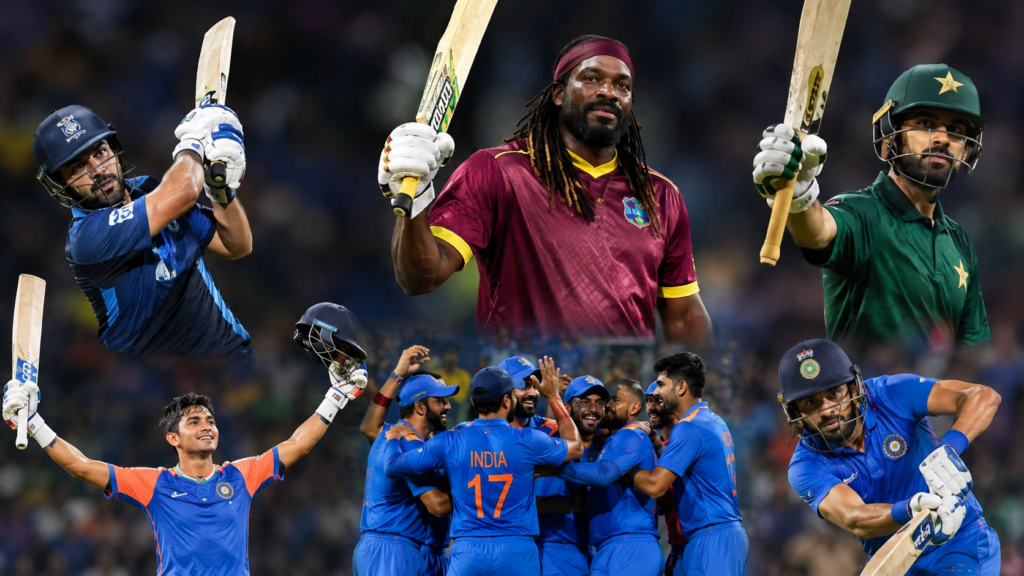
T20 Cricket’s Biggest Records: Speed, Power and Consistency
Twenty20 cricket has transformed batting into a contest of power, timing and fearless shot-making. A single explosive innings can change a match in minutes, while a successful chase can turn a challenging target into a memorable victory.
Three aspects of the format stand out: the fastest centuries in T20 cricket, the players with the most hundreds across all T20 matches, and India’s success in chasing targets in men’s T20 Internationals over the last five years.
Estonia’s Sahil Chauhan holds the record for the fastest men’s T20 International century, reaching 100 in just 27 balls against Cyprus in June 2024. West Indies legend Chris Gayle leads the all-time men’s T20 hundreds list with 22 centuries, followed by Pakistan’s Babar Azam with 13. India’s Abhishek Sharma has also climbed the rankings, reaching 11 T20 hundreds by October 2026.
Fastest T20 Century: The Record-Breaking 27-Ball Hundred
Sahil Chauhan produced one of the most extraordinary batting performances in T20 history when he smashed an unbeaten 144 off 41 balls for Estonia against Cyprus on June 17, 2024. He reached his century in only 27 deliveries, setting a new world record for the fastest men’s T20 International hundred.
Chauhan’s innings included 13 fours and 18 sixes, with his strike rate reaching 351.21. Estonia chased down Cyprus’ target of 191/7, finishing on 194/4 to win by six wickets. His 18 sixes also established a record for the most sixes by an individual batter in a men’s T20I innings at the time.
The performance surpassed Chris Gayle’s famous 30-ball century for Royal Challengers Bangalore against Pune Warriors India in the 2013 IPL. It also broke the previous T20I record of 33 balls, achieved by Namibia’s Jan Nicol Loftie-Eaton against Nepal in February 2024.
Other Fastest Centuries in Men’s T20 Internationals
27 balls — Sahil Chauhan: Estonia against Cyprus, 2024; finished unbeaten on 144.
29 balls — Muhammad Fahad: Turkey against Bulgaria, 2025; scored 120.
30 balls — Abhishek Sharma: India against Afghanistan, September 2026; scored 108 off 34 balls.
33 balls — Jan Nicol Loftie-Eaton: Namibia against Nepal, February 2024; scored 101.
33 balls — Sikandar Raza: Zimbabwe against Gambia, October 2024; finished unbeaten on 133.
33 balls — Finn Allen: New Zealand against South Africa, March 2026; scored 100 not out.
34 balls — Kushal Malla: Nepal against Mongolia, September 2023; scored an unbeaten 137.
These performances demonstrate that record-breaking batting is no longer limited to the major cricketing nations. Players from Estonia, Turkey, Namibia, Zimbabwe and Nepal have all produced extraordinary T20I centuries.
Abhishek Sharma’s 30-ball hundred against Afghanistan was particularly significant for India. It became the fastest T20I century by an Indian batter, surpassing the previous 35-ball mark shared by Rohit Sharma and David Miller.
Most Centuries in T20 Cricket: The All-Time Leaders
Scoring a century in T20 cricket is difficult because batters have limited deliveries to reach three figures. Repeating that achievement across seasons, leagues and international competitions is even more challenging.
Chris Gayle remains the leading men’s T20 century-maker with 22 hundreds, scored between 2005 and 2022. Babar Azam occupies second place with 13, while Abhishek Sharma has moved into third with 11 centuries. Quinton de Kock, Virat Kohli and David Warner have each recorded 10 hundreds.
Leading Men’s T20 Century-Makers
Chris Gayle — 22 centuries: The West Indies legend dominated franchise leagues and international T20 cricket for nearly two decades.
Babar Azam — 13 centuries: The Pakistan batter has consistently delivered hundreds across domestic, franchise and international competitions.
Abhishek Sharma — 11 centuries: The Indian left-hander has risen rapidly through aggressive performances in T20 cricket.
Quinton de Kock — 10 centuries: The South African wicketkeeper-batter is among the format’s most destructive opening batters.
Virat Kohli — 10 centuries: The Indian star combines consistency with the ability to accelerate when required.
David Warner — 10 centuries: The former Australia opener has scored hundreds across several major T20 competitions.
These figures cover all men’s T20 matches, including domestic cricket, franchise leagues and T20 Internationals. They are not limited to international matches.
Gayle’s most famous innings came in April 2013, when he smashed an unbeaten 175 off 66 balls for Royal Challengers Bangalore against Pune Warriors India. His innings included 13 fours and 17 sixes and remains the highest individual score in men’s IPL history.
Abhishek Sharma’s rapid rise illustrates the emergence of a new generation of aggressive batters. However, Gayle’s 22 centuries remain a formidable benchmark, with no other batter having reached 14 hundreds in the all-time men’s T20 list as of October 2026.
India’s T20I Chasing Record: Five Years of Pressure and Performance
India’s ability to chase targets has become an important part of its men’s T20I identity. A strong top order, a flexible middle order and aggressive finishing have helped the team compete in high-scoring matches against leading international sides.
In September 2022, the International Cricket Council reported that India had won 13 of its 14 T20I run chases since the beginning of 2021, a success rate of approximately 92.9% over that particular period. This was an impressive historical snapshot, but it should not be mistaken for India’s complete five-year chasing percentage through October 2026.
India has continued to produce notable run chases. In October 2026, the team reached 230/6 against New Zealand after being set a target of 226, completing its highest successful T20I chase. Sanju Samson scored 67 off 33 balls, while Naman Dhir finished unbeaten on 42 off 15 deliveries to seal a four-wicket victory with two balls remaining.
India also demonstrated its attacking ability in a successful chase of 199 against New Zealand in October 2026, reaching the target in just 13.2 overs. The performance highlighted how quickly an aggressive start can change the pressure of a run chase.
What Determines Success in T20 Run Chases?
Aggressive powerplays: Fast starts reduce the required run rate and give the middle order greater freedom.
Middle-order flexibility: Batters need to adapt to the match situation, whether wickets have fallen early or the required rate is climbing.
Batting depth: Contributions from all-rounders and lower-order batters can prove decisive when a chase reaches the final overs.
Composure under pressure: Successful teams balance boundary-hitting with strike rotation and calculated risks.
To establish an exact win percentage for the full five-year period from October 2021 to October 2026, every men’s T20I in which India batted second must be counted. Wins must then be divided by the total relevant matches, with ties and no-results handled separately. A complete, verified match-by-match dataset for that exact period is needed before publishing a definitive percentage.
The Numbers Behind T20 Cricket’s Evolution
From a 27-ball international century to 22 career hundreds, T20 cricket’s records reveal how far the game has evolved. Sahil Chauhan’s remarkable innings represents the extreme speed of modern batting, Chris Gayle’s record demonstrates long-term consistency, and the achievements of Abhishek Sharma highlight the impact of a new generation of aggressive batters.
India’s run chases provide another measure of the format’s evolution. Its 230/6 against New Zealand in October 2026 demonstrated how power-hitting and composure can overcome a demanding target, while other international performances from Estonia, Turkey, Zimbabwe and Namibia show that record-breaking T20 cricket is a global phenomenon.
As the format continues to develop, these records will remain benchmarks for future generations. The next milestone could be an even faster century, another batter closing the gap on Gayle’s total or a new record chase that raises expectations across the cricketing world.