Sumo in Japan: Where Ancient Ritual Meets Modern Sporting Greatness
Sumo in Japan Began as a Ritual Before Becoming a Sport
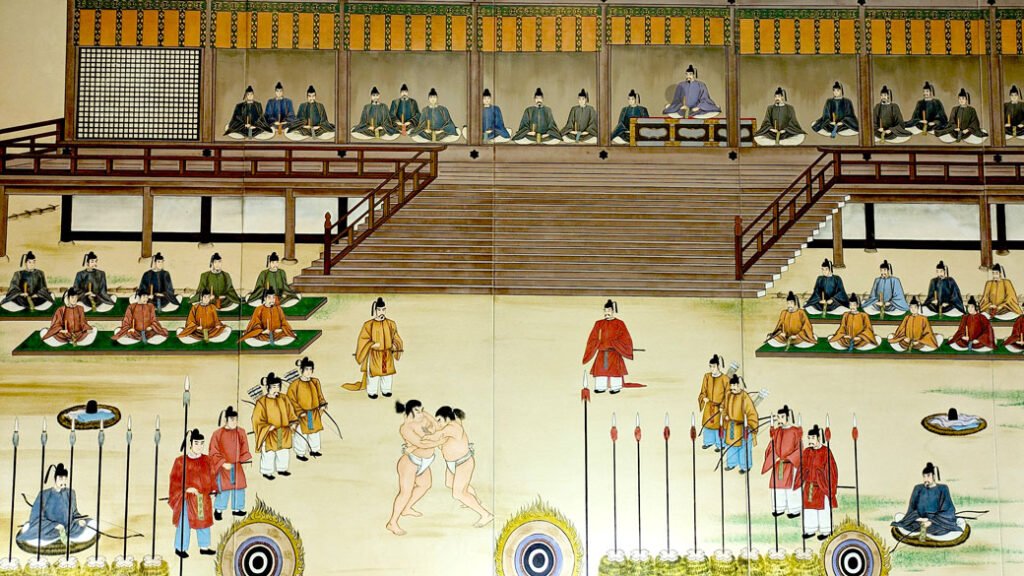
Long before packed arenas and professional tournaments, sumo had a religious purpose in Japan. The Japan Sumo Association traces its roots back around 1,500 years, with early contests connected to rituals for the gods and prayers for a good harvest. Sumo later became part of Imperial Court ceremonies during the Nara period.
That history is still visible every time a professional bout begins.The salt thrown into the dohyo, the stamping of the feet and the lengthy pre-bout rituals are not simply entertainment. They preserve traditions that have been carried through generations.
The dohyo itself is treated as a sacred space. Once the wrestlers step inside it, the contest follows a remarkably simple principle: force your opponent out of the ring or make any part of their body other than the soles of their feet touch the ground. That simplicity is one of sumo’s great attractions.The rules can be understood in seconds. Mastering them can take a lifetime.
Sumo in Japan Has No Weight Classes
One of the sport’s most striking features is that professional sumo has no weight divisions.
A smaller wrestler can therefore find himself facing someone considerably heavier. That makes technique, timing, balance and positioning just as important as raw physical strength.
The opening charge, known as the tachiai, can decide a contest almost instantly. Some bouts last only a few seconds, while others develop into prolonged grappling battles. Wrestlers can win through recognised techniques known as kimarite, including throws, pushes and trips. There is also a strict ranking structure known as the banzuke.
At its summit stands the yokozuna, the grand champion. Below him are ranks including ozeki, sekiwake and komusubi. A yokozuna cannot be demoted like lower-ranked wrestlers, but the position carries expectations of both performance and conduct.
Sumo in Japan Is Defined by Six Major Tournaments
Professional sumo has six major tournaments, or honbasho, every year.
Three are held in Tokyo, while Osaka, Nagoya and Fukuoka each host one. Each tournament runs for 15 days, with wrestlers competing according to their rank.
That calendar creates an unusual rhythm for the sport. A wrestler’s ranking can rise or fall depending on his performance, meaning every tournament carries consequences beyond a single victory or defeat.
And then there is the pressure of the dohyo.
A wrestler may spend months preparing physically, but one mistake in a bout can end his tournament record.
Sumo in Japan Has Produced Records That Define Eras
The sport’s history is filled with extraordinary champions, but few records illustrate its scale better than Futabayama’s 69 consecutive victories.
Futabayama went unbeaten from January 1936 to January 1939, winning five consecutive championships during that period. His streak remains one of sumo’s most celebrated achievements.
Then came Chiyonofuji, one of the defining yokozuna of his generation. His 53 consecutive wins under the modern six-tournament system stood as a major benchmark before Hakuho eventually surpassed it.
But Hakuho’s career changed the scale of statistical achievement in modern sumo.The Mongolia-born yokozuna won 45 top-division championships, a record listed by the Japan Sumo Association. He retired in September 2021 after a career record of 1,187 wins against 247 losses. His dominance also produced memorable numbers: Hakuho recorded 63 consecutive victories in 2010 and accumulated records for championships, career wins and other major statistical categories.
Sumo in Japan Has a Philosophy Beyond Winning
What makes sumo particularly fascinating is the philosophy attached to it.
A number of legendary wrestlers have left behind thoughts that reveal how the sport views discipline and defeat.
One saying attributed to Chiyonofuji captures the importance of respect:
“It begins with courtesy and ends with courtesy.”
Futabayama was associated with another philosophy:
“Practice as if it were the real tournament; treat the real tournament as if it were practice.”
And former champion Taiho expressed the relationship between competition and character by saying:
“A sumo wrestler can only forge his spirit in the ring.”
These quotations are reproduced in a collection of sayings attributed to former yokozuna and major rikishi; they should be understood as traditional recollections rather than contemporary interviews.
Sumo in Japan Has Become an International Sport
Although sumo remains deeply Japanese in its rituals and institutions, the professional sport is no longer exclusively Japanese in its talent pool.
Hakuho was born in Mongolia, while other foreign-born wrestlers have also reached the highest levels.
Hakuho’s career demonstrated just how far international participation has influenced modern sumo. After leaving professional competition, he said he wanted to help expand sumo internationally through what he called a “world sumo project.”
His career therefore represents an interesting paradox: a wrestler from outside Japan became one of the most celebrated figures in a sport so closely associated with Japanese culture.
Sumo in Japan Has a New Generation of Yokozuna
The story is continuing with a new generation.
Hoshoryu became the 74th yokozuna in January 2025, followed by Onosato becoming the 75th in May 2025, according to the Japan Sumo Association. Their promotions underline how the sport continues to renew itself while preserving its traditional structure.
The September 2026 Grand Sumo Tournament is another reminder of that continuity, with the Japan Sumo Association continuing to stage the tournament under the same centuries-old framework of rankings, rituals and daily bouts.
Sumo in Japan Is More Than What Happens Inside the Ring
A sumo bout may last less than a minute.
But understanding sumo requires looking beyond those few seconds.
It is the salt before the contest, the stamping of the feet, the silence before the charge, the hierarchy of the banzuke and the responsibility attached to becoming a yokozuna.
It is also the records of Futabayama, Chiyonofuji and Hakuho, each representing a different chapter of the sport.That combination explains why sumo has survived for centuries. The rules are simple, but the culture surrounding them is extraordinarily deep.
For Japan, sumo is not simply a sport where one wrestler pushes another out of a ring. It is a living connection between ritual, history, discipline, competition and national sporting culture.