Vithya Ramraj’s Record Run: India’s 400m Hurdles Journey
Vithya Ramraj’s Record Run: How India Has Progressed in the 400m Hurdles
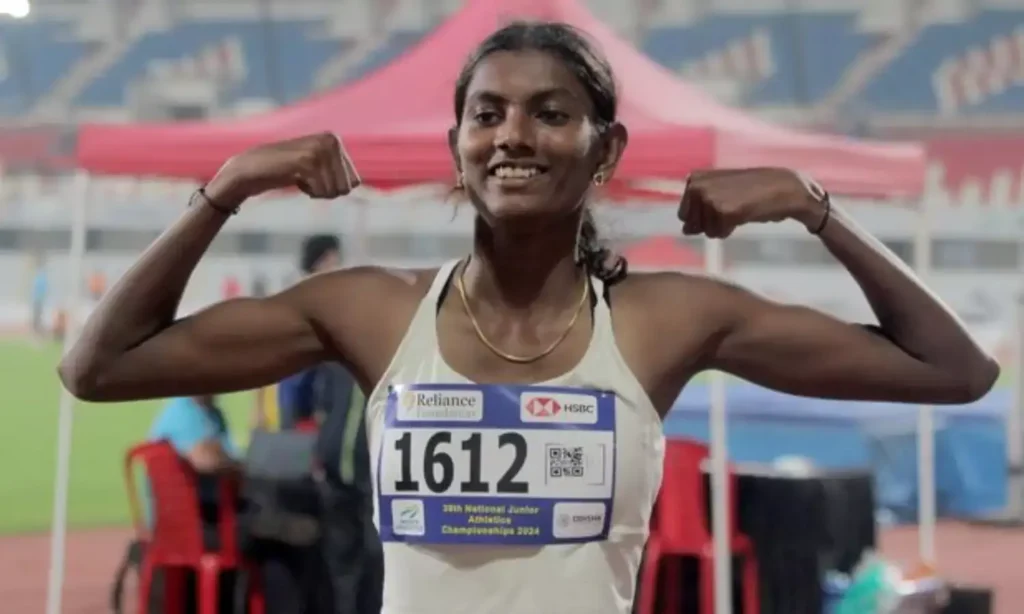
Vithya Ramraj has finally rewritten one of the most enduring records in Indian athletics. At the 2026 Asian Games in Nagoya, the Indian hurdler clocked 54.75 seconds in the women’s 400m hurdles to erase PT Usha’s national record that had stood for more than four decades. The bronze medal was important, but the timing carried an even greater significance for Indian athletics.
Vithya Ramraj Breaks a Historic Record
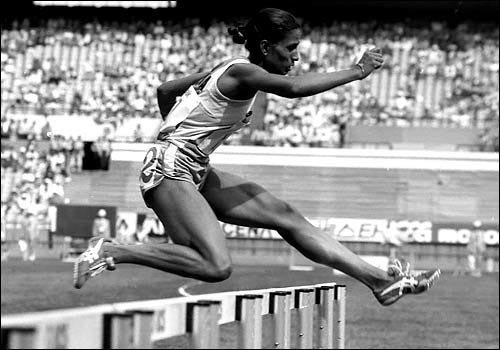
For years, PT Usha’s 55.42-second run at the 1984 Los Angeles Olympics remained a benchmark in the 400m hurdles. Vithya had already come agonisingly close to the mark at the 2023 Asian Games, where she equalled Usha’s time. Three years later, she returned to the Asian Games with the same target and finally moved the national record forward.
Her 54.75-second performance in Nagoya improved the previous mark by 0.67 seconds. Vithya finished third in the final, behind gold medallist Mariam Kareem of the UAE and Kazakhstan’s Adelina Zems. Yet for the Indian athlete, the biggest victory was seeing 54.75 appear on the scoreboard after years of chasing a record that had defined generations of Indian athletics.
PT Usha’s Legacy Gets a New Chapter
The importance of Vithya’s achievement cannot be separated from PT Usha and her place in Indian sport. Usha’s 1984 Olympic run became one of the most famous performances in the country’s track-and-field history, even though she missed an Olympic bronze medal by just 0.01 seconds.
Her 55.42-second performance remained the Indian 400m hurdles record for 42 years. Vithya first matched it at Hangzhou in 2023, creating expectations that she could eventually become the athlete to break it. After several years of development, that moment finally arrived in Nagoya.
The Long Road From 59.70 to 54.75 Seconds
Vithya’s progression shows that the record did not come suddenly. Her best time in the 400m hurdles was 59.70 seconds in 2018, before improving to 56.57 seconds in 2022. She then matched Usha’s 55.42-second national record in 2023, but still had to wait another three years to produce the breakthrough.
Her improvement has also been closely connected with her development in the flat 400m. Her personal best in that event has improved from 54.48 seconds in 2018 to 51.96 seconds in 2026. That speed has provided an important foundation for her progress as a 400m hurdles India contender.
Why the Flat 400m Matters
Coach Nehpal Singh has always believed that Vithya needed to develop her speed over the flat 400m to become a stronger hurdler. The approach was questioned initially, but her performances have increasingly supported his philosophy. According to the progression highlighted in the data, improvements in her flat event have consistently been accompanied by better hurdle times.
That versatility has now become one of Vithya’s biggest strengths. The 400m hurdles demands both speed and technical efficiency, with athletes having to maintain rhythm while clearing ten hurdles over a full lap. Vithya’s development in both disciplines has helped her become a more complete Indian track athlete.
A Three-Medal Asian Games Campaign
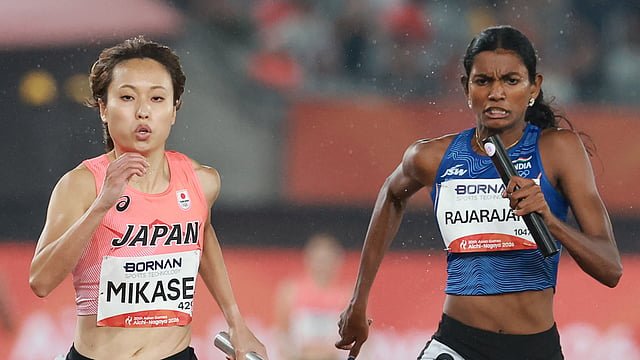
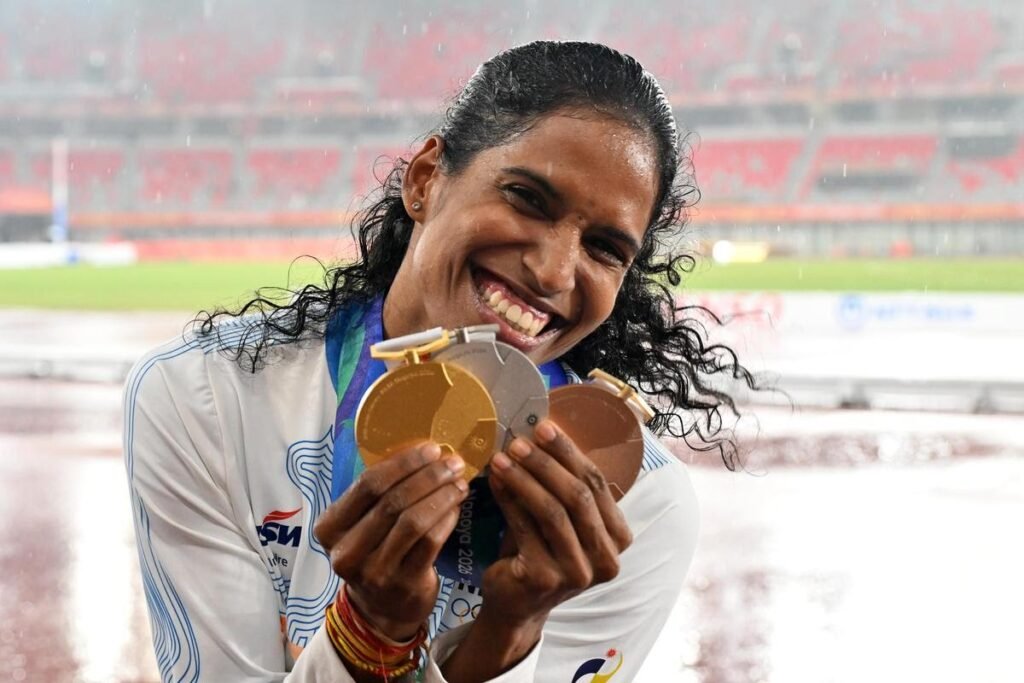
Vithya’s record-breaking bronze was only part of her impressive Asian Games 2026 campaign. She also contributed to India’s gold medal in the women’s 4x400m relay and won silver in the mixed 4x400m relay. That gave her a medal of each colour at the Nagoya Games.
Her performances demonstrated why the development of Indian athletics cannot be measured only through individual records. Vithya’s ability to contribute across different relay formats while competing at a high level individually reflects the growing depth and versatility among Indian athletes.
India’s 400m Hurdles Landscape Has Changed
When Usha set her record in 1984, the international landscape of the women’s 400m hurdles was very different. The event was still developing globally, and performances under 55 seconds were extremely rare. Over the decades, however, the standard across Asia has risen significantly.
Vithya’s 54.75 seconds now places her among Asia’s faster performers, although the continent has developed several elite hurdlers in recent years. Countries such as China, Kazakhstan, Bahrain and the UAE have produced athletes capable of challenging the 55-second barrier, making the Asian competition considerably deeper than it was during Usha’s era.
What Comes Next for Vithya Ramraj?
Breaking the record has not ended Vithya’s ambitions. Instead, it has changed the target. Her coach believes she has the ability to go below 54 seconds, while Vithya herself has shown that she is no longer satisfied simply with medals.
Her approach is centred on improving the clock because, unlike a medal, a time remains a permanent measure of an athlete’s performance. The next challenge will therefore be to build on her 54.75-second run and push closer to the next major milestone in the 400m hurdles.
A New Era for Indian Athletics
Vithya Ramraj’s record run is significant not only because it ended PT Usha’s long-standing national mark, but because it represents the continuing evolution of Indian athletics. Usha’s 55.42 seconds once represented the ceiling for Indian women in the event; Vithya has now pushed that ceiling higher.
The record also offers a glimpse of what could come next. With her flat-400m speed improving, her hurdling becoming more efficient and her confidence growing, Vithya has the opportunity to continue moving the national benchmark forward. Her 54.75 seconds is not simply a new record — it is another starting point for India’s 400m hurdles journey.