Asian Games 2026: India Open Kabaddi Title Defence With 49-24 Win Over Japan
Asian Games 2026 Starts With India Setting the Pace
India did not waste time settling into the pressure of defending its men’s kabaddi crown.
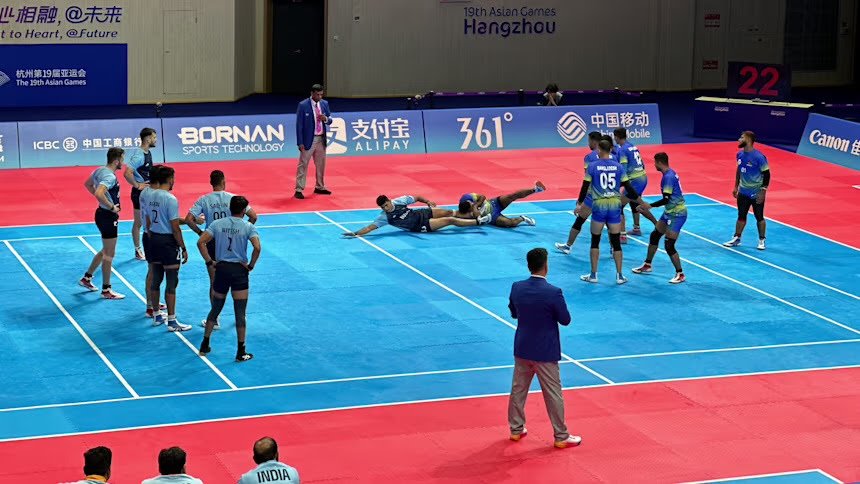
Facing hosts Japan in their opening Group A match at the Tokai Citizens Gymnasium on September 21, the Indian team produced a commanding first half and eventually secured a 49-24 victory.
The scoreboard told the story of India’s early control. India went into the break leading 31-9, leaving Japan with a huge deficit to overcome after just 20 minutes.The victory also gave India’s largely new-look squad an ideal start to a tournament where the team is chasing another Asian Games gold.
Asian Games 2026 Sees India’s Raiders Make Early Impact
India’s attacking unit immediately put Japan under pressure.
Ashu Malik was among the players who made an early impact, while Arjun Deshwal, Devank Dalal and Ayan Lohchab added pressure through their raids. The combination prevented Japan from settling into a rhythm and repeatedly forced the hosts into difficult defensive situations. India’s first-half dominance was also reflected in the All-Outs. The defending champions inflicted three All-Outs before half-time, helping them build the 22-point advantage.
Japan struggled to find consistent answers to India’s defensive structure. Their nine first-half points were not enough to keep pace with an Indian side that repeatedly turned successful defensive stands into attacking opportunities.
Asian Games 2026 Shows Japan’s Fightback After Half-Time
The second half was a different contest.
With the match effectively tilted in India’s favour, Japan returned with greater purpose and managed to make the final 20 minutes considerably more competitive.
Japan scored 15 points after the break, while India added 18. That meant Japan actually reduced the scoring gap during the second half, even though the damage from the opening period had already proved decisive.
India’s ability to absorb that response was important. Rather than allowing Japan’s improved momentum to turn into a comeback, the Indian defence maintained enough control to close out the match comfortably.
The final score of 49-24 therefore reflected two different phases: India’s overwhelming first half and Japan’s more organised second-half response.
Asian Games 2026 Brings a New-Look Indian Team
The result was significant beyond the scoreline because India are not simply relying on the same group that won gold at the previous Asian Games.
Only four members of the Hangzhou gold-medal squad return in the 2026 men’s team: Sunil Kumar, Pawan Sehrawat, Arjun Deshwal and Aslam Inamdar. Eight players are making their Asian Games debut. That makes India’s opening performance particularly relevant.
Sunil Kumar is leading the team as captain, with Pawan Sehrawat serving as vice-captain. Head coach Balwan Singh has also returned to the national setup after a decade, while B.C. Ramesh is the assistant coach.
The blend of experienced campaigners and newcomers will be tested further as the competition progresses.
Asian Games 2026 Road Ahead Gets Tougher
Japan was only the beginning.
India are in Group A alongside Japan, South Korea, Bangladesh and Chinese Taipei. The team’s next assignment is against South Korea on September 22, before matches against Bangladesh and Chinese Taipei complete the group stage. The top two teams from each group advance to the semifinals.
The group-stage format leaves little room for complacency. India’s opening win provides a strong points and momentum base, but the remaining matches will offer tougher tests.
The men’s kabaddi competition features 10 teams, split into two groups of five. The semifinals are scheduled for September 25, followed by the gold-medal match on September 26.
Asian Games 2026 Keeps India’s Gold-Medal Record in Focus
India have been the dominant force in men’s Asian Games kabaddi, winning eight of the previous nine gold medals. The only exception came in 2018, when Iran took the title and India finished with bronze.
That history explains the expectations surrounding the current squad.
But the first match also showed why past success cannot guarantee another medal. Japan improved significantly after the interval, and India’s next opponents will have studied the opening performance closely.
For now, however, India have achieved the most important objective: a winning start.
The 49-24 victory over Japan gives the defending champions an early platform. The next challenge against South Korea will show whether India can maintain the intensity that produced such a decisive opening half.