China’s Young Rhythmic Gymnasts Signal Bright Future with Dominant Home Performance
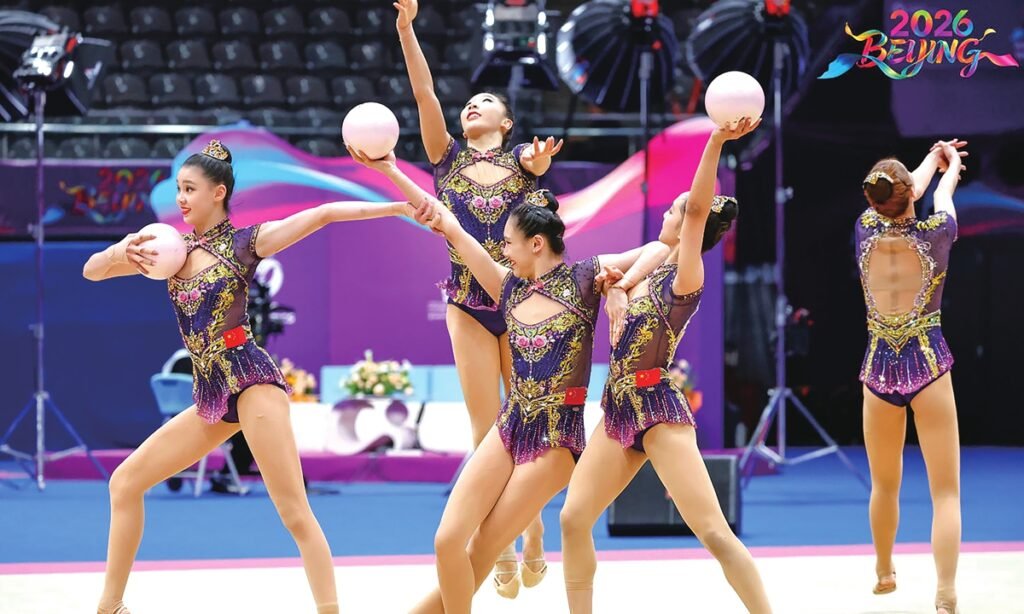
China’s rhythmic gymnastics team showcased its growing strength and depth at the 2026 FIG Rhythmic Gymnastics World Challenge Cup in Beijing, delivering an impressive medal haul while sending a strong message ahead of the Los Angeles 2028 Olympic Games.
Competing before a home crowd at the National Indoor Stadium, the Chinese squad secured four gold medals and four silver medals across the three-day competition. The host nation swept all three group titles and celebrated a breakthrough performance from 15-year-old rising star Wang Qi, who emerged as one of the tournament’s biggest success stories.
China Continues Winning Momentum After Paris Glory
Less than two years after claiming its historic Olympic gold medal in the group all-around event at the Paris 2024 Olympics, China has entered a new phase with several experienced athletes retiring from the national setup.
Despite the transition, the revamped squad showed remarkable composure. The group team, featuring a blend of Olympic champions and younger gymnasts, captured:
Group All-Around Gold
Group Five Balls Gold
Group Three Hoops and Two Clubs Gold
The victories came against a strong field that included competitors from Russia, Belarus and Uzbekistan, nations traditionally known for their excellence in rhythmic gymnastics.
Wang Qi Emerges as China’s Next Big Star
The standout performer of the event was 15-year-old Wang Qi, competing in her first season at the senior level.
She claimed the Individual All-Around Gold with a score of 110.80 points and finished ahead of Russia’s Sofiia Ilteriakova and Poland’s Liliana Lewinska. Wang later added four silver medals in the apparatus events, ending the tournament with an impressive five-medal collection.
Individual All-Around Results
Wang Qi (China) – Gold – 110.80 points
Sofiia Ilteriakova (Russia) – Silver
Liliana Lewinska (Poland) – Bronze
Her victory was particularly significant as it marked one of the first occasions she had defeated top Russian competitors on the international stage.
Blending Chinese Culture with Modern Artistry
China’s routines also drew attention for their artistic creativity. One performance incorporated elements inspired by renowned Song Dynasty poet Li Qingzhao, while another showcased a modern international style.
The choreography reflected China’s continued effort to blend traditional cultural themes with world-class technical execution, creating routines that stand out both artistically and competitively.
A New Generation Takes Charge
Following the retirement of several Olympic champions after Paris 2024, China’s coaching staff has focused on developing younger athletes capable of sustaining the country’s success.
The Beijing event demonstrated that the next generation is ready to take on greater responsibility. Young gymnasts benefited from the guidance of experienced teammates while gaining valuable exposure against elite international opposition.
Eyes Now on Bigger Challenges
While the home success was encouraging, Chinese athletes and coaches stressed that the journey toward Los Angeles 2028 is only beginning.
The return of Russian and Belarusian athletes to major international competitions has intensified the level of competition worldwide. Upcoming events, including the World Cup in Milan and the World Championships in Frankfurt, will provide further tests for China’s emerging stars.
For now, however, the Beijing Challenge Cup offered clear evidence that China’s rhythmic gymnastics program remains among the world’s strongest and is successfully building for the future.
The reigning Olympic champions may be entering a new era, but their ambition remains unchanged—staying at the top of the global podium.